







How much trouble can double entendre cause in politics, in this case, Tamil Nadu politics? I would have been inclined to say mere double entendre, but this is a very sensitive issue.
Dry humour: What happened in Tamil Nadu is that Dravida Munnetra Kazhagam (DMK) leader Udhayanidhi Stalin, also the Leader of the Opposition in the House, addressed a public meeting which took a dramatic turn over the use of double entendre.
Thanjavur is a major rice-growing zone of Tamil Nadu. It is not irrigated, and depends on Cauvery water. The Cauvery is a river that Tamil Nadu shares with Karnataka, an upper riparian or upstream state. After it uses its share of the water, then the rest comes into Tamil Nadu, and on that depends this summer paddy crop in the Thanjavur delta. A very large number of farmers are involved; it’s a very sensitive issue.
Stalin was saying that Karnataka’s commitment was that by this time 45,000 million cubic feet of water should have come in the Cauvery River for the Thanjavur region, or for Tamil Nadu. But then he said that water hasn’t come, that Chief Minister Joseph Vijay is only focused on filing false cases against DMK people. Then he stopped, a kind of pregnant pause, to which the crowd responded with chants of ‘Trisha, Trisha’.
Trisha is a very famous southern cinema actor, particularly famous in Tamil Nadu. She’s also a friend of Joseph Vijay. That was seen as a double entendre because Stalin allegedly went on to say whether the water reaches anywhere else or not, it should reach there. This is the exact translation from the ANI report of the rally.
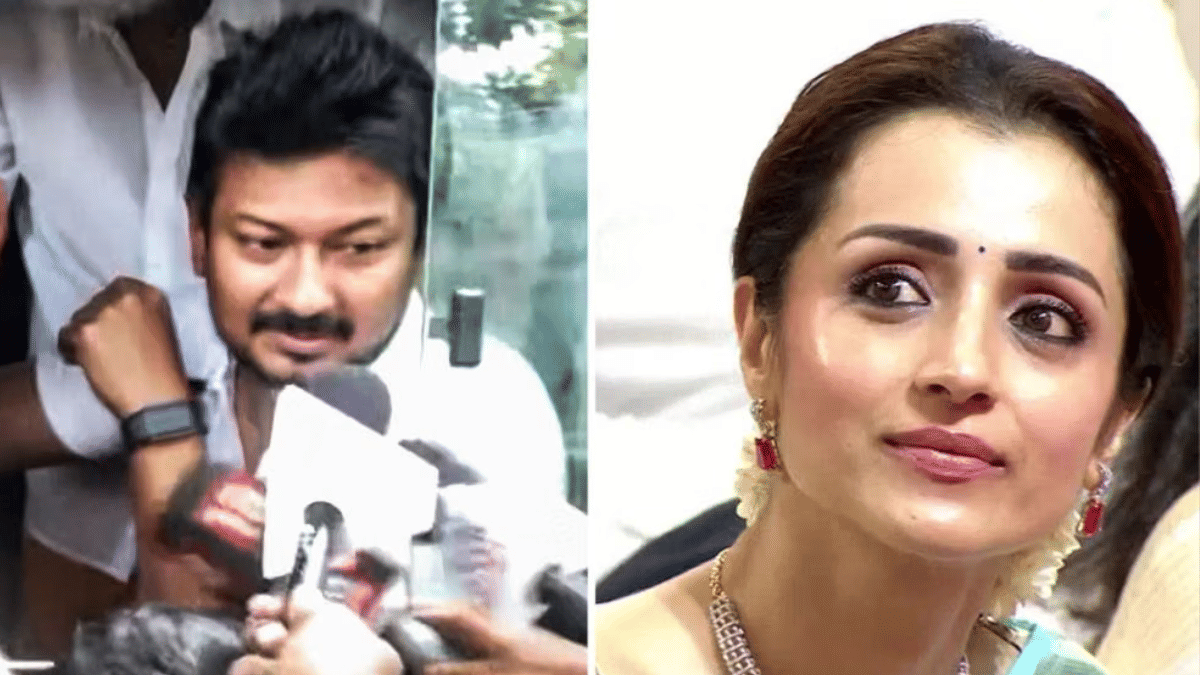
No funny business: Now, this led to immediate consternation in the government, and with Vijay, who took it as an insult, and also saw it as an affront to a woman. Multiple cases under various criminal sections were registered against Udhayanidhi Stalin. On Tuesday morning he was arrested, and taken to Thanjavur for “interrogation”. TV channels ran tickers all day, saying he’s being “grilled”. What about, I don’t know because whatever he said was in public.
Look at the sections under which he has been charged. The Bharatiya Nyaya Sanhita (BNS) is the new avatar of the old Indian Penal Code.
BNS Section 61, criminal conspiracy. What kind of criminal conspiracy can be there in a public statement? Section 79, which is insult to the modesty of a woman, what used to be called outraging the modesty of a woman in the past. Section 192, which is wantonly causing provocation to people to riot. And 296B, the use of obscene songs, words to deliver intentional insult to somebody and provoke breach of peace. And then Section 4 of Tamil Nadu Prohibition of Harassment of Women Act.
All of these sections were used to arrest Udhayanidhi Stalin.
The DMK went to the Tamil Nadu High Court, which said he must be released. The DMK said that this was done to make sure that Udhayanidhi Stalin would not be present in the Assembly on Wednesday when the state’s budget is presented.
Thanjavur is about 325 km from Chennai, quite a distance, but it is still possible to reach Chennai in time for the Budget session. Now this leads to many questions. First of all, it tells us that even modern politicians in Tamil Nadu are not beyond the methods of earlier ones.
Feud for thought: Tamil Nadu has a history of the old, bitter Jayalalithaa versus Karunanidhi rivalry when insults were regularly exchanged, and people were dragged out of their homes.
Is some of that coming back? Because, in this case, one is a descendant of Karunanidhi, a third generation descendant. The other is a newcomer, but he’s also a film star. Karunanidhi was not a film star, but he was a story writer. That’s why his title of Kalaignar.
Is some of that also coming back to Tamil Nadu politics now? Vijay is 51 and Udhayanidhi Stalin 48; both are from Loyola College.
Is the same kind of bitterness and division going to continue in Tamil Nadu politics? The immediate question that it raises is about the judgement, maturity and the ability of Joseph Vijay to handle power, because a chief minister in India has a lot of power. An old aphorism that a former chief minister of Uttar Pradesh used to relate says that that only three titles matter in India: PM, CM and DM, that is Prime Minister, Chief Minister, and District Magistrate.
Prime Minister is on that list for obvious reasons, but District Magistrate and Chief Minister are also important because both in a way control the police. In a district, the police report to the District Magistrate. So law and order is in their domain, and the two are therefore known to use or misuse their power.
Enough on his plate: Now Vijay is still settling down in the job; he hasn’t got past the 90-day mark. He doesn’t have a majority of his own; at least he did not start out with a majority of his own. He had 108, that’s 10 short of a majority. Then he got the Congress, Muslim League, a couple of others, and then he got a bunch of defectors in course of time from the All India Anna Dravida Munnetra Kazhagam (AIADMK).
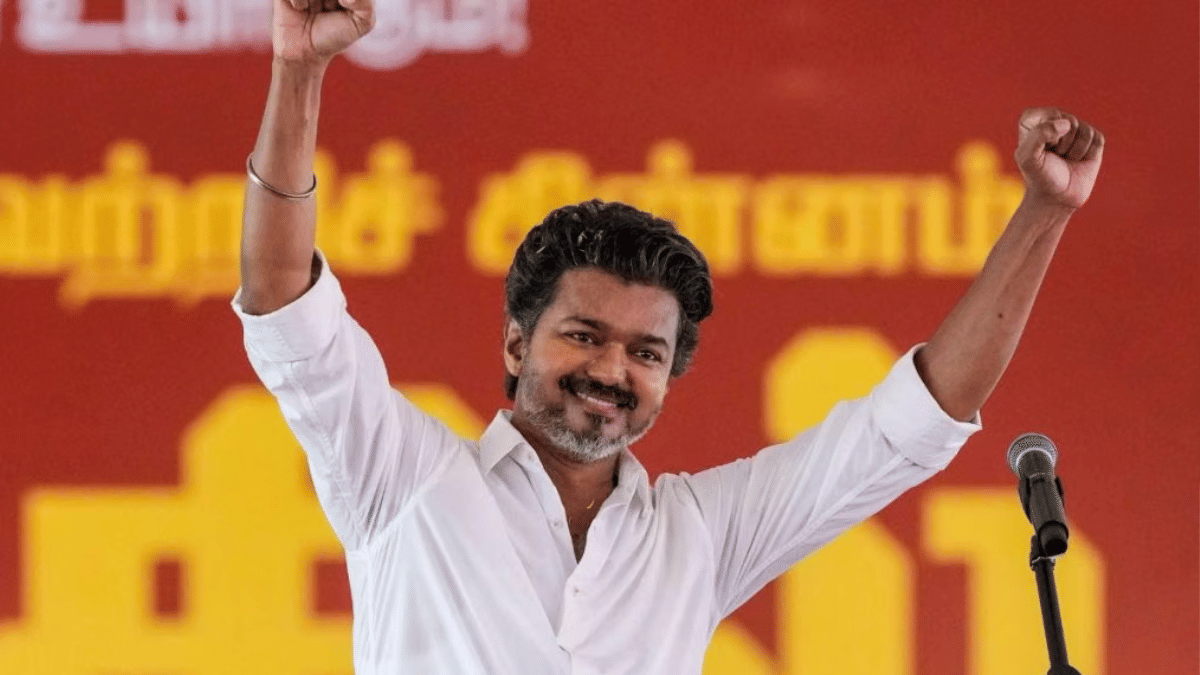
To that extent, Vijay is not somebody who came in, swept this election. Sure enough, he swept both the entrenched Dravidian parties out, that is the DMK and AIADMK, and got enough seats of his own to form a government. But the fact also is that he’s not built a party. He’s not built a proper Cabinet either, because his party is essentially his fan base.
Now, at the same time, he’s inherited a very difficult state because as the White Paper produced by his own government on Tamil Nadu’s finances reveal a big mess.
Tamil Nadu’s direct debt at this point, as per the White Paper, is more than Rs 10 lakh crores, that is Rs 10 trillion, but that balloons to Rs 13 lakh crore because the government is also the guarantor for Rs 3 trillion worth of debt taken by government-run corporations, including the civil supplies corporations, electricity department, and so on. This is the cost of subsidies and freebies that previous governments gave out.
If you see the state of the debt as a percentage of domestic output in Tamil Nadu, and this is a comparison that Tamil Nadu government’s own White Paper drew with the peer industrialised states of Gujarat, Karnataka, and Maharashtra, Tamil Nadu is at the top. It’s the wrong list to top because Tamil Nadu’s debt to GSDP ratio, the gross state domestic product, is 28.3 per cent compared to Gujarat, which is the best at 17.6 per cent. And Gujarat doesn’t even have any liquor revenue, at least officially; crooks and bootleggers, might have their liquor revenue but the state government doesn’t.
Maharashtra is at 19.7 per cent. And even Karnataka, which is also not known to be abstemious about freebies is at 23.4 per cent. Tamil Nadu is the worst state in this group. Its own tax to GDP ratio is at 5.45 per cent. As Vijay came to power, it’s the lowest in two decades, so he’s got real problems. And he made a bunch of promises before the elections, which he’s struggling to deliver on now. I will list some of those.
Also Read: Trisha remark row: DMK’s Udhayanidhi Stalin granted bail by Madras High Court
Glass act: If we stay with the White Paper—featured in a full episode of Cut The Clutter (link in the description)—a standout fact is how poorly the state does on liquor revenues.
In Tamil Nadu, the liquor business is run by the government. A lot of the liquor production is owned by local politicians, so Tasmac, is somewhat euphemistically or diplomatically called Tamil Nadu State Marketing Corporation, it sells liquor. That revenue is very little, compared to what it could be for a state as populated and wealthy as Tamil Nadu. Tamil Nadu, in terms of per capita income, is the second richest state in India.
The last two years—2024-25 and 2025-26—have seen Tamil Nadu record the highest Compounded Annual Growth Rate (CAGR) or GSDP growth rate in the country. And this state has a liquor revenue or excise revenue of only Rs 11,836 crore.
Compare that with Karnataka. That neighbouring state is at Rs 41,000 crore in liquor revenues, almost four times as much as Tamil Nadu. Similarly, Maharashtra, at Rs 34,173 crore, is more than three times as much as Tamil Nadu. That’s where the big gap is, and where the slippage of revenue is taking place.
If you see the CAGR of liquor revenue for Karnataka, it’s 11.66 per cent, and Maharashtra is at 18.69 per cent. Tamil Nadu is at just 9.49 per cent. As a percentage of GSDP, the highest liquor revenue is in Karnataka, at 1.25 per cent. Then Maharashtra is about half of this at 0.67 per cent, and Tamil Nadu is half of even that, at 0.34 per cent, or a fourth of Maharashtra.
These are the big gaps that exist, and it must be said that Vijay has shown concern for the situation, and that’s the reason the state has now set up a six-member committee under the leadership of Montek Singh Ahluwalia to show the way out of this fiscal mess.
Vijay’s come to this realisation very early on because he made many promises during the campaign, and once he came to power, he said the state is bankrupt, indicating that he can’t keep these promises. The senior Stalin said, Didn’t you know all this before you made those promises?
Look at some of these promises. These are the problems that Vijay should worry about right now, instead of getting into these personal prestige fights. These are sensitive issues, given, but at the same time, for governance one needs a thick skin.
Moon and back: Vijay promised 200 units free to 2.4 crore households, but then realised after coming to power that that wasn’t going to be possible. So then he said this will be limited only to those households who consume less than 500 units over two months. That will greatly reduce the number of these households.
He promised to increase to ₹2500 the previous DMK government’s monthly ₹1000 payout to women in the state. That was named after Karunanidhi, or his title Kalaignar, that he said that he’ll take to ₹2500 per month, but then realised he didn’t have the money, and now that’s under abeyance, pending fiscal assessment.
In his manifesto, Vijay had promised a complete waiver of loans for all farmers owning up to 5 acres of land, and half waiver for those owning more than 5 acres. Now he’s saying that this waiver will be limited to vulnerable small borrowers.
So he’s pulling back on many things. And then he also had some other setbacks.
You can call these errors of judgement. The state of Periyar, known for rationalism, has been built on Dravidian politics for more than 70 years. Vijay started out by appointing his own astrologer, as his Officer on Special Duty (OSD).
This is how Rickey Radhan Pandit Vetrivel came in as OSD. Vijay got pushback from his coalition partners and in the Assembly, and then he cancelled that appointment. Then while he was complaining about a bankrupt state, he persisted with the promise of 1 gramme of gold for every newborn baby. This money for this scheme, however, will be taken out of the state health budget.
Tamil Nadu is also the state of welfare, where the state is considered very efficient, providing essential services to its people. That’s why its human resources are so good. That’s why so much industries come to Tamil Nadu. That’s why so much industry, manufacturing seeks Tamil Nadu because they have human resources, because they have human resources, men, but more importantly, women available even with science technology engineering and mathematics (STEM) degrees and diplomas to work in these factories. To take away this money for a freebie out of the health budget attracted immediate criticism.
Also Read: AI City, laptops, hostels, branded cycles: Vijay’s first budget gives old schemes a Gen Z makeover
Bad moves: While I record this, it’s being reported that Vijay plans to send his budget to be presented on Wednesday morning to Tirupati to be blessed by Lord Balaji. That is not something that’s going to work very well among the followers of the Dravidian politics in Tamil Nadu, which is a lot of people, because the DMK and AIADMK between them account for a lot more votes than Vijay got.
Now the needle between him and Udhayanidhi Stalin is not new. So you can say Udhayanidhi could turn around and say we didn’t light the fire, it was always burning. And he can point to something that Vijay had said, pointing to Udhayanidhi in the Assembly. He had taunted Udhayanidhi as a child looking for his father in the Assembly.
The taunt was because the father, Stalin, lost the last election, and that was said with an it’s-all-over gesture. That’s also the gesture that Stalin used while announcing the breakup with the Congress. And by the way, the gesture also features in Jana Nayagan, the big hit released recently.
Vijay has been dealing with all these complexities and setbacks in less than 90 days; there was also a controversy over the fact that many of his ministers went out with him to watch the show of Jana Nayagan where several were found crying.
The wall outside my office is what I call the sycophancy wall of Indian politics, which basically has politicians of various parties looking like chamchas (sycophants) in terms in front of their leaders, and that is party-agnostic. I can find you there an example from any party. There is one there that features Jayalalithaa to give you an idea of the kind of sycophancy that Tamil politics has been known for.
Silver tongues: Some of these actions look like Vijay is also following the same trend because if anything, his success is much more around a personality cult. There was no ideology. There was no party. There was no cadre. A manifesto was put together in a hurry, and that’s why all his party people are essentially his fans, and they have the same breathless loyalty of a Tamil cinema fan. That Cabinet viewing of the movie show was also seen as insensitive because that is when the National Eligibility cum Entrance Test (NEET) protest was going on.
And remember Tamil Nadu has a position that cuts across parties that NEET should be withdrawn, and states should have their own examinations. That is a consensus in Tamil Nadu; no party supports NEET. In spite of these protests, the Cabinet went out to see the movie, and this happened just when NEET protests were building up in Tamil Nadu.
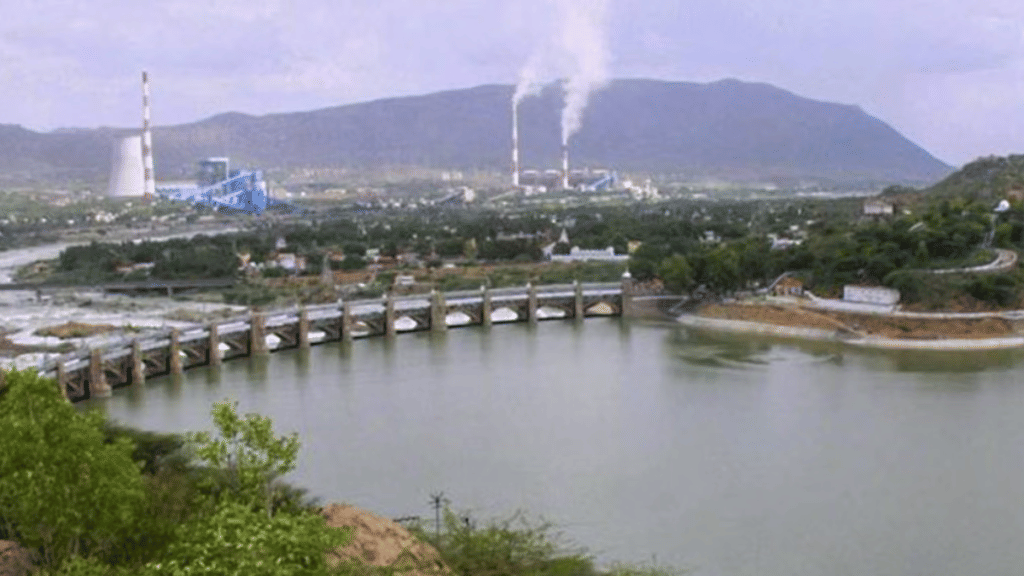
Dam trouble: Now, a little bit more about the source of this water problem. The source of the water problem is the Mekedatu Dam that Karnataka plans to build. Mekedatu in Kannada literally means a goat’s leak.
This is a narrow gorge in the Cauvery river as it leaves Karnataka and enters Tamil Nadu, about 4 km upstream of Tamil Nadu. Karnataka says they’re not going to use any of this water for irrigation. They will store some water as a balancing reservoir to keep the river running, but redirect some of that water to Bengaluru for drinking water needs, and they say they will take a very small amount, but Tamil Nadu is not convinced. They are in the Supreme Court, one of the most enduring and long-lasting river water contests in India.
When we talk about river water issues in India, sometimes living in Delhi, we think of Sutlej-Yamuna Link Canal and stuff like that. But the fight over river water in the south is much more intense. It’s between Maharashtra, Telangana, Andhra, Karnataka, Karnataka-Tamil Nadu, Tamil Nadu-Kerala, each one of these is a complex story. In course of time, we’ll end up visiting some of these.
Also Read: Tamil Nadu’s legacy of NEET opposition puts Vijay’s silence on Delhi protests under spotlight