







Chennai: The Tamil Nadu School Education Department has issued a circular prohibiting any “political, communal, separatist and non-educational events, meetings and campaigns” on school premises, as ruling TVK faces criticism over its ministers, leaders and workers visiting campuses for various events, including Chief Minister Vijay’s birthday celebrations.
The directive, however, does not specify what kind of events would be regarded as non-academic and “non-eductional”, and educationists emphasise that the government should define cocurricular and extra-curricular activities for more clarity on the directive.
The circular was issued on 10 July. Earlier, former AIADMK MLA VPB Paramasivam moved the Madras High Court over holding such events on school premises.
During a hearing on the PIL on Monday, Advocate General Vijay Narayan submitted that the circular was issued jointly by the Directors of School Education, Elementary Education, and Private Schools following complaints of “outsiders” using campuses for religious, political, and caste-based activities. Paramasivam PIL was withdrawn after the AF informed the court of the circular.
The government’s 10 July directive emphasised that the state’s 57,671 schools, including private ones, where over 1.03 crore students study, must remain focused solely on curricular and co-curricular activities and ensure unity among children from diverse backgrounds.
The circular stated, “Any sort of celebrations or messaging should not be permitted on school campuses, whether they are in playgrounds or open spaces. School premises should not be used for holding political, communal, separatist and non-educational events, meetings and campaigns. Only educational and co-curricular activities can be conducted in schools to ensure the overall educational development of students.”
During the hearing Monday, Advocate General Vijay Narayan submitted that such activities create divisions, psychological pressure on young minds, and undermine educational goals. Principals and headmasters have been instructed not to allow outsiders into classrooms, auditoriums, or playgrounds except for government-authorized events, he said.
Also Read: DMK, AIADMK have gone quiet after defeat. TVK’s Vijay is going on the offensive after win
The controversial visits
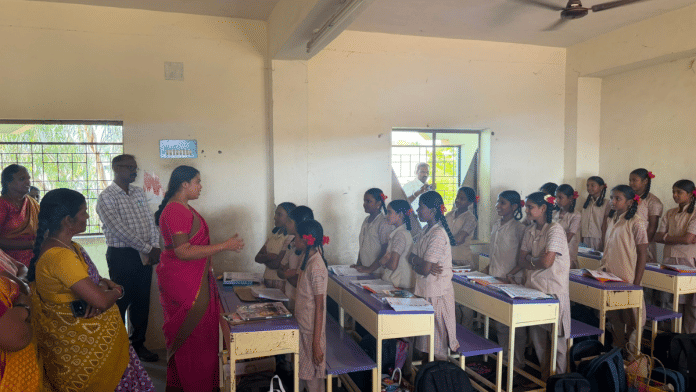
The government’s circular follows intense backlash over recent incidents involving ruling Tamilaga Vettri Kazhagam (TVK) functionaries and ministers. A government school visit by Industries Minister S. Keerthana’s in Sivakasi of Virudhunagar district brought sharp criticism.
During the inspection, Keerthana questioned students on their English proficiency in front of cameras, recorded the interaction, and shared it online.
In a viral video, she asked a student, “What’s your father?” and remarked on the child’s inability to respond fluently, drawing sharp criticism for publicly humiliating the student and using the visit for political optics.
Child rights activists and opposition parties accused her of shaming children from disadvantaged backgrounds instead of supporting them.
Keerthana later clarified her intent was to encourage government school students to develop English speaking skills. She also underlined her own Tamil-medium background. But the incident led to widespread outrage.
இன்று சிலர், "அரசு பள்ளி மாணவியை கேலி செய்தார்" என்று ஒரு பொய்யான கதையை பரப்புகிறார்கள்.
உண்மை என்ன தெரியுமா?
நானே ஒரு அரசு பள்ளி மாணவி. நானே தமிழ் வழிக் கல்வியில் படித்தவள்.
இன்று என் ஆங்கிலத்தை வைத்து என்னை கேலி செய்கிறவர்கள், உண்மையில் என்னை மட்டும் அல்ல… என்னைப் போன்ற… pic.twitter.com/2ZKzH5bgX3
— Virudhai Magal Keerthana (@Keerthana4VNR) July 7, 2026
Shortly after her visit, newly inducted TVK member and former AIADMK leader Dr C Vijayabaskar also visited schools following his entry into the party. His interactions with students, along with activities by other TVK workers, including disrupting classes to promote party symbols and involving students in Chief Minister Vijay’s birthday celebrations drew criticism and allegations of politicising education.
In several schools across the state, students were actively roped into the CM’s birthday celebrations organised by TVK functionaries around 22 June. Children participated in creative activities such as solving picture puzzles featuring the CM’s images, assembling large portraits, and making human formations to depict his face on school grounds.
The students wore party scarves, carried portraits, cut cakes, and chanted slogans like “Vijay Anna” during class hours. At an event in Tiruvallur, around 3,000 students from a private school formed a massive human portrait, disrupting regular academics.
These engagements drew criticism and School Education Minister A. Raj Mohan issued a statement that said, “Schools are not exhibition halls or stages for politics. They are centres of learning. From now on, no one other than those necessary will be allowed entry in school campuses.
“Except for official events conducted by the government, birthday celebrations or non-government events shall not be allowed. No members of any political party, no members of any private organisation shall be permitted to directly meet students.”
The government circular to the schools stated that no birthday celebrations of leaders other than those announced by the government shall be held in the school premises or school students shall be taken to or allowed to participate in such celebrations.
“No events of any kind, including sports competitions, medical camps, art shows among others shall be held in the school premises in connection with such celebrations. Furthermore, the provision of food items and gifts shall be completely avoided,” it said.
Educationists welcome circular
Educationists have welcomed the circular as a much-needed step to protect vulnerable students. Many experts argue that repeated political intrusions expose children to bias, disrupt learning, and erode the neutral environment essential for holistic development.
However, they said there should be more clarity on what activities are not allowed. Educationalist PB Prince Gajendra Babu welcomed the move stating that the students should be allowed to be a part of co-curricular and extracurricular activities but those programmes should not be linked to any individual with a political identity.
“Similarly, students should not be made a part of any sort of promotion of any person who has roots in any political party. The cocurricular and extra-curricular activities should be classified properly so that there is no engagement of any individual who has no academic link.
“Students cannot be used for the glorification of any political leader or a party. Any of the academic programmes should ensure that they do not compromise the values of the Constitution that a student should be given in a school such as equality, freedom and liberty,” he told ThePrint.
Psychologists and child rights advocates also highlighted the risks of psychological pressure and discrimination, urging sustained enforcement to prioritise education over publicity. Parents and teachers’ groups echoed these views, seeing the ban as restoring focus on academic excellence.
“The political influence on the students at a young age is not an ideal thing at a school which is supposed to be an unbiased environment. Political activities should be avoided to protect the democratic rights of the students as well, and no politician should directly interact with our students in any capacity,” said S Vignesh, a member of the State Parents Teacher Association.
(Edited by Ajeet Tiwari)
Also Read: Vijay will rewrite Tamil Nadu politics. Get ready for long-term dominance