



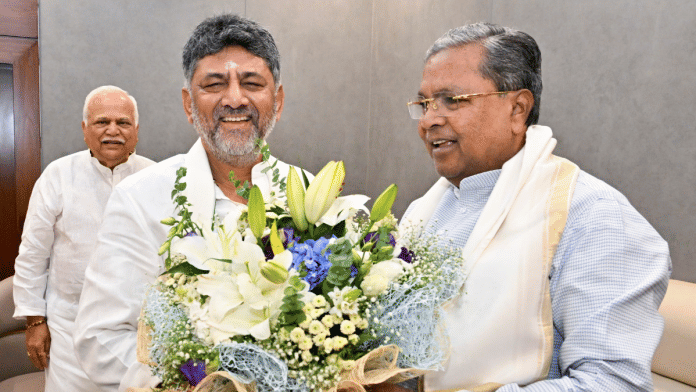
Bengaluru: D.K. Shivakumar, popularly known as DKS, took oath as the Chief Minister of Karnataka on Wednesday, with G. Parmeshwara, a Dalit leader, appointed as his deputy.
The 64-year-old Congress loyalist replaced Siddaramaiah who stepped down last week after Leader of the Opposition in the Lok Sabha, Rahul Gandhi, asked him to honour the promise made in 2023 of stepping down midway through the term.
Shivakumar took oath in the presence of Rahul, Congress president Mallikarjun Kharge, spiritual leaders, industry captains, pro-Kannada activists, daily-wage workers and others from diverse sections of the society in a low-key affair inside the Lok Bhavan.
Taking a leaf from Rahul, Shivakumar held the Constitution on one hand and took his oath in the name of his spirtual guru, Veera Gangadhara Ajjaya.
ಕರ್ಮಣ್ಯೇವಾಧಿಕಾರಸ್ತೇ ಮಾ ಫಲೇಷು ಕದಾಚನ |
ಮಾ ಕರ್ಮಫಲಹೇತುರ್ಭೂರ್ ಮಾ ತೇ ಸಂಗೋಸ್ತ್ವ ಕರ್ಮಣಿ || pic.twitter.com/VElVFR1U3M
— DK Shivakumar (@DKShivakumar) June 3, 2026
Siddaramaiah’s son Yathindra took oath as a minister in the Shivakumar-led government. The composition of the Cabinet so far shows a Siddaramaiah imprint with many of his loyalists retaining and finding place in it.
Apart from Shivakumar, 13 others also took oath and will be part of the newly constituted cabinet. He can induct up to 20 more ministers later.
The Congress party has maintained that the first list comprises senior members to ensure continuity in governance and a smooth transition of power.
Parameshwara, a party veteran and a prominent leader of the Scheduled Caste (Right) faction of the Dalit community, will be Shivakumar’s sole deputy in the first list.
According to people aware of the developments, Siddaramaiah convinced the Congress high command to make Parameshwara the Deputy Chief Minister. Siddaramaiah had earlier projected Parameshwara as his replacement and argued in favour of the ‘Dalit CM’ narrative.
K.J. George, U.T. Khader, K.H. Muniyappa, Ramalinga Reddy, M.B. Patil, Satish Jharkiholi, Eshwar Khandre, Priyank Kharge, Yathindra Siddaramaiah, Krishna Byre Gowda, Byrathi Suresh and Sharan Prakash Patil also took oath as ministers.
The list shows an overwhelming influence of Siddaramaiah in Shivakumar’s Cabinet, suggesting that the 77-year-old retains significant power despite losing his position as the chief minister.
Yathindra, a one-time MLA and incumbent MLC, has been accommodated to placate the former chief minister.
Similarly, George, Jharkiholi and M.B. Patil, Suresh are among the seniors from Karnataka who backed Siddaramaiah’s bid to continue as chief minister for the full five-year term and are seen as loyalists. More importantly, they did not back Shivakumar’s bid to replace Siddaramaiah.
Khader, who served as speaker of the Karnataka Assembly and is believed to be close to Siddaramaiah, returns to the Cabinet. Priyank is the son of Congress chief Mallikarjun Kharge. Patil is from Kharge’s Kalyana Karnataka region and is likely the AICC’s president’s choice.
One of the senior-most Congress leaders in Karnataka, Ramalinga Reddy, is Shivakumar’s choice and is key to the impending Greater Bengaluru Authority (GBA) elections for controlling the city’s civic body.
Senior leader Muniyappa is a member of the SC-Left, who has maintained good ties with both leaders.
Eshwar Khandre is from the Kalyana Karnataka region but more importantly, he is the incumbent president of the All India Veerashaiva Mahasabha, which represents one of the most dominant and politically powerful groups in the southern state.
The Congress’s decision only to induct 13 members to the Cabinet is the same playbook the party followed three years ago when Siddaramaiah took oath, i.e. inducting members representing various prominent caste groups and regions.
Initially, Shivakumar will have three Vokkaligas, including the CM himself, two from Scheduled Caste communities and one from Scheduled Tribe, three each from the dominant Lingayats and communities classified as backward classes. Khader and George are from minority communities. Notably, there are no women in the existing list.
The remaining berths are expected to be filled up in the coming days as MLAs continue to make their case before the high command.
However, political analysts suggest that the heavy presence of Siddaramaiah’s backers in the new cabinet could potentially create multiple power centres, potentially undermining the new CM’s authority.
Also Read: Siddaramaiah’s resignation without drama doesn’t guarantee stability in Karnataka politics
‘No power transfer is smooth’
On Wednesday, Shivakumar visited the homes of former Prime Minister H.D. Deve Gowda and former Chief Minister B.S.Yediyurappa to seek their blessings and support. He also visited Siddaramaiah’s official residence to seek his blessings before taking oath.
Though the two leaders have shown surprising camaraderie over the last few days, analysts say that Siddaramaiah’s peace and cooperation will be contingent on several factors.
“No political power transition can be smooth. Discontent is the hallmark of such transitions,” A. Narayana, a Bengaluru-based political analyst and faculty at the Azim Premji University, told ThePrint.
“Siddaramaiah’s declaration that he will cooperate with the high command’s choice is to be taken with a pinch of salt because that has not been his record so far. He will remain calm and not topple the apple cart only if the cabinet is constituted to his satisfaction,” he added.
The Bharatiya Janata Party (BJP) had faced a severe backlash after it forced Yediyurappa to step down in 2011. Realising that the Lingayat strongman was indispensable politically, the BJP inducted him to the party’s parliamentary board and even appointed his son B.Y. Vijayendra as the state party chief.
On its part, the Congress wasted no time in appointing Siddaramaiah to the Congress Working Committee (CWC), the party’s highest decision-making body, to placate the senior leader who remains a central figure in backward classes politics.
The consensus is that Siddaramaiah’s cooperation for the new government cannot be taken for granted. Political analysts listed factors like cabinet composition, portfolio allocations and support for the former chief minister’s closely held projects like the caste census and social justice as key to his continued support.
‘The silence has a lot of sound’
Siddaramaiah’s stepping down as the Chief Minister without protest has raised many questions in Karnataka, analysts like Sugata Srinivasraju said
Srinivasraju said that the 77-year-old has never given up power without a fight. “The silence has a lot of sound,” he said, alluding to Siddaramaiah’s quiet exit.
Siddaramaiah may have weighed his options and preferred stepping down quietly rather than kicking up a storm, he explained. Especially since he has to consider the future of his son and questions over the Mysuru Urban Development Authority (MUDA) irregularities.
The quiet exit, he said, should not be taken as the AHINDA (Kannada acronym for minorities, backward classes and Dalits) leader taking a backseat or retiring from politics.
Siddaramaiah declining the high command’s offer of a Rajya Sabha seat may prove to be a hurdle for Shivakumar, he added.
“One challenge is that Siddaramaiah is not leaving Bengaluru. If he had gone to Delhi, it would have been less of a problem. That will be one big management issue for Shivakumar,” Srinivasraju told ThePrint.
Siddaramaiah is also unlikely to vacate ‘Cauvery’, the Chief Minister’s official residence. Given that Shivakumar’s home office ‘Krishna’ is next door, Siddaramaiah’s presence there serves as a constant reminder of his continued influence.
He added that Shivakumar also has to manage the expectations of Kharge, whose son Priyank, is also part of the Karnataka Cabinet now.
Siddaramaiah built and projected an image of being clean unlike Shivakumar who has made no bones about being the party’s ‘resource person’, he said.
“The moment he makes a mistake, there will be a ton of bricks falling on Shivakumar that has never happened to Siddaramaiah. Siddaramaiah was Teflon-coated, nothing stuck. But everything sticks to Shivakumar,” Srinivasraju said.
(Edited by Tony Rai)
Also Read: From Sathanur to Bidadi, how Shivakumar-Deve Gowda rivalry has shaped Karnataka politics in 40 years