





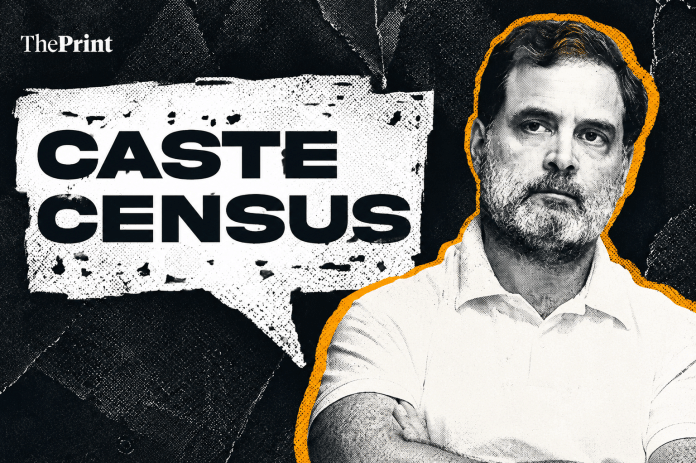

New Delhi: Congress president Mallikarjun Kharge and Leader of the Opposition Rahul Gandhi have written to Prime Minister Narendra Modi to demand a change in how caste is to be recorded in the Census, arguing that the method proposed by the government could lead to an inaccurate dataset.
Their objection is based on the “open column” where respondents can state their caste, which the enumerator will record. According to them, this would result in the same caste being recorded by different names, making it harder to determine the size and socio-economic condition of different communities.
In Rahul Gandhi’s case, the Congress leader has for the better part of the past three years made caste census central to his social-justice pitch—calling it an “X-ray” of India, his “life’s mission” and linking it to due representation of OBCs, Dalits and Adivasis.
However, mentions of caste census appear to have declined in his speeches and public statements since the end of 2024.
An analysis by ThePrint of his speeches, public meetings, press conferences and parliamentary interventions found that Gandhi referred to the caste census on 14 instances in 2023. This number climbed to 22 in 2024, the year of the general election.
But, it fell to 8 in 2025, after the central government announced caste enumeration as part of the census in April, and stands at 4 so far in 2026.
The decline has coincided with a shift in Gandhi’s broader political messaging. His focus has increasingly shifted towards issues that resonate with younger voters—education, jobs, irregularities in government examinations. As part of this, he also launched ‘Chhatron Ki Goonj’ as a platform to interact with students and raise issues that concern India’s Gen Z.
Ashutosh Singh, political expert and professor at Punjab University, said Gandhi was now trying to court the urban middle-class and lower middle-class youth, a constituency that cares little for caste politics. “Among many young people in metropolitan India, there is even a certain degree of ignorance about caste, they may not know or care very much about their own caste identities, Gandhi is trying to reach a constituency that does not necessarily see caste as central to its political identity,” Singh told ThePrint.
Singh also described the shift as significant given the size of India’s young and working-age population. “Young people have energy and aspirations and a greater willingness to enter an agitational mode because they often feel they have less to lose. If Congress could connect with this constituency, including young women and sections of deprived communities, it could give the party a broader social base.”
“The larger political opportunity for Rahul Gandhi is to bring these constituencies together,” Singh said. He added that a relatively secular youth constituency, cutting across caste and including young women and deprived sections, could provide Congress with a “counterweight to Right-wing politics fuelled by religiosity”.
But, the caste census has not disappeared from Rahul Gandhi’s politics.
Instead, his focus has shifted from demanding a caste census and questioning what the resultant data would achieve, to now objecting to the enumeration process, and asking what should follow from the data. That shift is particularly significant because the caste census was one of the defining themes of the Congress party’s 2024 Lok Sabha campaign.
Also Read: Who wants caste census—PM Modi, Rahul, Akhilesh? Everyone and none
Post-election decline in mentions
Gandhi’s pitch for a caste-census became prominent in 2023, in the run-up to the general election.
In April 2023, a month before the Karnataka Assembly elections, he demanded that the Centre release caste data collected during the 2011 Socio Economic and Caste Census. He asked how the government could frame policies for OBCs without knowing their population.
Gandhi also linked the issue to OBC representation in government, and the 50 percent judicial ceiling on reservations for Dalits and Adivasis, stating that the exact numbers of different communities had to be established before questions of representation and reservation could be addressed. The language became sharper later in the year.
Gandhi began describing the caste census as an “X-ray of India”, saying it would show the population of OBCs, Dalits and Adivasis and their representation in positions of power.
In October, ahead of the Madhya Pradesh elections, he said the Congress would “force” the government to conduct a caste census.
By the end of 2023, the demand for a caste census had become a staple of Gandhi’s election campaigns.
The issue featured even more prominently in 2024. ThePrint’s analysis shows that Gandhi referred to the caste census on 23 instances that year.
During the Bharat Jodo Nyay Yatra, he expanded the argument. In February 2024, Gandhi described the caste census as a “social X-ray” and proposed combining it with a financial survey. He said the exercise should establish not only the population of different communities but also their share of India’s wealth and their representation in institutions.
He repeatedly pointed to the composition of the higher bureaucracy, judiciary, media and corporate sector to argue that the share of OBCs, Dalits and Adivasis in positions of power did not correspond to their share of the population.
In April 2024, Gandhi described the caste census as his “life’s mission” and linked it to his demand to remove the 50 percent reservation ceiling.
In August that year, speaking in Prayagraj, he said the caste census should become the “foundation for policy-making”.
The turning point came on 30 April, 2025, when the Union government announced that caste would be enumerated as part of Census 2027.
Rahul Gandhi welcomed the decision, but did not treat it as the end of the campaign. Instead, he called it the “first step”, demanded a timeline for the exercise, and immediately returned to the issue of the 50 percent reservation ceiling. “The 50 percent cap on reservations is becoming an impediment to the progress of our country and to the progress of Backward Castes, Dalits and Adivasis and we want this barrier to be eliminated,” he said.
He also said the Congress would push for implementation of Article 15(5), which provides for reservation in private educational institutions.
After the announcement, Gandhi’s emphasis increasingly shifted to what the caste census would lead to. He pointed to Telangana’s caste survey as a model and asked whether the Centre would conduct a thorough exercise.
He continued to link caste data to representation and the judicial ceiling for reservations.
At the same time, the number of instances when he mentioned the caste census declined, from 22 in 2024 to 8 in 2025 and further in 2026. So far, Gandhi has referred to the caste census 4 times this year, according to ThePrint’s analysis, the most recent being his joint letter with Kharge to Prime Minister Narendra Modi this week.
Kharge and Gandhi have also flagged the absence of a separate category for “Backward Classes” in the census questionnaire. Their suggestion, citing caste surveys conducted in Telangana and Bihar as examples, is that the government use a pre-determined list of caste groups. They have asked the government to withdraw the existing questionnaire and consult political parties, experts and the public before finalising a new one.
(Edited by Amrtansh Arora)
Also Read: New census questions may be meant for National Population Register, says ex-deputy Registrar General