





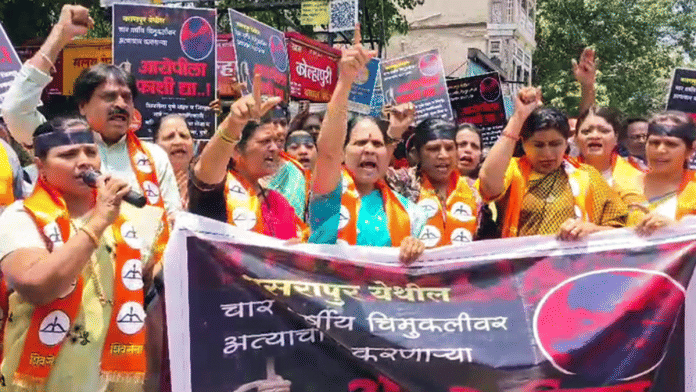


Mumbai: In the aftermath of the Nasrapur rape and murder case, the five-year-old Shakti Bill is back in focus, with opposition politicians calling for its immediate implementation in Maharashtra.
This isn’t the first time the Opposition has demanded the implementation of the Shakti Criminal Laws (Maharashtra Amendment) Bill, 2020. There was a similar demand when two school girls were sexually assaulted in Badlapur in August 2024.
Modelled on the lines of the Andhra Pradesh Disha Act that provides for death penalty in heinous crimes such as rape and gang rape, it was unanimously passed by the Maharashtra Assembly in 2021 and then forwarded for Presidential nod.
But, it went into cold storage after the Bharatiya Nyaya Sanhita (BNS) and the Bharatiya Nagarik Suraksha Sanhita (BNSS)—which replaced the the Indian Penal Code (IPC) and the Code of Criminal Procedure (CrPC)—came into effect 1 July 2024.
Neelam Gorhe, the Deputy Chairperson of the Maharashtra Legislative Council, said many provisions of the Shakti Bill are present in the BNS.
“When we compared the BNS and the Shakti Bill, (we found that) 80 percent of provisions from the Bill are under the BNS. So, why must this state act be passed separately? But then I went through these two legislations and took multiple meetings with police and stakeholders, and for whatever provisions remained to be included in the BNS from the Shakti Bill, Maharashtra should pass another law,” Gorhe said.
Gorhe was part of the Maha Vikas Aghadi (MVA) in 2021, but is now in the ruling Mahayuti in Maharashtra. During the budget session in March, the Maharashtra government passed a Bill to amend the BNS for incorporating stringent provisions from the Shakti Bill.
However, lawyers and advocates argue that the Shakti Bill needs to be implemented without any delay.
“There are many good provisions under the Shakti Bill such as punishment for false cases of rape, or those lodged under the POCSO (Protection of Children from Sexual Offences) Act. The misuse of laws is one of the biggest reasons why they are ineffective,” advocate Abha Singh told ThePrint.
Singh is a practicing advocate at the Bombay High Court and also a women’s rights activist.
“Acid attack victims will be helped with plastic surgery and punishment has been made more stringent. And hence, the implementation of the Shakti Bill would be a welcome step,” Singh said.
Another Mumbai-based lawyer Sujay Kantawala told ThePrint that the Shakti Bill has to be implemented for providing swift justice in such crimes.
“In this tangle between the Centre and the state, the Bill is yet to be implemented. So unless it is implemented, how will the victims get justice? The timeline has to be strictly enforced and a dedicated prosecutor needs to be appointed by the government,” Kantawala said.
“The problem is we have all the acts in place but the problem is its enforcement and implementation. Because of these inordinate delays, it defeats the purpose. So when will the victims get justice and closure?”
Also Read: Award-winning Nagpur NGO head arrested for ‘exploiting women, hurting religious sentiments’
Strict provisions
First proposed in 2020, the Shakti Bill was hailed by the MVA government as a landmark decision that would curb sexual violence against women and children. However, there was opposition from the Bharatiya Janata Party (BJP), women’s rights activists, lawyers and academicians who argued that it had a patriarchal worldview and would be a step backward for women’s rights.
It was then sent for a review to a 21-member committee comprising MLCs and MLAs. One of the demands was that a list of habitual offenders needs to be kept at the police stations, Gorhe said.
“But many citizens groups opposed it, saying the police will misuse it. But how will we get the data if there is no list? We had given these suggestions but the committee did not accept them since many organisations opposed it then.”
The Bill amended the CrPC and the IPC to include the death penalty for rape and gang rape “in cases which have the characteristic of the offence being heinous in nature and where adequate conclusive evidence is there and the circumstances warrant exemplary punishment, with death.”
It proposed that the investigation in such cases should be completed within 15 days, down from two months. Authorities would have to submit specific reasons for failure to do so. The trial should be conducted daily within 30 days of filing a charge sheet, down from two months, and the appeal period reduced from six months to 45 days.
It also included acid attack victims in the bracket of heinous crimes with the punishment enhanced to a minimum of 15 years, extendable to life imprisonment along with fines.
Bail can only be decided by session or higher courts and there is no provision for anticipatory bail in cases of acid attacks, rape, or gangrape, it said.
One of the rules in the Act mandates that social media platforms, if they have any evidence of sexual offences against children, must present it to the investigating officer. The same is applicable in cases of rape, sexual harassment, and acid attacks. Failure to do so would result in imprisonment for a maximum of three months and/or a fine of Rs 25 lakh.
“By making these social media platforms accountable, it is important because we all know how objectionable videos are circulated on social media, this will help in convicting the accused,” Singh said.
The amendments related to acid attack victims is also a welcome step, the advocate added.
The setback
Sent to the President for approval in March 2022, the Bill has been pending since then as the Centre flagged reservations regarding its provisions. One of the grey areas was the short time frame for investigation and filing of charge sheets. The Centre also questioned the data retrieval clause in the Act, contending that it breached data privacy.
As the IPC and CrPC gave way to the BNS and the BNSS, the Centre questioned the need for a new law in 2024. The next year, the Centre sent the Bill back to Maharashtra.
In December 2025, Chief Minister Devendra Fadnavis informed the House that the Bill was sent back because its provisions overlapped with “constitutional rights of the citizens and powers of central laws”. The stringent BNS could take similar action as intended by the proposed Shakti Bill, he added.
NCP-SP senior leader Anil Deshmukh, who was the home minister when the Bill was introduced, has accused the Centre and the state of passing the buck at a time when crimes against women were rising.
“Had the Shakti Bill been implemented, the accused in the Nasrapur case would have been hanged within 15 to 21 days, and it would have been a deterrent,” he said.
The Shakti Bill, Deshmukh said, should be implemented without delay to prevent such crimes.
Party colleague Rohit Pawar said that a special one-day session should be called to pass the Shakti law in Maharashtra.
Senior Congress leader Vijay Wadettiwar also accused the Centre of not allowing the passage of the Shakti Bill.
“The Centre doesn’t have the guts to bring in the strict Shakti Bill to protect the women and girls in Maharashtra. The state government should put aside political differences and call a special one-day session for this,” he told the media.
(Edited by Tony Rai)
The problem is there are enough studies to show that death penalties actually don’t stop such crimes.
Now, is it possible these studies have a left leaning bias ? Maybe. But if these studies are true then also you have to do your own studies in the Indian context.
Secondly, this is a fact and has ample evidence that What really stops crime is quicker investigations and court trials.
Also does death penalty makes it tough for the prosecution team to get a conviction ? Because we are talking about ending a life which means the threshold is much higher when it comes to evidence.
I personally think that you should definitely give death sentences for rape and murder, rape of a minor. I mean we all know I many “activist” tried to protect the nirbhaya perpetrators from the death penalty. They all made sure to drag the case for a millennia.