



Hyderabad: Andhra Pradesh Chief Minister N Chandrababu Naidu proposed a monumental inter-state Godavari-Cauvery link project as a “permanent” solution to floods and water scarcity, as his Tamil Nadu counterpart sought more water for Chennai from the TDP-ruled state. This comes as El Niño-driven climate pressures leave states increasingly interdependent for drinking water and irrigation needs.
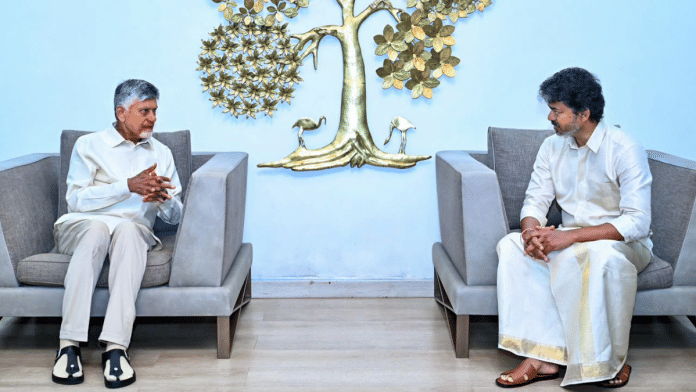
Naidu’s suggestion came during a meeting with Vijay on Tuesday in Vijayawada.
“I came to Vijayawada to discuss the river-interlinking project with Chief Minister Chandrababu Naidu. I am thankful for the suggestions he has made for the commitment to release additional water to Chennai,” CM Vijay said, addressing an audience in Vijayawada during the Navaratri Utsav.
Drawing on Andhra’s proven track record of executing intra-state river-linking projects, such as the historic Pattiseema life irrigation scheme that connected the Godavari and Krishna rivers, Naidu said the suggested Godavari-Cauvery link could become a vital, climate-resilient solution to secure water needs of the parched southern peninsula.
Vijay was in Vijayawada to participate in the Vijayawada Utsav and discuss the possibility of Andhra Pradesh releasing an additional 10 Thousand Million Cubic (TMC) feet of water to Chennai for the city’s drinking water needs through the Telugu Ganga project.
At the meeting, Naidu explained the importance of linking the Godavari and Cauvery rivers, describing river interlinking as a permanent solution to drought, an official release from the Andhra Pradesh state government said.
“CM Chandrababu Naidu said that despite reduced Krishna water inflows due to the impact of El Niño this year and the resulting severe water scarcity, the Andhra Pradesh government remained committed to addressing Chennai’s drinking water needs,” the government release stated.
Andhra had already released 4.08 TMC of water to Chennai earlier this year.
At the Vijayawada Navaratri Utsav, CM Naidu added, “Vijay is working to develop Tamil Nadu. He formed a political party and became chief minister within two years. The enthusiasm of the youth gives me confidence that the young people of our country can achieve anything in the world,” Naidu said.
Earlier, at the meeting, Naidu also suggested, according to the release, that the Pennar, Godavari, Krishna, Cauvery and Tungabhadra rivers be linked for the benefit of the four states of Andhra Pradesh, Telangana, Karnataka and Tamil Nadu.
While the Godavari and Cauvery rivers do not naturally meet, the National Water Development Agency (NWDA) plans for water to be transferred across basins rather than the rivers physically merging naturally.
Answering a question in the 2023 budget session of the Parliament, the Ministry of Jal Shakti said that the Government of India formulated a National Perspective Plan (NPP) in 1980 and that the Interlinking of Rivers (ILR) under the NPP includes linking the river basins of the Godavari, Krishna, Pennar, and Cauvery.
As envisaged under the NPP, Godavari is to be augmented by transfer of surplus waters from Mahanadi and Brahmaputra basins, for further diversion of waters to Krishna, Pennar and Cauvery basins, pending approvals from the respective state governments.
According to the NWDA’s Parliamentary response, at the first stage, water is proposed to be diverted from the Godavari River near Inchampalli in Telangana. Next, it is proposed to be lifted and routed to the Nagarjuna Sagar Dam on the Krishna River.
In the third stage, the proposal states that water would move further south to the Somasila reservoir on the Pennar River before it is finally designed to reach the Grand Anicut (Kallanai) near Thanjavur and Tiruchirappalli on the Cauvery River in Tamil Nadu.
(Edited by Ajeet Tiwari)
Also read: In deadly dry Bundelkhand, Ken-Betwa link finally seems real. But critics have questions, fears