


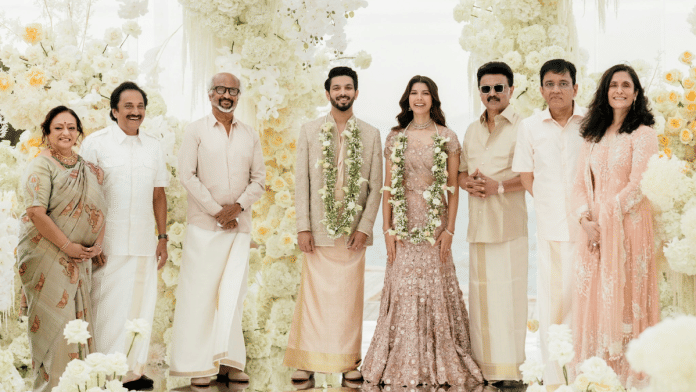
Chennai: The wedding of Sun Group heiress Kavya Maran and music composer Anirudh Ravichander last week has revived a deeper conversation about whether Dravidian politics and its first families have come a full sociological circle from the inter-caste reformist alliances of the 1960s to a quieter accommodation of tradition six decades later.
Kavya, daughter of Kalanithi Maran, has married into a traditional Tamil Iyengar family. Her uncle, former Union minister Dayanidhi Maran, did the same in 1994 when he wed Priya, also from an Iyengar background.
The marriage of Kavya’s grandfather, the late Union minister Murasoli Maran, to Mallika Maran in 1963 was hailed by the Dravida Munnetra Kazhagam (DMK) leadership as a landmark inter-caste statement.
Political commentator S. Nagarajan explains that Mallika Maran’s paternal lineage has frequently been linked to a Tamil Brahmin family from Madurai, whose father was the son of the Madurai scholar-patriarch Arupathi Natesa Iyer.
“Murasoli Maran’s marriage was held up by M. Karunanidhi and C.N. Annadurai as a living proof that Dravidian rationalism could dismantle rigid caste endogamy at the height of the Self-Respect Movement’s influence,” he said.
Nagarajan, who has also examined this family trajectory in detail, sees a clear generational pattern.
“Looking across the Maran household, which is closely intertwined with the broader Karunanidhi family, you effectively find someone from every major community strand over three generations,” he said. “What began in the 1960s as an ideological rupture with Brahminical orthodoxy has, through personal choice and changing social realities, come a quiet full circle. The third generation’s alliances show that individual autonomy and family sentiment have often outlasted rigid political dogma.”
The timing of the Kavya-Anirudh wedding has further pushed the discussion. In early November, photographs and videos from the Chennai wedding of DMK general secretary Durai Murugan’s granddaughter Senthamarai showed the ceremony being solemnised by Vedic priests amid Sanskrit chants, even though the invitation prominently featured Periyar E.V. Ramasamy, Annadurai, and Karunanidhi.
Dravidar Kazhagam president K. Veeramani publicly criticised Durai Murugan, warning that personal family choices among top office-bearers should not undermine the Dravidian movement’s anti-ritualistic, rationalist foundations.
Facing mounting criticism, Durai Murugan issued a rare public expression of regret. He explained that he had yielded solely to his granddaughter’s personal insistence for a traditional wedding, while affirming that his own marriage and that of his son was conducted strictly as Self-Respect ceremonies.
“The personal choices can change with time but when the recognised bearers of the Dravidian movement who believed in Periyar, engage in traditional rituals, the public opinion brings criticism in the form of allegations of ideological dilution,” says political analyst A Ramasamy. “However, we have seen that the Karunanidhi family has accepted partners across all castes and beyond that too.”
The younger generation in Tamil Nadu, according to Nagarajan, increasingly treats marriage as a matter of personal compatibility, global aesthetics and family sentiment rather than an ideological manifesto.
Nagarajan adds that the story of Mallika Maran’s storied lineage, Kavya’s marriage and Duraimurugan’s candid apology reflects the evolving soul of modern Tamil Nadu.
“One can see the whole rhetoric come full circle. Rather than a simple retreat to the past, it illustrates how fierce twentieth-century ideological battles have mellowed into twenty-first-century social pragmatism, where ancestral roots, personal faith and rationalist heritage can coexist in the same family album,” the political commentator asserts.
(Edited by Tony Rai)