


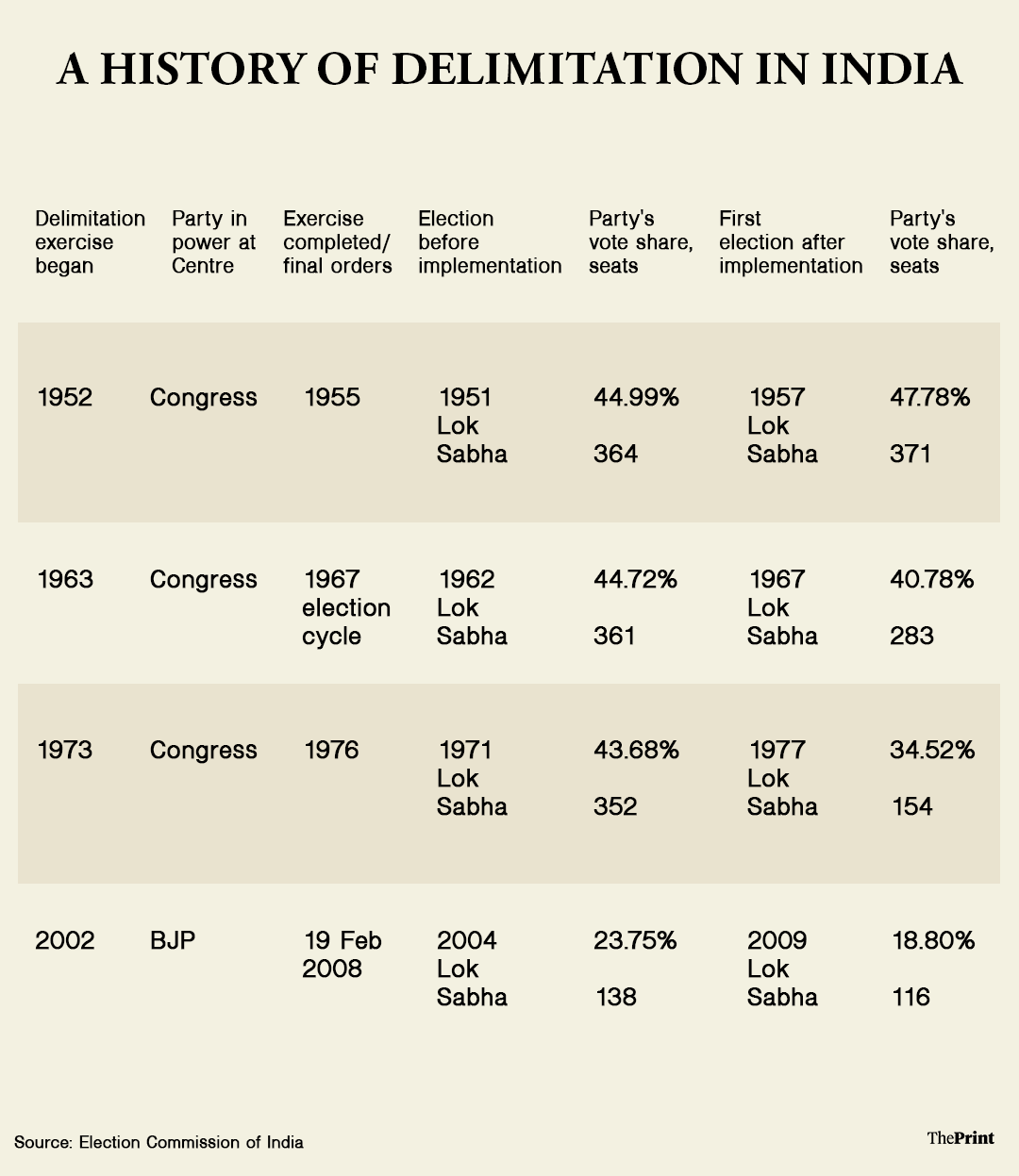
New Delhi: While the Opposition is apprehensive about the proposed delimitation exercise by the Narendra Modi government, the electoral record of previous exercises offers an interesting perspective. In three of the four national delimitation exercises since Independence—with 1952 being the exception—the party ruling at the Centre saw its number of seats and vote share decline after the exercise.
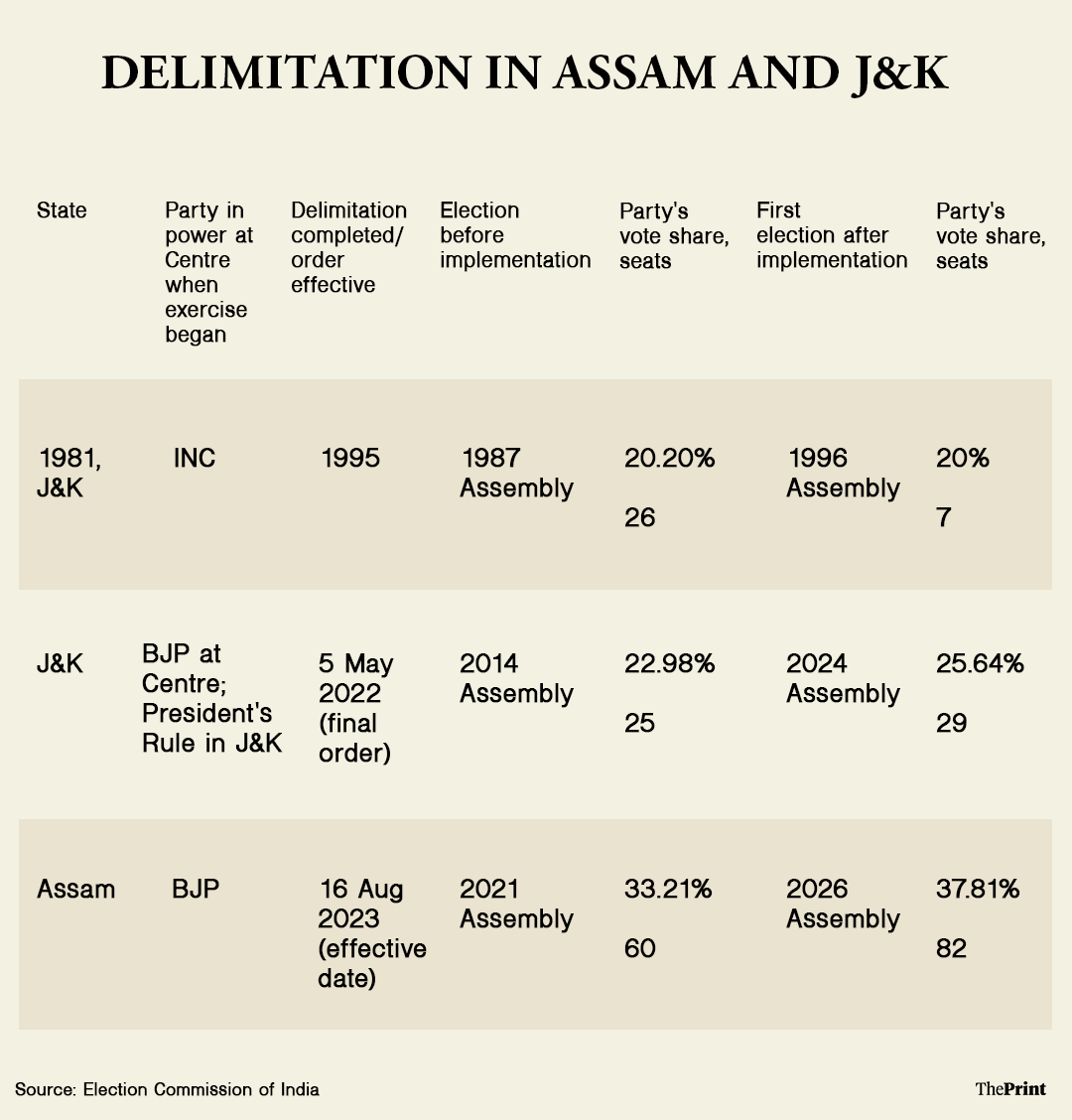
However, delimitation exercises conducted in Assam and Jammu and Kashmir under the Narendra Modi government saw the ruling Bharatiya Janata Party (BJP) gain seats and vote share, triggering allegations of gerrymandering.
The Opposition’s apprehensions today stem largely from these exceptions.
In Jammu and Kashmir and Assam, the BJP increased its tally in the Assembly elections held after delimitation. Before these two instances, the only exception was the first delimitation exercise, which began in 1952 and concluded in 1955.
The Congress won 364 seats in the first Lok Sabha elections in 1951, before the exercise, and 371 seats in the 1957 Lok Sabha elections held afterwards. This represented a marginal increase of seven seats.
In Jammu and Kashmir, the last Assembly elections before delimitation were held in 2014, when the BJP won 25 seats. In the 2024 Assembly elections, it won 29 seats.
The biggest increase was seen in Assam in the Assembly elections held earlier this year. The delimitation exercise in the state was conducted by the Election Commission of India (ECI). The BJP won 60 seats in the 2021 polls, held before delimitation. This figure rose to 82 in the Assembly elections held earlier this year.
The ‘flaws’ in the Bill
The new Constitution (One Hundred and Thirty-Second Amendment) Bill, 2026, cleared by the Cabinet on Friday, proposes to increase the maximum strength of the Lok Sabha to 850 and that of state Assemblies to 650. It seeks to achieve this by increasing the number of Lok Sabha seats allocated to each state and Union Territory, as well as the number of Assembly seats in each state and Union Territory, by 50 percent of their current strength.
Former Lok Sabha Secretary-General PDT Achary has raised several questions about the manner in which the government intends to conduct the exercise this time.
He points out that the current strength of the Lok Sabha was fixed at 543 on the basis of population figures from the 1971 Census. The government now proposes to increase this strength to 850.
“What is it going to be based on?” he asked in an interview with ThePrint.
“It has to be replaced by another formula. But the government has not come out with any kind of formula. They have just said, okay, ‘all of you will get 50 percent’. But what is that based on? Why not 60? Why not 70? When you are changing the whole thing, a formula has to be worked, as the Constitution makers had done,” Achary told ThePrint.
He also questioned the government’s “intention” in pushing the legislation through in such haste, pointing out that women’s reservation could have been implemented within the existing strength of the Lok Sabha.
“You don’t have to redraw the constituencies to enforce women’s reservation,” he said.
The J&K and Assam story
The delimitation exercise in Jammu and Kashmir became necessary following the abrogation of Article 370 and the division of the erstwhile state into two Union Territories.
The erstwhile state of Jammu and Kashmir had 111 Assembly seats—46 for the Kashmir Valley, 37 for the Jammu region, four for Ladakh and 24 reserved for Pakistan-occupied Kashmir (PoK). With Ladakh carved out as a separate Union Territory, the J&K Assembly was left with 107 seats.
However, the Jammu and Kashmir Reorganisation Act, 2019, increased the number of Assembly seats to 90 for Jammu and Kashmir, in addition to the 24 reserved for PoK, taking the total to 114.
Critics and Opposition parties alleged that the constituencies had been redrawn in a manner that consolidated Hindu votes in the Jammu Parliamentary constituency by removing the Muslim-majority districts of Poonch and Rajouri from it. The commission also increased the number of seats in the Jammu region from 37 to 43 and in the Kashmir Valley from 46 to 47.
The boundaries drawn in Assam also came under intense scrutiny, with experts alleging “gerrymandering” and “electoral manipulation”. The redrawn maps featured “islands” and even a constituency with a “garland-like shape”.
Psephologist Yogendra Yadav also alleged that, wherever possible, Muslim votes were either dispersed across multiple constituencies to dilute their impact or concentrated in a single constituency, reducing the overall weightage of their votes.
Initially, a delimitation commission was constituted in March 2020 under the chairmanship of former Supreme Court judge Justice Ranjana Prakash Desai to redraw constituencies in the Union Territory of Jammu and Kashmir and four north-eastern states—Assam, Arunachal Pradesh, Nagaland and Manipur.
However, in March 2021, the four north-eastern states were removed from the commission’s purview in view of multiple pending cases before the Supreme Court and the Manipur High Court.
The Election Commission of India was subsequently asked to conduct the delimitation of parliamentary and Assembly constituencies in Assam under Section 8A of the Representation of the People Act, 1950. Section 8A allows the President to direct the ECI to conduct delimitation in Arunachal Pradesh, Assam, Manipur and Nagaland, depending on the prevailing situation and circumstances in these states.
All Assembly and parliamentary constituencies in Assam were delimited on the basis of the 2001 Census, while the number of Assembly and Lok Sabha seats was retained at 126 and 14, respectively.
In Jammu and Kashmir, the exercise was conducted by the Delimitation Commission headed by Justice Desai, using the 2011 Census as its basis.
In both cases, however, allegations of “gerrymandering” emerged, with experts alleging that constituency boundaries had been drawn in a manner that favoured the ruling BJP.
(Edited by Viny Mishra)
Also read Delimitation Bill: Modi govt just a whisker away from 2/3 majority in Lok Sabha, 3 parties hold key