


New Delhi: The Narendra Modi government seems to be a whisker away from the two-third majority in Parliament required to pass the Constitution Amendment Bill that proposes to provide a proportionate increase of 50 percent in Lok Sabha seats across all states and links the delimitation exercise to women’s reservation.
The Bill also proposes to freeze each state’s share of parliamentary representation till 2051. Cleared by the Union Cabinet Friday, the Bill will be introduced Monday in the Lok Sabha, when the House meets for a special session.
According an analysis by ThePrint, just an abstention by one opposition MP and non-availability of two jailed members, Amritpal Singh and Abdul Rashid Sheikh, will push the Bill through, provided the three fence sitters—Nationalist Congress Party’s Sharad Pawar faction, Dravida Munnetra Kazhagam (DMK) and the Yuvajana Sramika Rythu Congress Par (YSRCP)—come around to support the Bill.
The amended Bill as cleared by the Union Cabinet seems to address the conditions put forward by the three parties. Together, these regional parties have a combined strength of 34 MPs.
In the DMK’s case, it is about maintaining the proportion of seats which the Bill addresses while the other two parties are also softening their stand. On Friday, DMK president M.K.Stalin reiterated two demands: that Tamil Nadu’s existing 7.18 percent share of the Lok Sabha seats be protected in the event of an expansion of the House, and that the existing proportions of parliamentary representation among states remain frozen for another 25 years.
Nationalist Congress Party (Sharadchandra Pawar) has formally extended support to the Delimitation Bill, its spokesperson Jitendra Awhad announced.
Meanwhile, the opposition INDIA bloc allies are meeting Saturday to take a stand on the revised Constitutional Amendment Bill involving delimitation. The special sitting of the Parliament will start Monday, with the Lok Sabha sitting Monday and Tuesday and the Rajya Sabha on Wednesday and Thursday.
Also Read: Women’s reservation is the pretext, delimitation is the plan
How numbers currently stack up in Lok Sabha
In April, the government fell 54 votes short of securing the requisite majority in the Lok Sabha for the Constitution (131st Amendment) Bill, which sought to enable delimitation based on the 2011 Union Census.
Seven months on, as it prepares to make a second attempt at pushing through the legislation, shifts in political alignments have altered the parliamentary arithmetic.
In June, 20 of the 28 Lok Sabha MPs of the All India Trinamool Congress broke away from the Mamata Banerjee-led party and announced their merger with the Nationalist Citizens Party of India (NCPI).
The rebellion dealt a blow to the INDIA bloc, leaving Mamata’s faction with just eight MPs. Though the breakaway group is not formally part of the ruling National Democratic Alliance (NDA), it is aligned with the BJP.
The INDIA bloc also lost the support of the DMK and its 22 Lok Sabha MPs in the aftermath of the Tamil Nadu elections that took place in April.
On the other hand, the NDA has made gains. The merger of six MPs from the Uddhav Thackeray-led Shiv Sena with the Eknath Shinde faction has taken its strength in the Lok Sabha to 13.
The ruling alliance gained another MP earlier this week when the Shiromani Akali Dal returned to its fold, six years after walking out of the NDA over the now-scraped farm laws.
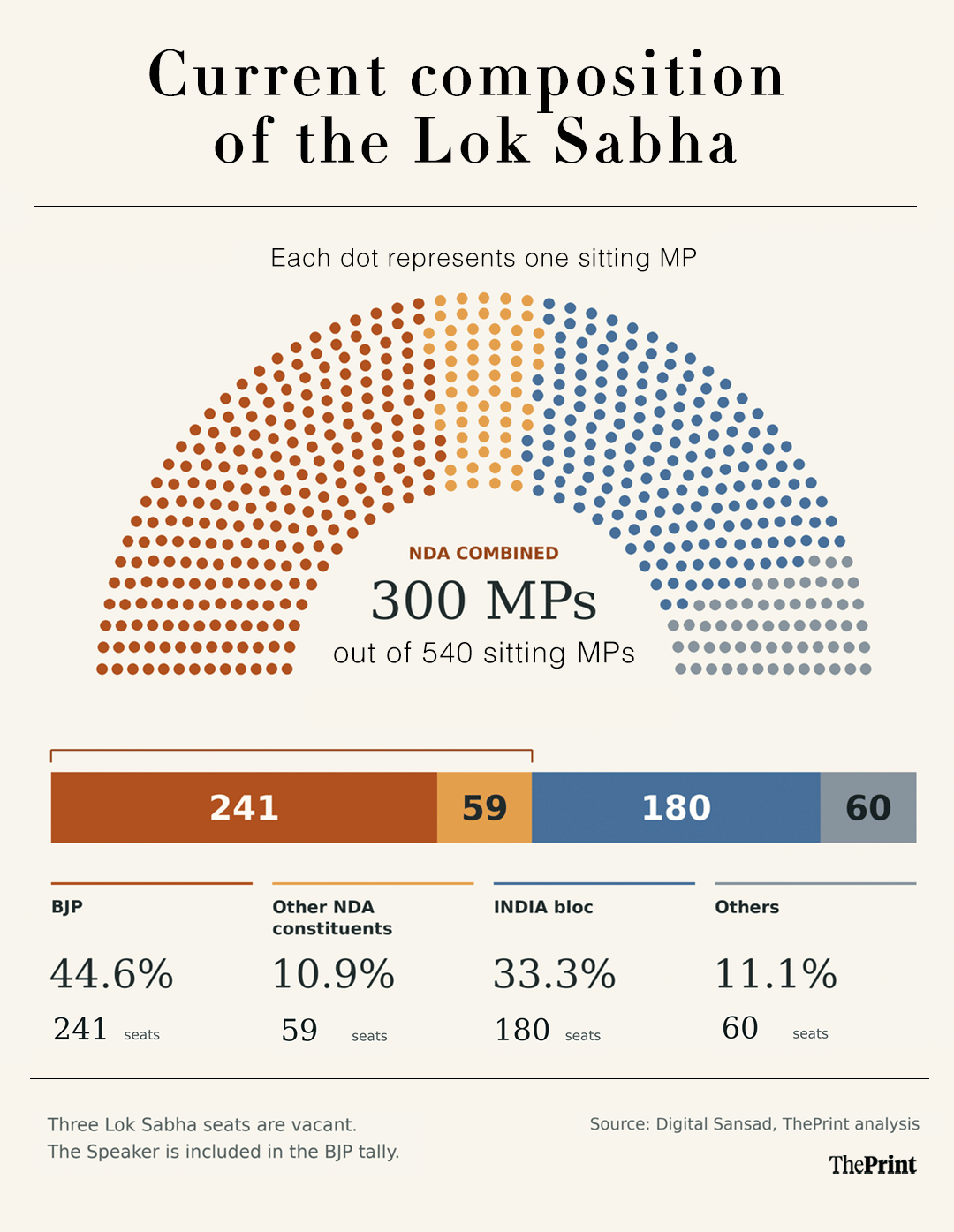
The current strength of the Lok Sabha stands at 540, with three seats lying vacant. Of these, 300 MPs, or nearly 56 percent, belong to the NDA, while 180 are from the INDIA bloc. Of the remaining 60 MPs, seven are Independents while others belong to parties and factions outside the two alliances.
While the political churn may have helped the government, the NDA still remains short of the two-thirds mark in a fully voting Lok Sabha. The focus shifts to parties outside the ruling alliance and the stand they take on the proposed legislation.
Where NDA can find numbers
Unlike an ordinary Bill, a Constitution Amendment Bill requires a special majority to get through Parliament. With the current strength of the Lok Sabha at 540, the number the government needs to muster is 360 at present.
The Sharad Pawar-led NCP faction, which remains part of the INDIA bloc, has eight MPs in the Lok Sabha. The Jagan Mohan Reddy-led YSRCP, which has 4 MPs and backed the Constitution Amendment Bill in April, appears inclined to do so again, but with a condition. Party sources told news agency ANI that its support would be contingent on the legislation safeguarding regional representation.
ThePrint mapped eight possible combinations of support from the three parties, taking as its starting point a tally of 324 votes in favour of the proposed amendment.
This baseline assumes support from all NDA MPs, barring the Speaker, the 20 Trinamool rebels, the United People’s Party Liberal (UPPL), the All India Majlis-e-Ittehadul Muslimeen (AIMIM), the Bharat Adivasi Party (BAP), the Zoram People’s Movement (ZPM), and Independent MP Umeshbhai Babubhai Patel.
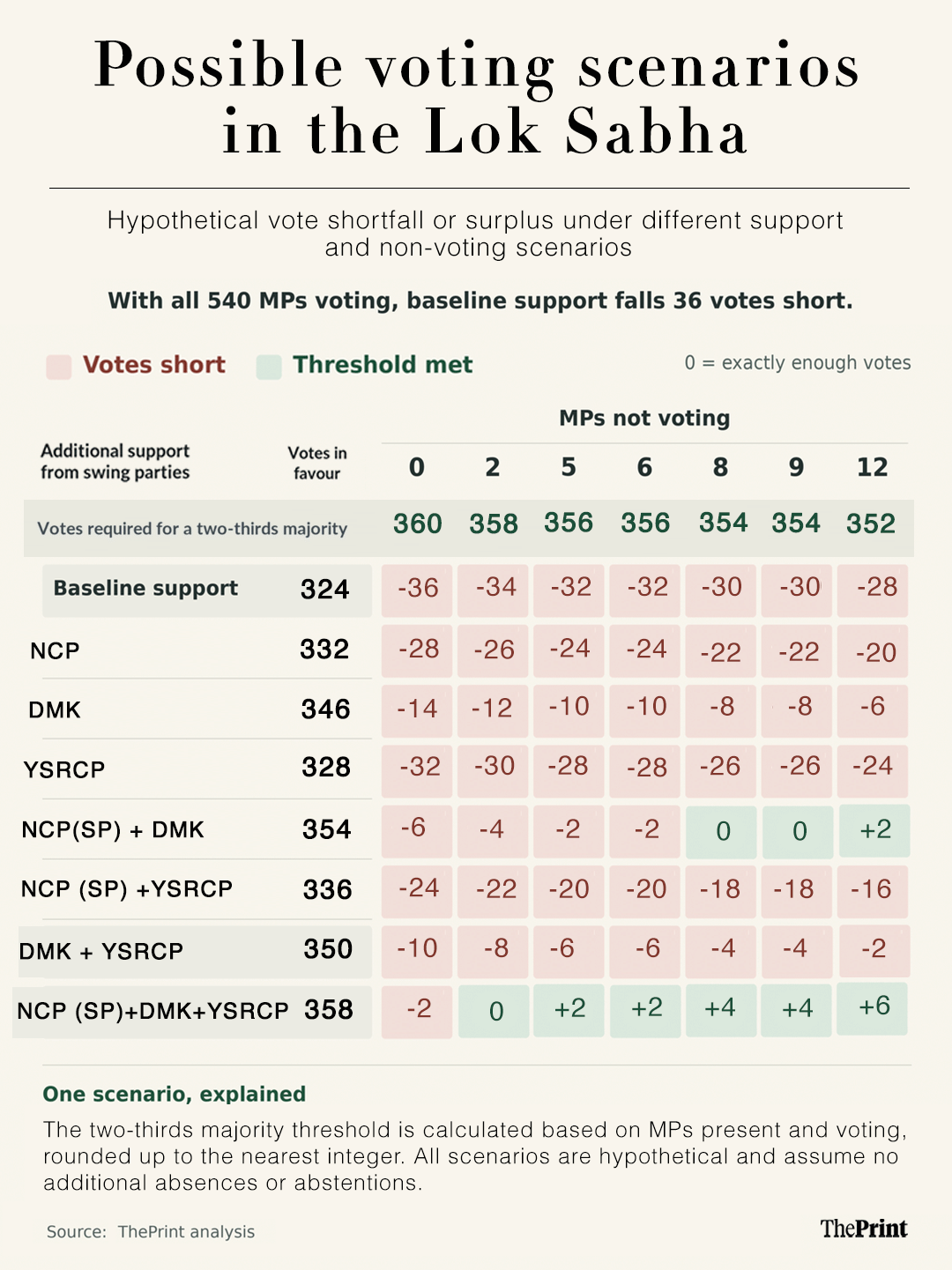
The DMK, with its 22 MPs, can make the biggest difference to the government’s tally. Its support alone would take the number of votes in favour of the amendment to 346. If the NCP (SP) comes on board as well, the tally rises to 354.
Even if all three parties were to throw their weight behind the legislation, however, the government would have 358 votes—two short of the requisite majority in a fully voting Lok Sabha.
However, the two-thirds mark is not set in stone. Since the threshold is determined by the number of MPs present and voting, every absence or abstention on the non-supporting side brings down the number of affirmative votes the government needs.
Should the two above-mentioned jailed MPs be absent, the two-thirds mark will come down to 358—precisely the number the government can muster with the backing of all three regional parties.
Additionally, the government can get the Bill through the Lok Sabha even without the YSRCP’s four votes. With the DMK and the NCP (SP) on board, the absence or abstention of eight non-supporting MPs will be enough for its tally of 354 to meet the requisite majority.
The renewed delimitation push, then, can hinge as much on the votes it secures as on those that are not cast.
(Edited by Tony Rai)