


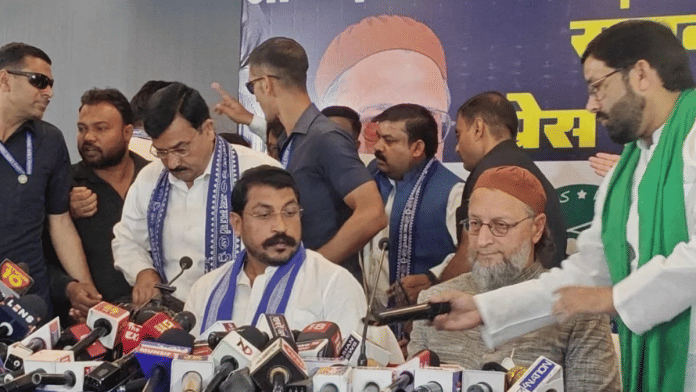
Lucknow: Asaduddin Owaisi’s All India Majlis-e-Ittehadul Muslimeen (AIMIM) and Chandrashekhar Azad’s Azad Samaj Party (Kanshi Ram) have joined hands to form a third front called the ‘Samajik Parivartan Morcha’ ahead of Assembly elections in Uttar Pradesh. The alliance has named Chandrashekhar Azad as its chief ministerial candidate.
Announcing the alliance at a joint press conference in Lucknow on Thursday, Owaisi said the alliance would contest all 403 assembly seats in Uttar Pradesh even as Azad appealed to the Samajwadi Party (SP) and Congress to join the new political formation.
The move could make the coming electoral contest interesting, particularly in constituencies with a sizeable Muslim and Dalit population. The big question, however, is whether the Owaisi-Azad alliance can cut into the Samajwadi Party’s support base and emerge as a challenge in the 2027 polls.
“We invite the Samajwadi Party and Congress to come together and contest the elections with us,” Azad said, announcing that the alliance would hold a major rally in Lucknow on 26 November to demonstrate its political strength.
ThePrint has learnt that several smaller regional parties, including Swami Prasad Maurya’s Apni Janata Party, are also in touch with the two leaders. There is a possibility that these parties may join the alliance in the coming days.
The decision to project Azad as the alliance’s chief ministerial candidate is particularly significant. It indicates an attempt to bring Muslim and Dalit political constituencies under one umbrella, potentially creating a new challenge for the Samajwadi Party and Bahujan Samaj Party.
But the big question is whether Owaisi and Azad can translate their individual political influences into statewide electoral strength and dent the Samajwadi support base in the 2027 elections.
In the past few elections, the Samajwadi Party has maintained a strong presence among Muslim voters in Uttar Pradesh, while the Bahujan Samaj Party has traditionally enjoyed considerable support among Dalits.
Professor Kaviraj of Lucknow University told ThePrint, “Owaisi’s AIMIM has contested elections in Uttar Pradesh before but has failed to achieve significant electoral success. Azad, meanwhile has been trying to expand his political influence beyond western Uttar Pradesh and establish a wider Dalit support base.”
He added: “If the two leaders manage to bring a section of Muslim and Dalit voters together, the alliance could make electoral contests more complicated for the SP, particularly in constituencies where Muslim voters play a decisive role, but now elections are getting bipolar so minority voters would watch who is challenging BJP more.”
20% Muslim population, 75 seats in 14 districts
Muslim voters are considered an important factor in Uttar Pradesh’s electoral politics. Muslims account for nearly 20 percent of the state’s population, with 14 districts where their population is estimated to be above 30 percent. Together, these districts account for 75 Assembly constituencies.
The 2022 assembly election results in these 75 constituencies offer an interesting picture. The BJP emerged as the biggest winner, securing 38 seats, while the Samajwadi Party won 30. The Rashtriya Lok Dal (RLD) bagged six seats and Apna Dal (Sonelal) won one.
The figures underline that the BJP managed to perform strongly even in districts with a substantial Muslim population, while the SP also secured a significant number of seats.
If the AIMIM and Azad Samaj Party contest these constituencies together in 2027, their impact may not be limited to Muslim votes. Azad’s presence could help the alliance attract a section of Dalit voters as well.
Nothing won, but damage inflicted
The AIMIM’s electoral record in Uttar Pradesh, however, suggests that the road ahead will not be easy. In the 2022 assembly elections, Owaisi’s party fielded candidates in around 95 constituencies but failed to win a single seat.
The party received 4,50,929 votes, accounting for approximately 0.49 per cent of the total votes polled. All its 95 candidates lost their security deposits.
Despite its limited overall vote share, the AIMIM’s presence attracted political attention in several constituencies, particularly where the SP lost by narrow margins and the number of votes secured by AIMIM candidates was higher than the victory margin.
For instance, in Sultanpur, the SP lost to the BJP by just 1,009 votes, while the AIMIM candidate secured 5,251 votes. In Kannauj, the SP’s defeat margin was 6,090 votes, compared with 4,482 votes secured by the AIMIM.
The difference was even more striking in Kursi, where the SP lost to the BJP by just 217 votes, while the AIMIM secured 8,541 votes. Similarly, in Ramnagar in Barabanki, the SP lost by 261 votes, while the AIMIM candidate received 4,940 votes. In Aurai, the SP’s defeat margin was 1,647 votes, against 2,190 votes secured by the AIMIM. In Shahganj, where the SP lost to the Nishad Party by 719 votes; the AIMIM received 8,128 votes.
These figures have often been cited to argue that the AIMIM’s presence could have affected the SP’s electoral prospects in some constituencies. It would be incorrect, however, to assume that all the votes polled by AIMIM candidates would automatically have gone to the SP in their absence.
Voters may have chosen other parties or candidates, and electoral preferences cannot be reduced to a straightforward transfer of votes. Nevertheless, the numbers indicate that AIMIM had the potential to influence close contests in some seats.
The SP also suffered defeats in several constituencies with a sizeable Muslim population in the 2022 elections. These included Nakur, Barhapur, Moradabad Nagar, Dhanaura, Hasanpur, Hastinapur, Dhaulana, Garhmukteshwar, Bareilly, Nanpara, Bahraich, Payagpur and Utraula.
The BJP and its allies won these constituencies, while AIMIM candidates secured varying numbers of votes. In Moradabad Nagar, the SP lost by 782 votes, while the AIMIM candidate received 2,661 votes. In Nakur, the SP’s defeat margin was 315 votes, compared with 3,593 votes secured by the AIMIM.
In Bahraich, the SP lost by 4,078 votes, while the AIMIM received 2,240 votes. In Payagpur, the SP’s defeat margin was considerably higher at 12,056 votes, while the AIMIM secured 3,586 votes. In Utraula, AIMIM candidates received 12,303 votes, although the SP’s defeat margin stood at 21,796.
The numbers suggest that the AIMIM managed to establish a presence in several constituencies, although its electoral influence varied considerably from seat to seat.
The Azad Samaj Party (Kanshi Ram), led by Chandrashekhar Azad, contested 111 seats in the 2022 Uttar Pradesh Assembly elections. The party secured approximately 0.77 per cent of the total votes polled but failed to win a single seat.
Azad rising
Azad himself contested against Chief Minister Yogi Adityanath from Gorakhpur Urban but suffered a major defeat and lost his security deposit.
However, his political fortunes changed in the 2024 Lok Sabha elections. Contesting independently from Nagina in western Uttar Pradesh, Azad defeated his rivals and entered Parliament without the backing of any alliance.
His victory gave him a stronger political platform and helped establish him as an emerging Dalit leader in the state.
The challenge for Azad now will be to convert his Lok Sabha victory and growing political visibility into a wider electoral base across Uttar Pradesh.
The biggest test for the new alliance will be whether it can turn its political messaging into votes on the ground.
Owaisi’s AIMIM seeks to consolidate its position among Muslim voters, while Azad is attempting to expand his influence among Dalits. If the two leaders succeed in bringing sections of these communities together, the alliance could alter electoral calculations in several constituencies.
However, the extent of its impact will depend on factors such as seat selection, local candidates, organisational strength and the ability of both parties to transfer their respective support bases to each other.
Meanwhile, the new alliance has already triggered political reactions. Aseem Waqar, who was earlier associated with the AIMIM and has since joined the Congress, questioned the formation of the front and alleged that it had the BJP’s backing. In a statement targeting the alliance, Waqar claimed that its reins were effectively in the hands of Home Minister Amit Shah. “Many people work for the BJP and Amit Shah. Some do so out of fear of cases and jail, while others do it to increase their wealth. I will make more major revelations very soon,” he alleged. Waqar also claimed that the alliance had been formed with the BJP’s tacit support.
(Edited by Nardeep Singh Dahiya)