





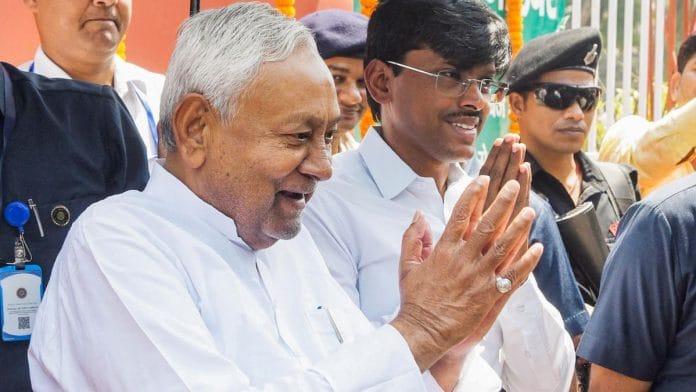


New Delhi: As Nitish Kumar walked down the steps of the Patna Secretariat for the last
time as chief minister Tuesday, an unusual scene unfolded behind him—hardened politicians, not known for public displays of emotion, wept.
The rare moment signalled more than a routine change of guard. It reflected the end of a political chapter shaped as much by personal loyalties as by a leader who, according to the political class and neutral observers, taught a state scarred by decades of misgovernance to hope again.
It all began on 24 November, 2005, when Nitish took oath as chief minister for the second time, in what would become his first full term in office—a period defined by efforts to pull Bihar out of a deep governance morass marked by lawlessness.
Two decades on, as Nitish exits the stage, Bihar tells a story of both transformation and limitation.
The state has witnessed sustained double-digit growth, driven by infrastructure development and welfare expansion, emerging from the economic stagnation of the early 2000s during the tenure of Lalu Prasad Yadav.
Former JD(U) leader K.C. Tyagi, a long-time aide of Nitish, told ThePrint that he was a beacon of hope who transformed Bihar’s trajectory. “Bihar was in complete disarray, there was anarchy, no development. There was no law and order, no roads, no electricity, and no clear roadmap for development. Badhaal tha Bihar (Bihar was in a bad way),” Tyagi said.
“He instilled a sense of belief among people, even in a hopeless state where jobs seemed impossible to find. That was his biggest victory,” said Devesh Kumar, a senior Bihar BJP leader.
Central to this shift was Nitish’s social engineering. He mobilised the Extremely Backward Classes (EBCs) and expanded their role in Bihar’s politics, broadening his support base beyond traditional caste alignments.
Following the 2023 caste survey, his government increased reservations for Scheduled Castes, Scheduled Tribes, Other Backward Castes and Extremely Backward Castes from 50 to 65 per cent, though the move was later struck down by the Patna High Court.
“He took charge when Bihar was at a low point,” said Prof Chandrachur Singh of Delhi University. “By softening the sharp edges of caste-driven politics and bringing backward groups into the mainstream, he built wider acceptance.”
Riding a wave of popularity, Nitish pushed through prohibition in 2016, soon after promising it during the 2015 polls, a move that found strong resonance among women and was framed as a major social reform. But the policy also brought unintended consequences: a thriving black market, increased smuggling, hooch tragedies, and a hit to state revenues.
His government introduced 50 percent reservation for women in panchayats, expanded self-help groups under the Jeevika programme, and rolled out the 2006 cycle scheme for schoolgirls, measures that improved enrolment and participation.
Nitish’s political career, however, was as defined by governance as it was by flip-flops. Sworn in as chief minister a record 10 times, he switched alliances five times in the last 11 years, earning the sobriquet ‘Paltu Ram’. Yet, he retained an unmatched ability to stay at the centre of power and lead coalitions to victory.
His tenure also saw improvements in law and order through stricter policing and faster trials, alongside visible gains in roads, bridges, and rural electrification.
Yet, the limits of this model remain stark. Bihar continues to lag on key human development indicators, recording a Human Development Index score of 0.609 in 2022, among the lowest in the country. The education sector is under strain, with enrolment down over 23 percent and secondary school dropout rates at nearly 20 percent. Higher education participation remains low, with a Gross Enrolment Ratio of just 25.5 percent, while migration continues unabated.
A former IAS officer who witnessed both the Lalu Prasad Yadav and Nitish eras offered a more critical view. “Crime against women is still a reality. Students don’t stay back, and there aren’t enough people working within the state. Nothing has really changed. It’s a bureaucratic regime marked by corruption and bribes,” she said.
This is an updated version of the report.
(Edited by Nardeep Singh Dahiya)
Also Read: Nitish Kumar’s journey from endurance to exhaustion