





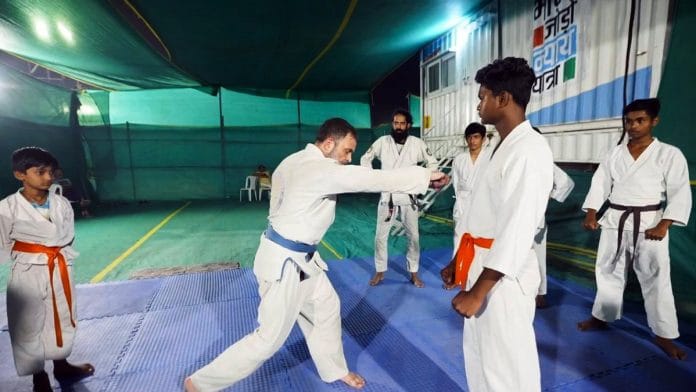

New Delhi: Learning to play the parai, a traditional drum associated with resistance to caste oppression in parts of southern India; staging Theatre of the Oppressed, a participatory performance form from Brazil linked to global Left movements; and practicing Jiu-Jitsu, a martial art built on technique, discipline, and self-defense. These exercises are part of a quiet but broader shift within the Congress party as Rahul Gandhi pushes to reframe its identity around social justice and the empowerment of ‘backward castes’.
What began as a refrain in his speeches is now shaping the party’s internal culture.
The change is being driven by the party’s training department, led by Gandhi’s close aide Sachin Rao. Once focused largely on organisational mechanics and electoral strategy, the programme has been recast significantly to reflect Gandhi’s vision of a Congress waging an ideological battle against the BJP-RSS.
The department’s 30-day leadership development programme, Netrutva Sangam, spread over three months, will also include training on election management, including voter list verification—a task carried out by booth level agents (BLAs) appointed by the party.
What has lent an ideological edge to the residential programme, as part of which workers also spend 10 days in Sevagram, established by Mahatma Gandhi in Maharashtra’s Wardha in 1936, is the incorporation of traditional and modern performance arts, steeped in symbolism.
Parai, for instance, is a percussion instrument traditionally played by the Dalit Paraiyan community in Tamil Nadu. Those who play it are known as Paraiyars (drummers).
In fact, the English word Pariah, used to refer to a person considered a social outcast, is derived from the Tamil term.
“One of the big elements of the programme is getting people to try things they have not done before. As part of that thought process, they are taught to play parai, use the charkha. Parai is taught in the first leg of the 30-day programme. Instructors also speak about the significance of the instrument as a symbol of emancipation from caste-based oppression,” Rao told ThePrint.
He described training on parai and charkha as practice tracks, which, he said, also includes learning the Theatre of the Oppressed and Jiu-Jitsu. Congress MP Rahul Gandhi, who is also Leader of the Opposition in the Lok Sabha, is a self-declared practitioner of the martial art with its roots in Japan.
Another example is the Theatre of the Oppressed, developed by Brazilian theatre practitioner Augusto Boal in the 1970s. It is a form of theatre considered a tool for social change through collective action. In this form of theatre, even the audience can intervene and are considered a part of the performance.
Over time, it became popular with various progressive movements globally. Rao said this form of theatre enables communities to narrate their own stories which the trained workers will facilitate. “They learn the technique, facilitate conversation and actually go into the community. It is taught during the second leg of the training programme.”
Jiu-Jitsu, on the other hand, is taught in the last 10-day sitting. It is a kind of self-defence training that discourages violent aggression and Rahul Gandhi holds a blue belt in it. It is also popularly known as the ‘gentle art’ for its emphasis on conflict resolution through non-violent self-defence techniques, such as grappling and pinning.
While the first 10-day sitting is held in Ghataprabha in Karnataka, the second session is held in Sevagram, and the last one is usually held in a state in northern India, Rao said.
Adding, “The idea is to offer leadership development experience to party functionaries and workers or those planning to join the Congress stream.
“It forces people to stretch their personal boundaries. It is not just about theoretical learning, but involves shram daam, engagement with the community.”
(Edited by Amrtansh Arora)
Also Read: Congress picks Khurshid to lead party’s foreign affairs wing, BJP ex-MP as vice-chair