



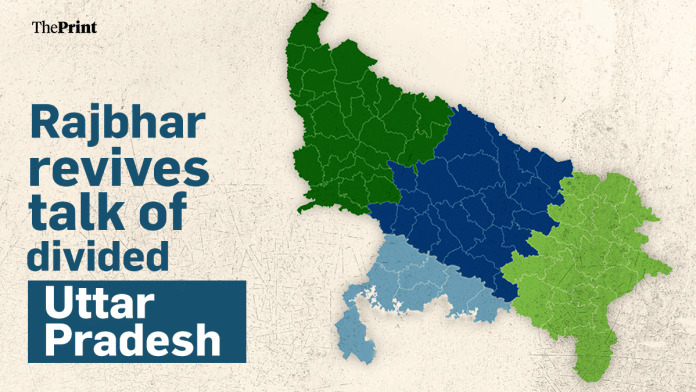
Lucknow: Assembly elections just around the corner, the long-standing political debate over dividing India’s most populous state and carving out four smaller states has resurfaced. It began with Suheldev Bharatiya Samaj Party (SBSP) national president Om Prakash Rajbhar claiming that Prime Minister Narendra Modi “assured” him that Uttar Pradesh will be divided into smaller states after a caste census is held.
Rajbhar, a minister in the Bharatiya Janata Party-led government in Uttar Pradesh, declared Sunday at the ‘Samajik Samrasta Maha Rally’ in Deoria: “The state will be divided into four parts. And on the day the Purvanchal state is formed, if the chief minister is to be from any caste, then a Rajbhar’s son will become the chief minister.”
Despite Rajbhar’s claim that the Prime Minister “assured” him, the central government has yet to confirm whether it has any plans to divide Uttar Pradesh.
Even before this, the demand to carve up Uttar Pradesh to improve governance has surfaced several times. In 2011, the Mayawati-led Bahujan Samaj Party (BSP) government had passed a resolution in the Assembly proposing that Uttar Pradesh be divided into four states: Purvanchal, Bundelkhand, Paschim (Harit) Pradesh, and Awadh Pradesh.
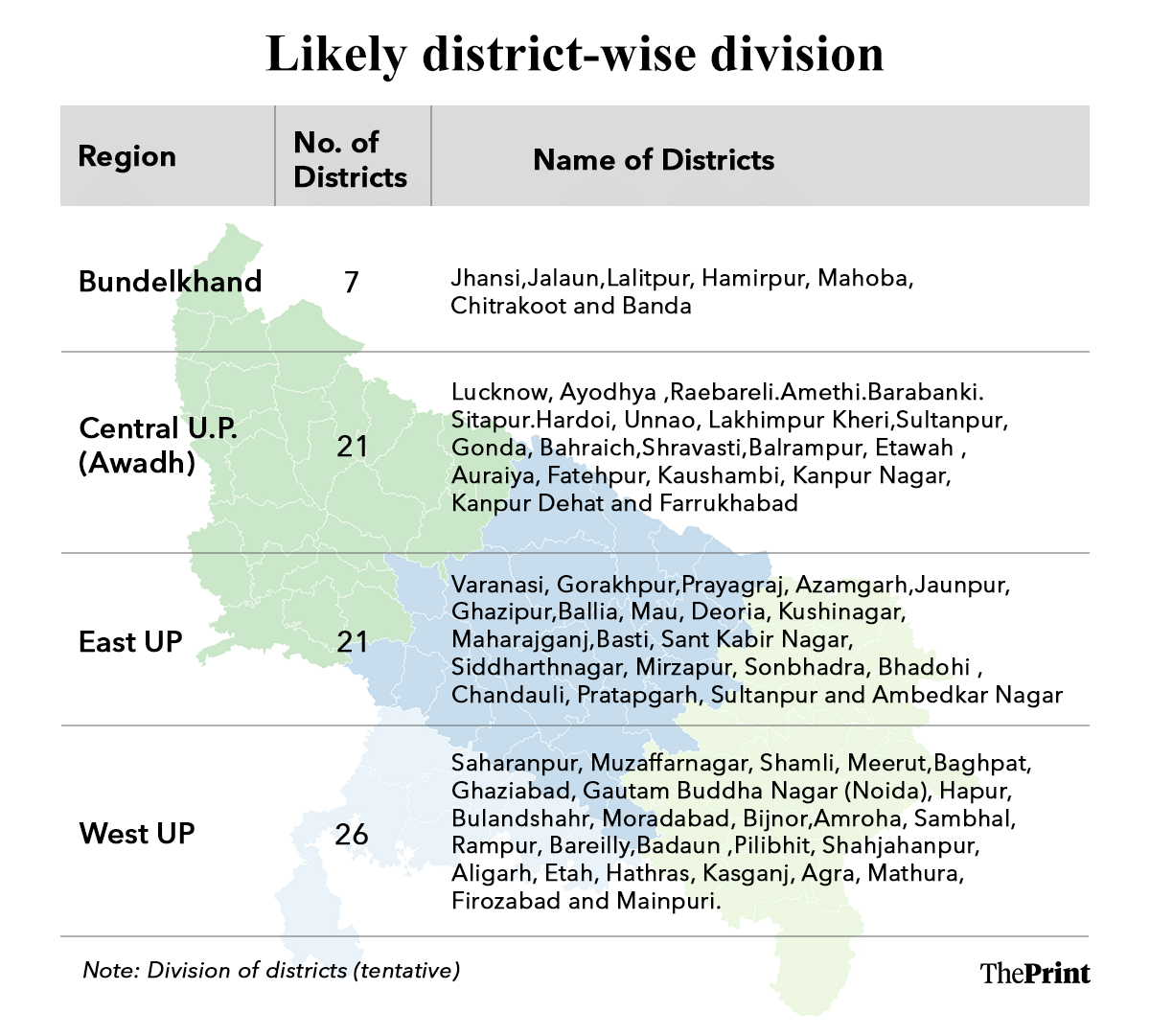
Under Mayawati’s proposed blueprint, Purvanchal would comprise 22 eastern districts, including Gorakhpur. Lucknow, the state capital, would fall under Awadh Pradesh, while Paschim Pradesh, or Harit Pradesh, would comprise western districts Meerut and Ghaziabad, among others. Bundelkhand would comprise the seven southern districts.
The proposal was subsequently sent to the President, but never received assent.
Rajbhar’s latest remarks also come against the backdrop of the political contest over the Extremely Backward Classes (EBC) vote in eastern Uttar Pradesh. His demand for a separate Purvanchal state and projection of a member of the Rajbhar community as its first chief minister is also being seen as part of his broader political positioning in the region.
ThePrint explains the political and social equations across the four proposed states, and which parties and communities have traditionally held influence in each.
Also Read: ‘Yogi’s law & order’ as centerpiece, RSS steps up ground work for UP polls in tandem with BJP
Western Uttar Pradesh (Paschim/Harit Pradesh)
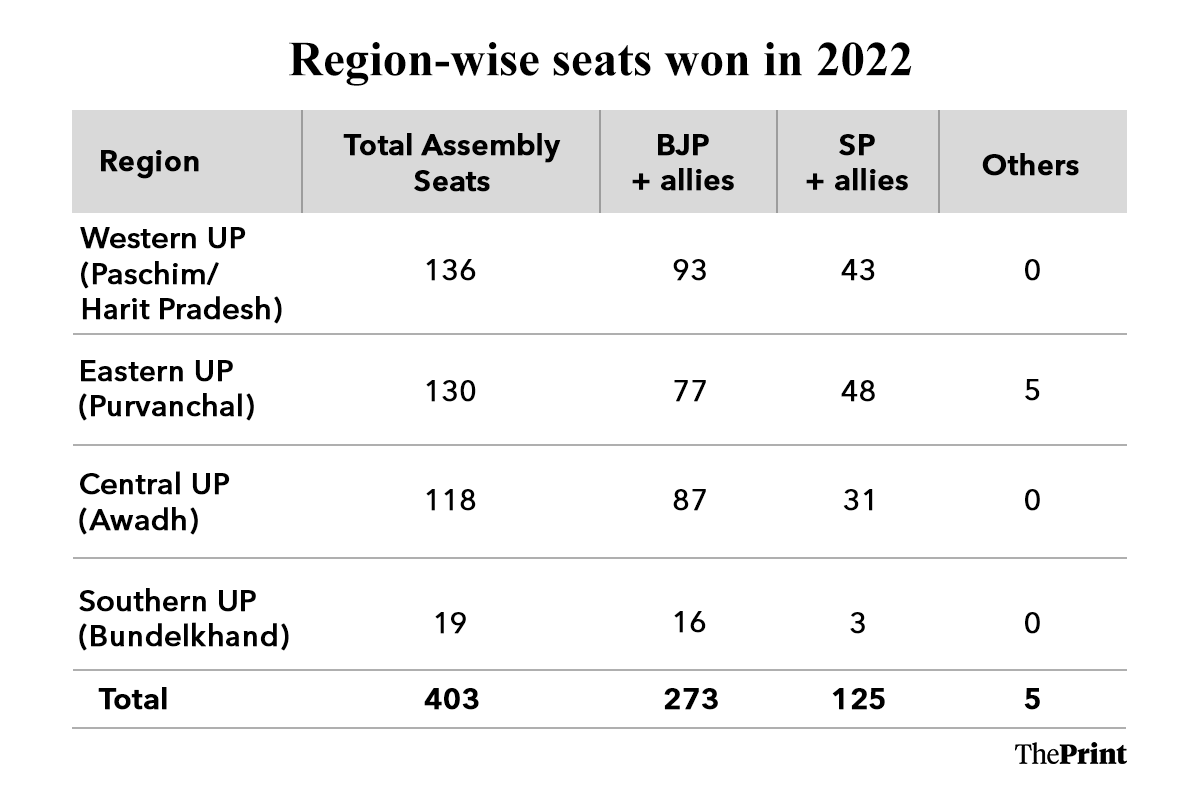
Western Uttar Pradesh covers at least 136 Assembly seats across 26 districts.
This region stretches from Ghaziabad and Gautam Buddha Nagar in the west to Bareilly and Shahjahanpur in the east. It also includes Saharanpur and Agra.
Referred to as Paschim Pradesh/Harit Pradesh in Mayawati’s plan, this region has a complex religious and caste composition. For instance, Muslims account for at least 25 percent of the population in several districts here, while Dalits constitute the largest social group among Hindus—approximately 18-20 percent of the overall population across the belt.
Within the Dalit community, Jatavs for a large chunk in western Uttar Pradesh.
Jats, Gurjars and Rajputs are among the other influential communities. Their concentration, however, varies considerably from district to district. Jats have a strong presence in districts such as Meerut, Muzaffarnagar, and Baghpat, and parts of the Braj belt, while Saharanpur and Bijnor have sizable Gurjar populations. The concentration of Muslims, meanwhile, is particularly higher in Rampur, Saharanpur, Moradabad and Meerut districts.
The region’s politics has revolved around combinations of Jats, Muslims and Dalits. The Rashtriya Lok Dal (RLD), BSP and Samajwadi Party (SP) have, at different points in time, attempted to build political coalitions around these communities.
When BSP’s Dalit base was strong, it benefited from these equations, while SP and RLD sought to consolidate Jat-Muslim support. The BJP’s position in western Uttar Pradesh changed significantly after 2014. The Muzaffarnagar riots of 2013 and subsequent political realignment among sections of Jats and other communities contributed to its rise in the region. But the 2022 Assembly elections signalled a drop in the BJP’s graph here.
Of the 136 Assembly seats in this region, the BJP won 93 in 2022, down from 110 in 2017.
The SP, meanwhile, increased its tally from 20 seats in 2017 to 43 in 2022, with the SP-RLD alliance at the time benefiting from the farmer mobilisation against the now-withdrawn farm laws and consolidation of sections of Jat and Muslim voters.
The BSP and Congress drew a blank in this region in 2022.
Lucknow-based political analyst Shilp Shikha Singh told ThePrint that western Uttar Pradesh was once a BSP stronghold, with Dalits and Muslims together accounting for over 40 percent of the population in several constituencies.
However, as Muslim voters increasingly shifted towards the SP alliance and a section of Dalit voters moved towards the BJP and other parties, the BSP’s traditional support base fragmented, weakening the party’s hold over the region, said Singh.
Southern Uttar Pradesh (Bundelkhand)
Bundelkhand, comprising 19 Assembly seats across seven districts in this regional classification, remains one of Uttar Pradesh’s most economically disadvantaged areas.
Here, Dalits constitute the largest social group among Hindus while Thakurs, Lodhs, Kurmis and Yadavs are among the other politically influential communities.
The region has historically been significant for the BSP because of its sizable Dalit population and political consciousness spurred by the Bahujan movement. Dalits constitute roughly 25 percent of the overall population here.
Bundelkhand was central to BSP founder Kanshi Ram’s early mobilisation efforts, to the extent that Konch in this belt was among the 13 seats the party won in 1989, when its candidates were first elected to the Uttar Pradesh Assembly.
The region’s caste politics has also been shaped by social conflict involving dominant communities and weaker sections. The rise of Yadavs added another layer. Post 2014, the BJP expanded its footprint by gaining a chunk of General and Dalit votes, besides a section of non-Yadav OBCs. Muslims account for 9-10 percent of the overall population here.
By 2017, the BJP brought a broad range of castes under the umbrella of Hindutva and emerged as the dominant force here. Along with its allies, it won all 19 seats in 2017.
In the 2022 Assembly elections, it retained its dominance in the region but lost three seats to the Akhilesh Yadav-led SP.
Central Uttar Pradesh (Awadh)
Awadh, or central Uttar Pradesh, has traditionally held great importance, electorally speaking. It is economically better placed than Bundelkhand and parts of Purvanchal.
Brahmins, Thakurs, Kurmis, Pasis and Yadavs are spread across the region. Among Dalits, Pasis (non-Jatavs) and not Jatavs are the dominant force here.
The Ram temple movement and the wider politics of Hindutva have had a significant impact on the region since Ayodhya is part of this belt.
Professor Kaviraj of the Department of Political Science at University of Lucknow told ThePrint, “Two communities are particularly important to understanding the region’s political fluidity: Pasis among Dalits, and Kurmis among OBCs.
“Neither community has historically followed a completely fixed voting pattern in favour of the BSP or SP. Instead, both have often aligned with influential local leaders and political formations. Later, the BJP became their first choice for a while before this ‘Samvidhan Bachao’ narrative in the 2024 Lok Sabha polls.”
Of the 118 Assembly seats in Awadh, the BJP won 71 in 2017, increasing its tally to 87 in 2022. The SP, too, made gains, from 9 seats in 2017 to 31 in 2022. The results showed that while the SP’s graph rose in the region, the BJP retained a significant advantage here.
Eastern Uttar Pradesh (Purvanchal)
In the current scheme of things, eastern Uttar Pradesh, or Purvanchal, is considered the most politically significant region in the state since it is home to Gorakhpur, political bastion of CM Yogi Adityanath, and Varanasi, Lok Sabha constituency of PM Narendra Modi.
The region’s caste equations are complex. Here, OBC communities are dominant, while Brahmins and Rajputs also play an important role in some constituencies. EBC groups, including Nishads, Rajbhars and Mauryas also play a significant role in determining electoral outcomes in districts like Mau, Ghazipur and Ballia.
After the 2014 Lok Sabha polls, a sizable section of non-Yadav OBC voters moved towards the BJP. Pasis, too, have increasingly consolidated behind the BJP in parts of this region.
Muslims account for roughly 18-20 percent of the population in this region, with relatively higher concentrations in districts such as Mau, Azamgarh and Jaunpur. However, the community has since 2014 shown a greater preference for the Akhilesh-led SP.
The BSP’s weakening organisational and electoral position has further narrowed Muslim voters’ options, strengthening the SP’s position in the region.
Purvanchal has 130 Assembly seats. The BJP won 115 of these seats in 2017, but its tally dropped to 77 in 2022. The SP, meanwhile, increased its tally from 17 seats in 2017 to 48 in 2022. This reflected SP’s improved position among sections of OBC and Muslim voters, although the BJP remains the single largest party in the region.
(Edited by Amrtansh Arora)