





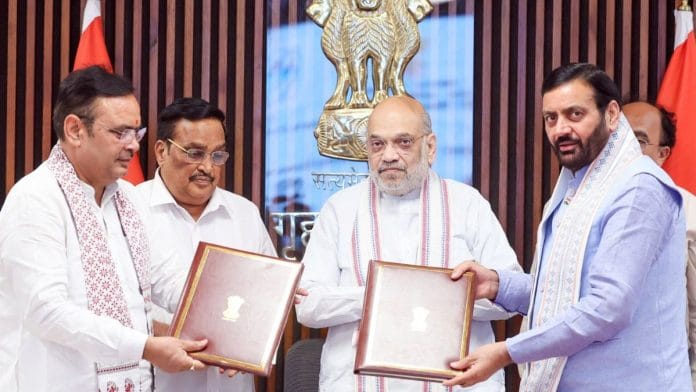


Gurugram: Haryana and Rajasthan Monday signed a Memorandum of Understanding (MoU) for the construction and implementation of the Yamuna Water Project, with Union Home Minister Amit Shah presiding over the ceremony in New Delhi.
This MoU will effectively allow Rajasthan to use the 1.119 billion cubic metres of Yamuna water allocated to it under the 1994 Upper Yamuna River Board agreement, through dedicated infrastructure.
The agreement drew immediate criticism from opposition parties, who questioned whether Haryana was giving away water it had not yet secured for itself.
Union Jal Shakti Minister C.R. Patil, Haryana Chief Minister Nayab Singh Saini, and Rajasthan Chief Minister Bhajanlal Sharma were present at the signing. Saini posted a video of the event with a post on his X, “Today, a historic water agreement (MOU) was signed between Haryana and Rajasthan in New Delhi under the chairmanship of the Hon’ble Union Home and Cooperation Minister Shri @AmitShah ji. As per the 1994 Upper Yamuna River Board agreement, water will be provided to Rajasthan, and the Renuka, Kishau, and Lakhwar dam projects will gain new momentum. This agreement is an important step towards water management, inter-state cooperation, and a water-secure future.”
Under the agreement, approximately 580 million cubic metres of surplus Yamuna water, available in Haryana between July and October, will be directed to Rajasthan through three underground pipelines from the Hathnikund Barrage via the Western Yamuna Canal.
The rest of the water for Rajasthan will be directed once the Renuka, Kishau, and Lakhwar dam projects are completed.
The pipelines, each with a diameter exceeding 3.6 metres, will supply drinking water to Sikar, Churu, and Jhunjhunu districts in Rajasthan and to Bhiwani and Fatehabad areas in Haryana.
Shah described the agreement as resolving a water dispute that had persisted for nearly three decades, calling it a vindication of Prime Minister Narendra Modi’s “solution through dialogue” approach.
He said the framework, prepared with the involvement of the Central Water Commission, incorporated cost-sharing arrangements, water release protocols, maintenance responsibilities, monitoring systems, and a dispute resolution mechanism.
“If states move forward with the spirit of cooperative federalism, even a problem persisting for three decades can be resolved easily,” Shah said.
The water that flows downstream unused during the monsoon season will now be stored in large ponds, which officials said would also help recharge groundwater levels.
Saini said multiple rounds of discussions had been held under Patil’s chairmanship before the MoU was finalised, and assured that Haryana would extend full cooperation in implementation.
Haryana Chief Secretary Anurag Rastogi was among the senior officials present.
‘Will oppose MoU tooth & nail’
After the announcement, INLD national patron and former finance minister Prof. Sampat Singh held a press conference at the party’s Chandigarh headquarters and said the party would oppose the MoU “tooth and nail”.
He argued that Haryana’s share of Yamuna water had already been whittled down, from roughly 8 billion cubic metres (BCM) under the pre-1994 arrangement to 5.730 BCM under the 1994 MoU, while the Renuka, Kishau, and Lakhwar-Vyasi dams envisaged under that agreement to augment Yamuna flows remain unbuilt more than three decades later.
Singh recalled that when the 1994 agreement was signed, all 17 INLD legislators had resigned from the Haryana assembly in protest under the leadership of the late Om Prakash Chautala.
हरियाणा के पानी के अधिकार को लेकर आज महत्वपूर्ण प्रेस वार्ता की।
इंडियन नेशनल लोकदल का स्पष्ट मत है कि भाजपा द्वारा कराया गया हरियाणा–राजस्थान जल समझौता प्रदेश के हितों और अधिकारों के विरुद्ध है। हम इस समझौते का पुरजोर विरोध करते हैं और हरियाणा के पानी के हक की रक्षा के लिए हर… pic.twitter.com/OZwBE5tjAe
— Prof. Sampat Singh (@ProfSampatSingh) June 29, 2026
He said a party meeting under Abhay Singh Chautala would soon decide the next course of action.
Leader of the Opposition Bhupinder Singh Hooda questioned the timing and sequence of the agreement.
When contacted, Hooda told The Print that before committing Yamuna waters to Rajasthan, the Haryana government should first have ensured the state’s own share of water through the Sutlej Yamuna Link canal, a decades-old dispute with Punjab that remains unresolved despite repeated Supreme Court directions in Haryana’s favour.
Hooda also raised the Hansi-Butana canal issue. Since 2011, the Supreme Court has maintained an ad-interim injunction restraining Haryana from rupturing or “puncturing” the Bhakra Main Line to draw water into the 109-kilometre Hansi-Butana multipurpose channel — water Hooda described as Haryana’s existing allocation from the Bhakra system, with no stake of any other state in it.
Punjab has opposed the move, arguing it could threaten its own supplies and pose safety risks to the BML.
The case remains sub-judice.
“The BJP government has never made any efforts to get the stay on puncture of the BML vacated from the Supreme Court,” Hooda said.
(Edited by Gitanjali Das)