





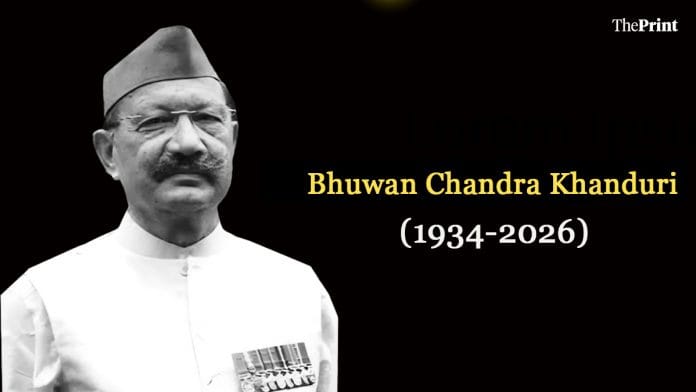


New Delhi: BJP veteran and former Uttarakhand chief minister Bhuwan Chandra Khanduri, who transitioned from a successful military career to politics and played an instrumental role in executing the Golden Quadrilateral Project, died on Tuesday after prolonged illness. He was 91.
He was undergoing treatment at a Dehradun hospital.
Born on 1 October 1934 in Dehradun in the present-day Uttarakhand, and a nephew of former Uttar Pradesh chief minister Hemvati Nandan Bahuguna, Khanduri had a distinguished three-decade career in the armed forces that culminated in him being conferred with the Ati Vishisht Seva Medal (AVSM) in 1982.
In 1991, the former Corps of Engineers officer, Lt Gen (Retd) Khanduri made a remarkable transition, venturing into politics. He contested the 1991 Lok Sabha elections from the Garhwal constituency as a Bharatiya Janata Party candidate, and emerged victorious.
But the former army officer could not retain the seat in the 1996 polls, losing to the Congress’s Satpal Maharaj. But, he subsequently won the seat four more times: 1998,1999, 2004 and 2014.
It was not only his political victories, but his stringent emphasis on discipline, integrity and effective governance that catapulted him to become one of the icons of Uttarakhand politics and a dependable BJP leader.
Khanduri’s most significant governmental contribution was the successful execution of the much celebrated Golden Quadrilateral project as the minister for road transport and highways in the Atal Bihari Vajpayee-led government.
उत्तराखंड के पूर्व मुख्यमंत्री मेजर जनरल भुवन चंद्र खण्डूडी (सेवानिवृत्त) जी के निधन से अत्यंत दुख हुआ है। सशस्त्र बलों से लेकर राजनीतिक जगत में उन्होंने बहुमूल्य योगदान दिया, जिसके लिए उन्हें सदैव याद किया जाएगा। उत्तराखंड के विकास के लिए वे हमेशा समर्पित रहे, जो मुख्यमंत्री के… pic.twitter.com/JNhgOsj0eY
— Narendra Modi (@narendramodi) May 19, 2026
The monumental project transformed the country’s road transport system by connecting four major metropolitan cities situated on four different ends of the geographical compass: Delhi (in the north), Mumbai (west), Chennai (south) and Kolkata (east).
The project boosted the infrastructural, logistical and economical development of India at a time when the country was just spreading its wings as a fast-growing economy.
He also played a key role in implementing the National Highways Development Programme, a project of four-laning of existing national highways and six-laning of selected highways.
Khanduri resigned as a Member of Parliament in 2007 to helm Uttarakhand as the chief minister, his first term in the post. His tenure saw sustained internal conflict with BJP leader Bhagat Singh Koshiyari.
Yet, he somehow survived with the party’s continued support. But that support ran out in 2009 with the BJP’s poor performance in the 2009 Lok Sabha elections.
He was replaced by Ramesh Pokhriyal ‘Nishank’. However, ahead of the 2012 elections, the BJP brought Khanduri back amid allegations of corruption against Nishank and a groundswell of support marked by the slogan “Khanduri hai zaruri”, reflecting the high regard he commanded within the party.
प्रदेश के पूर्व मुख्यमंत्री आदरणीय मेजर जनरल भुवन चंद्र खंडूरी (सेवानिवृत्त) जी के निधन पर उनके देहरादून स्थित आवास पर पहुंचकर उन्हें श्रद्धांजलि अर्पित की तथा उनकी पुत्री, माननीय विधानसभा अध्यक्ष श्रीमती @RituKhanduriBJP जी व शोकाकुल परिजनों को सांत्वना देते हुए अपनी संवेदनाएं… pic.twitter.com/u1aNiUZNsa
— Pushkar Singh Dhami (@pushkardhami) May 19, 2026
But the BJP lost the polls narrowly, and Khanduri too could not defend his Kotdawr Assembly seat. The Congress formed the next government in the state.
Khanduri moved to national politics again, fighting the 2014 Lok Sabha elections from the Garhwal seat. He defeated the Congress’s Harak Singh Rawat.
In the first Modi Cabinet, he was appointed the chair to the Parliamentary Standing Committee on Defence between September 2014 owing to his experience in the armed forces.
But in August 2018, he was removed from the post, with the Congress alleging the BJP insulted its senior leader, while the ruling party said he was replaced due to health reasons.
(Edited by Ajeet Tiwari)
Also Read: How Uttarakhand CM Dhami is emerging as another Hindutva poster boy