





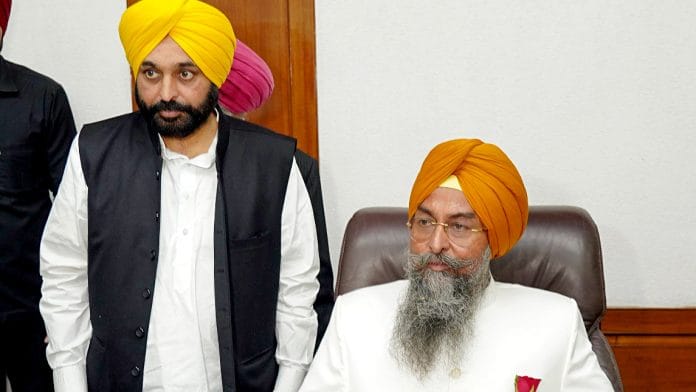


Chandigarh: The Akal Takht, the highest temporal body of the Sikhs, has summoned the Speaker of the Punjab Vidhan Sabha, Kultar Singh Sandhwan, on 8 May to explain his position in the House passing vital amendments to the Jaagat Jot Guru Granth Sahib Satkar Act, 2008.
Addressing a press conference following a meeting of representatives of multiple Sikh bodies, the Jathedar of the Akal Takht, Giani Kuldip Singh Gargajj, said that the Act was passed “completely bypassing” the Akal Takht, despite the temporal body and the Shiromani Gurudwara Prabandhak Committee (SGPC) suggesting that they be consulted by the Punjab government.
“However, the government chose to ignore the Akal Takht, which is the central institution that safeguards the Sikh religion and the mardaya (code of conduct). This is unacceptable. Most of the representatives of the Sikh bodies which met today were of the view that the Act should be rejected by the Akal Takht. Before taking any action on the demand of the Sikh bodies, it was decided that the speaker be summoned to the Akal Takht to explain his position,” said Gargajj.
On 13 April, the Punjab Assembly had, during a special session called on Baisakhi, passed the Jaagat Jot Sri Guru Granth Sahib Satkar (Amendment) Bill, 2026 that provides for stricter punishments for the sacrilege of the Guru Granth Sahib, considered to be a living guru by the Sikhs. A week later, the Bill was given assent by the Governor.
2008 law & the amendment
The original 2008 Act was largely regulatory in nature, aimed at controlling the printing and distribution of the Guru Granth Sahib by anyone other than the SGPC, the regulatory body of Sikh gurdwara. The 2026 amendment transforms it into a penal statute to deter anyone disrespecting it.
The law, notified in June 2008 when the Shiromani Akali Dal-BJP combine was in power in the state, provided for the prevention of “printing, publication, storage, distribution of supply of the Guru Granth Sahib by any authority or body beyond the SGPC”, with the only penalty being a two-year imprisonment and fine.
The amended law has introduced the element of sacrilege in the Act, prescribing a graduated but severe punishment regime with punishments ranging from seven years to life imprisonment, and fines ranging from Rs 2 lakh to Rs 25 lakh.
The amendment has also introduced a system of custodial responsibility—defining “custodian” as any individual or institution responsible for the care of a Saroop (authorised copy) of the Guru Granth Sahib—and imposes a legal duty to ensure its protection.
Gargajj said Sunday, “We have no objection to the government bringing in provisions that relate to sacrilege and giving harsher punishments to the culprits. But on questions of regulating the printing and distribution of Guru Granth Sahib, who is a living Guru for us, the government should have consulted us, and only then gone ahead with any changes. The Speaker has been asked to be present on 8 May and explain the motive of the government behind the move.”
The Jathedar also objected to the use of the word “custodian” for anyone doing seva (spiritual service) of Guru Granth Sahib.
“Nobody can be the custodian of the Guru. He is our custodian. We are sevadars. The government cannot be expected to even use the correct language to refer to the Guru in this Act. Also, how can trackers be installed in the Guru Granth Sahib? He is our Guru. And then the government wants us to make public information of every person who has been provided the Guru Granth Sahib. Will that information not facilitate sacrilege? The government and its representatives have no idea how to maintain and uphold the maryada of the Guru,” he added.
On Thursday, the SGPC suspended providing Sri Guru Granth Sahib to sangat (devotees) and Gurdwara Sahibs until 20 May in view of the amendment to the 2008 Act.
Political implications
The summoning of the speaker by the Akal Takht is also politically significant. The passing of the Amendment Act has been hailed as a “game changer” by the ruling Aam Aadmi Party (AAP) ahead of the assembly elections expected to be held early next year.
During the special session of the Vidhan Sabha held Friday, the treasury benches led by Chief Minister Bhagwant Mann passed a resolution patting his own back in having succeeded to legislate against sacrilege—an issue that has dominated state politics for over a decade. Mann also announced that he would lead a four-day “Shukrana Yatra” across Punjab starting Wednesday.
The summoning of the speaker by the Akal Takht in the middle of the yatra is expected to dampen the ruling party’s self-congratulatory stance.
(Edited by Mannat Chugh)
Also read: Panthic tug-of-war: Akal Takht’s summon to Punjab CM Mann & case of the missing saroops