



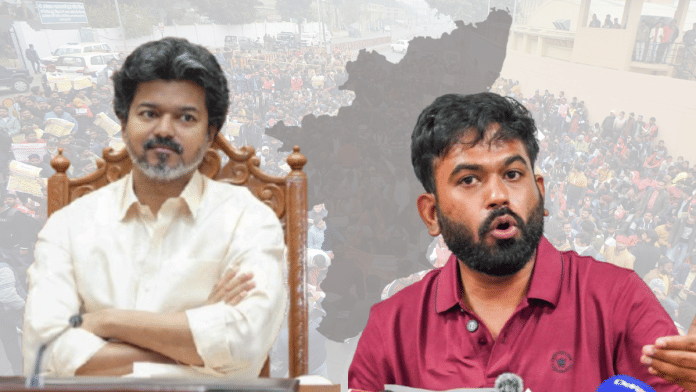
Chennai: With the Cockroach Janta Party (CJP) openly criticising the welfare and governance measures of the Tamilaga Vettri Kazhagam (TVK) , the rivalry is seemingly becoming a contest between two entities that majorly draw support from the young population including those from Gen Z.
CJP founder Abhijit Dipke in his speech at the “People’s Tribunal” protest in Bengaluru on 8 October 2026, openly pointed fingers at TVK’s assembly election win and alleged that SIR was used to bring down the governments led by Pinarayi Vijayan (Kerala) and MK Stalin (Tamil Nadu). He claimed that Vijay became the chief minister of Tamil Nadu due to vote theft or rigging caused by the Special Intensive Revision (SIR), and that DMK and Stalin lost because of it.
Though not a political party, the CJP has shared some common political ground with the opposition Dravida Munnetra Kazhagam (DMK). It can utilise the opportunity to criticise the TVK as a move to position itself independently in Tamil Nadu.
CJP functionaries and its South India leadership have publicly questioned the pace, originality, and delivery of the Vijay government’s key promises such as employment guarantees and education reforms to the rebranding or partial rollout of schemes such as free or subsidised LPG cylinders, gold ring for newborns scheme, and loan relief.
In several instances, the CJP has come out on X to slam the government’s several initiatives as cosmetic renaming of earlier programmes or as falling short of the transformative agenda.
They also highlighted earlier friction, including a short-lived Tamil Nadu government directive, later withdrawn after backlash, that sought to discourage students and youth from joining protests organised by Left parties and CJP.
The directive was issued by the Directorate of Collegiate Education in August to principals of higher education institutions, asking them to take “appropriate action” to prevent students from participating in protests organised by the Left parties and the CJP.
This directive, the CJP has been saying, was unconstitutional and out of step with the very generational politics that the TVK once championed. It argued that a government born of Gen Z aspirations cannot treat independent youth mobilisation as a threat.
The Abhijeet Dipke-led CJP rapidly grew into a nationwide Gen Z-driven protest movement focused on unemployment, the National Eligibility-cum-Entrance Test (NEET) exam integrity, and institutional accountability, and now presents itself as the true patron and continuing voice of that generational surge. However, in Tamil Nadu, it finds very minimal presence with support only Left student groups such as the Students’ Federation of India (SFI) on issues such as the Special Intensive Revision (SIR)-related agitation.
“We are neither a fan of anyone nor a rival. CJP views the TVK government as one holding a lot of hope because the youngsters supported it. The order discouraging students from participating in protests was withdrawn and it is good that they are learning their lessons,” CJP national organisation co-in-charge Deepak Baliyan told ThePrint.
“We will also welcome the schemes that benefit the people, especially youngsters, but we will not hesitate to criticise them if their schemes and policies are only populist but limit or restrict the youngsters from asking for their rights. The concerns of youngsters in Tamil Nadu remain in focus.”
On the other hand, the TVK has attracted national attention with Chief Minister Vijay’s star power and echoes of party leaders proposing him as a future prime minister. The TVK also claims to have a major Gen Z backing, with party functionaries arguing that more than 60-65 percent of supporters are youngsters below the age of 30.
The TVK had rode a wave of youth disillusionment with the long-dominant Dravidian parties, making “change” the motto for the 2026 Tamil Nadu elections. Its IT wing points to early administrative moves, alliance-building, and scheme launches as evidence of its seriousness.
TVK national spokesperson Felix Gerald said that the party will not respond to the CJP’s criticism and comments for now.
Political analyst Sunil Kumar explained that Tamil Nadu politics largely revolves around regional issues. “The electoral politics in the State did not focus on issues like corruption for many years but now we see the regional aspirations centering on the same. It is mainly due to youngsters.”
The CJP-led politics with a focus on student involvement in politics is not what Tamil Nadu political parties follow, he explained to ThePrint. “Tamil Nadu has seen this culture of protest driven by demand and supply in cases like the anti-Hindi protests or Jallikattu protest and this is why the CJP may find relevance and popularity in the state in the coming years.”
As CJP continues national campaigns on electoral processes and youth issues, Vijay’s silence on these matters has also been questioned by the DMK. Political commentator Arun Kumar said that the CJP needs to come out of the DMK’s shadow if it wants to expand in Tamil Nadu.
“The TVK government’s criticism is a good start for the CJP as it is attacking politically but the government is not responding to it, as per its usual response strategy,” Kumar said.
“Once the TVK responds, the CJP will surely gain momentum in Tamil Nadu. Most CJP affiliates in Tamil Nadu are Left-wing supporters, and are seen as an ally of the DMK, which is a hurdle for independently building support.”
(Edited by Tony Rai)
Also Read: Five rollbacks of govt orders in four months. Is bureaucracy driving Vijay’s TVK administration?