



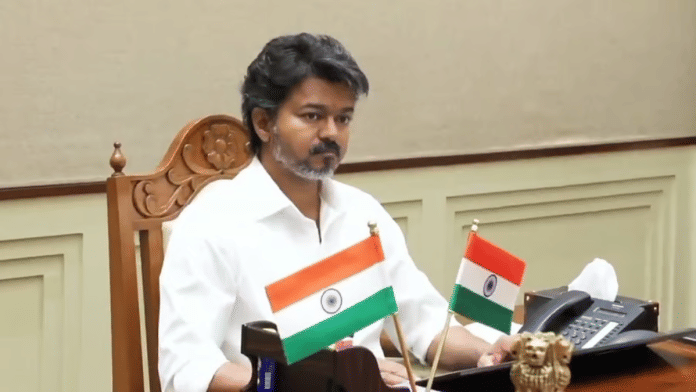
Chennai: The Tamilaga Vettri Kazhagam (TVK) administration is facing the Opposition’s barb of a ‘U-turn government’, after it reversed five orders within four months of assuming office.
The latest volte-face pertains to the government order (GO) exempting the public (law and order) department—that was declared an intelligence and security organisation—from the purview of the Right to Information (RTI) Act.
The order, various stakeholders said, lacked transparency for a government that claims to ensure transparent governance. The department deals with issues pertaining to policing, public order and law-and-order administration.
The repeated reversals have led to critics pointing out at what they called an administrative inconsistency. While withdrawal and corrections of government orders are not uncommon for a new government, its frequency has raised questions about the decision-making process within the TVK administration and the balance of power between the political executive and the bureaucracy.
And, it is not just the opposition parties who are criticising Chief Minister C. Joseph Vijay and his party. Even the TVK allies, including the Congress, are questioning whether the now withdrawn decisions were taken by the political leadership or driven largely by officials.
Among the orders withdrawn is the one on the appointment of Special Officer of Vijay’s personal astrologer Radhan Pandit Vettrivel. The government had notified the posting but later cancelled following criticism from the opposition and allies.
The administration also cancelled a circular concerning restriction of protests by Left student organisations in Tamil Nadu after nationwide protests arose over the National Eligibility-cum-Entrance Test (NEET) discrepancies. The circular, which had sought to regulate or restrict certain forms of campus agitation, was rolled back after facing opposition from student groups and political parties.
Another circular that was revoked related to the enumeration of Communist Party members. Issued in August, the tahsildar of Guziliamparai taluk in Dindigul district had directed village assistants and revenue inspectors to collect the names and addresses of members and leaders of the Communist Party of India and the Communist Party of India (Marxist) in every revenue village under the taluk.
The circular warned that action would be taken against those who failed to comply. The order reportedly arose in the context of a land dispute involving CPI(M) workers in Chinnaravuthanpatti village in the same taluk and triggered strong political reactions.
Then, the TVK government withdrew land acquisition proceedings for the Melma SIPCOT project. The decision to acquire land for the industrial park had met with local resistance and legal concerns, prompting the administration to cancel the related government order.
After the order on exemptions under the Right to Information (RTI) Act was revoked, even TVK allies offered advice to the government to ensure that the administration needs to be handled differently.
Glad this has been revoked. My unsolicited & friendly advice to the @TVKVijayHQ Government & @CMOTamilnadu don’t let bureaucrats set the tone, tenor & direction of the administration. https://t.co/LbMgZvSdVy
— Karti P Chidambaram (@KartiPC) September 27, 2026
On Sunday, Congress leader Karti P. Chidambaram offered friendly advice to the TVK leadership on X. The chief minister, he posted, should not let bureaucrats set the tone, tenor and direction of the administration.
The opposition Dravida Munnetra Kazhagam (DMK) points out at the inexperience of the TVK government calling these orders as a move to divert the public’s attention from ground issues to these topics.
DMK spokesperson Syed Hafeez told ThePrint that the revoking of orders time and again is an outcome of “a clueless government and an inexperienced chief minister”. The government can make mistakes but then this cannot occur so repeatedly, he added.
“The GO on the appointment of K. Venkata Narayana as the Special Representative of the Government of Tamil Nadu in New Delhi by the TVK government came up when the TVK minister Sarath Kumar’s old video of using a white powder during an IPL match surfaced. So the government uses such orders to divert the real issues,” he added.
“September 27 was one year since the Karur stampede tragedy but this GO became the point of discussion. Whether it is deliberate or a coincidence, TVK’s inexperience is clear.”
Political analyst Sunil Kumar construed the pattern of withdrawals as an indication that a significant power rests with the bureaucracy.
“Policy decisions, reforms and implementation can only be suggested by bureaucrats but they should also consider the public perspective. It is not a sign of good governance if power is in the hands of bureaucrats and public opinion is not considered,” he told ThePrint.
The government should be cautious before an order is issued and at least a discussion with allies is important to understand the ground reality, and assess the ground reality, he asserted. “Especially when it is a new government, the responsibility becomes even more important .”
Critics and political commentators also questioned the decision making capacity of the government pointing out the inexperience and political atmosphere in TVK.
Academician and political commentator Ramu Manivannan said that since decision making capacity comes with experience, the TVK lacks that competence. “They do not have experienced leaders who assess these issues and making policy decisions properly. It is not surprising that so many decisions were revoked,” he told ThePrint.
“It is a very unfortunate situation with the governance. They might make popular decisions in terms of populist schemes to woo the public but they are not making significant policy decisions as part of governance. They do not have dignity in reversing these major decisions as well.”
Political analyst A. Ramasamy said that the government should involve multiple agencies while bringing out an order that impacts the public. The announcement of the new secretariat in Pattinapakkam is one such example, he told ThePrint.
“The legal authorities, civil servants, economists, academicians, activists, non profit organisations, and other stakeholders related to a particular field need to be consulted before a decision is made and an order is drafted,” Ramasamy told ThePrint.
(Edited by Tony Rai)
Also Read: What’s behind Left parties’ decision not to go with Vijay’s TVK-led alliance in bypolls