







On a quiet morning, a small crowd had gathered at Drigh Road Airport in the bustling port city of Karachi.
Parked on the aerodrome was a beautifully designed, red-and-white de Havilland Puss Moth – a monoplane no bigger than a medium-sized car. Tucked inside it was about 55 pounds of mail and its pilot.
At precisely 6:30 a.m., the engine roared to life, and the marvel took to the air. It was 15 October 1932.
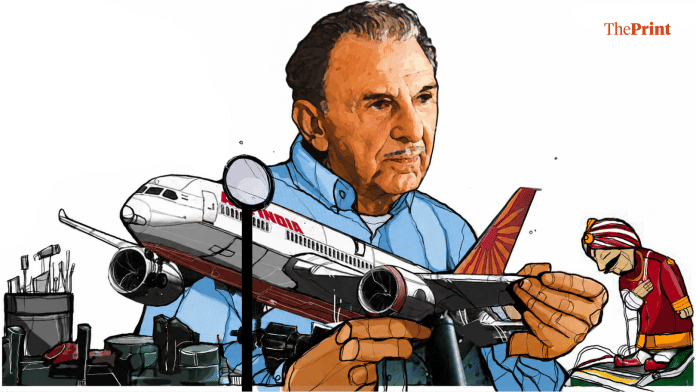
And the man flying it was none other than JRD Tata, today celebrated as the father of Indian civil aviation.
Years later, recalling that morning, JRD Tata said, “As we hummed towards our destination at a ‘dazzling’ hundred miles an hour, I breathed a silent prayer for the success of our venture and for the safety of those who would work for it.”
There was, after all, no grand airline yet.
Just two planes, three pilots, one of whom was JRD Tata himself, three mechanics, and a dream that was still taking its first, uncertain flight.
That was how the story of Air India began.
Almost a century later, Air India has passed through multiple metamorphoses – private ownership, nationalisation, bureaucratic control, bailouts and rebirths, and finally, a long-awaited homecoming to the Tatas.
Yet, somehow, the Maharaja remains. A little of that old charm, the old aura, survives. Unfortunately, it has also become a symbol of how the old world is refusing to keep up with the times.
And Air India is never, not in the headlines.
From the horrific Ahmedabad crash last year, to one of its pilots testing positive for marijuana, to endless corporate “Game of Thrones” at the top – from a new foreign CEO to former chairman N. Chandrasekaran announcing his exit – the airline’s journey has been bumpy.
When a dream became a reality
The beginning of civil aviation in India is associated with one name – JRD Tata. But the first sparks of the revolution were lit by Nevill Vintcent, whom B.M. Lala, in Beyond the Last Blue Mountain, described as the “Indian JRD Tata.”
Vintcent, a former Royal Air Force officer, had come to India in the late 1920s. Around the same time, Britain’s Imperial Airways was planning an air service from London to Karachi, beginning in April 1929.
That’s when he hatched a plan for extending air connectivity between Karachi and Bombay.
Surprisingly, JRD Tata was not his first choice. Vintcent initially approached Russa Mehta, son of textile magnate Sir Homi Mehta. When nothing beneficial came out of that meeting, he turned his attention to JRD – and in 1929, the two men met. It was a match made in heaven – Vintcent had the idea, while JRD had the passion, the name and the willingness to make it happen.
But enthusiasm alone could not get an airline off the ground. Under British rule, indigenous industry faced systematic constraints, and starting an airline from scratch felt like an impossible dream.
The first task, however, was to convince Tata Group chairman Sir Dorabji Tata. It was also the year of the Great Depression, and the Tatas were feeling the economic strain.
A whole gamut of choices was to be made. Routes to plan. Whether to opt for a normal plane or a seaplane? Carry mail or passengers? Or perhaps both?
And then there was the government. For three long years, the British-ruled Government of India kept dilly-dallying, seemingly reluctant to allow an Indian firm to enter the airline business, wrote Harsh Bhat in #TataStories: 40 Timeless Tales to Inspire You.
Finally, on April 24, 1932, the breakthrough came – the deal was sealed.
But the victory came with strings attached – the venture could not be entirely “Made in India” in spirit. Government aerodromes, ironically, built on Indian soil, could be used without restriction. The aircraft and personnel had to be British.
JRD pressed ahead. He travelled to England and purchased two Puss Moths. The route was set – Karachi-Ahmedabad-Bombay, later extending to Madras via Bellary.
On the morning of 15 October 1932, as the little Puss Moth rose into the air, so did the beginnings of a new saga – the very first signs of a modern India.
Tata Air Mail was born. It was India’s first-ever commercial flight, and through the roar of that single engine, the country’s beloved Maharaja Airlines was born.
At Ahmedabad, the aircraft stopped to refuel, and a lone bullock cart, carrying four gallons of petrol, laboured its way to the runway. After hours of flying through heat and turbulence, and a bird flying into the cabin, forcing JRD to kill it, finally at 1:50 p.m., the Puss Moth touched down in Bombay.
In its 1933-34 report, the Directorate of Civil Aviation praised Tata Services for completing its first year with “100% punctuality,” through the difficult monsoon months.
Slowly, new routes opened up, aircraft grew bigger, and the airline eventually welcomed its very first passenger.
Profits, though modest, followed. By 1946, Tata Air Lines was carrying roughly one out of every three air passengers in India.
The same year, with his prominent nose, handlebar moustache and unmistakable striped turban – the Maharaja made his royal debut.
The brainchild of Bobby Kooka, Air India’s Commercial Director, the Maharaja was “funny, irreverent, and up to antics,” writes Harsh Bhat, “but always full of India, his proud homeland.”
Kooka was constantly reinventing the Maharajah, wrote Bhat, “as a lover boy in Paris, a sumo wrestler in Tokyo, a Romeo in Rome, and a guru of transcendental meditation in Rishikesh.”
To distinguish itself from the deep-pocketed airlines, Air India turned to niche advertising, creating hoardings so bold and unapologetically satirical that they often courted controversy. Bhat writes that JRD would later admit that these hoardings “demolished and punctured innumerable egos” – and earned him the wrath of many MPs.
Another hoarding introducing non-stop flights to Paris read “Romancing Paris, non-stop,” with a portrait of the Monalisa flaunting the Maharaja’s iconic moustache.
The hoardings proved so provocative that their controversy eventually spilled over into Parliament.
Taking the Maharaja to foreign skies
Yet amid the chaos, JRD put before the government his proposal for an international airline – Air India International. Within weeks, the government gave it the green light.
The proposal soon came up in the Constituent Assembly. On 12 December 1947, India’s first Minister of Communications, Rafi Ahmed Kidwai, revealed that the State would acquire a 49% stake in the company.
To which Ananthasayanam Ayyangar, a freedom fighter and member of the Constituent Assembly, asked, why only 49%?
It was the very first seed of bureaucratic intervention that would grow massively in the decades to come. For now, however, Air India was about to capture the foreign skies.
Air India International was formally incorporated on March 8, 1948.
Exactly three months later, on June 8, a gleaming Lockheed Constellation, the Malabar Princess, stood on the Bombay tarmac, ready for its maiden flight to London.
JRD later recalled that the sight that moved him most was “Seeing the Indian flag displayed on both sides of the Malabar Princess as she stood proudly on the apron at the airports of Cairo, Geneva and London.”
On every flight, he walked the aisles with keen eyes, scribbling notes about the colour of the tea, the temperature of the food, the beer being served and even the hairstyles of air hostesses.
Road towards nationalisation
But a quiet discord was beginning to brew, the first signs of which appeared in 1949.
JRD and Communications Minister Rafi Ahmed Kidwai found themselves on opposite sides over a proposed Night Mail Service. (One short line about the night mail service) “Tata comes out against resuming Night Air Service,” read an Indian Express headline dated 24 September 1949, with JRD calling the proposal “ill-advised.”
Kidwai made his case plainly. In a letter to JRD, on 29 September 1949, he wrote, “I’ve been anxious for night service not only because it will provide facilities for quicker exchange of mail between cities but also to attract more traffic to air transport.”
JRD, however, remained unmoved. In this first clash between the Maharajah of aviation and the government, as B.M. Lala wrote, the Minister won. It was, perhaps, an early warning.
Just a few years later, a chilling sense of déjà vu set in. JRD found himself at loggerheads with the Ministry once again.
India’s aviation sector was struggling, kept afloat by heavy government subsidies and war-surplus Dakotas. As the tide of centralisation gathered force, the Cabinet, in a dramatic turn of events, decided to nationalise the country’s struggling private airlines.
On 20 April 1953, Parliament took up the Air Corporations Bill. The proposal?
Acquisition of the private airlines and creation of two State-owned entities instead – Air India International and Indian Airlines Corporation. What followed was more than a debate over airlines. It was a fight over who should control India’s skies – the State or private enterprise? And who would ultimately pay for it – the taxpayer, the workers, the consumer or the airline owners?
Introducing the Bill, Jagjivan Ram, then Civil Aviation Minister, said, “Air transport is a public utility and ought to be developed in the national interest unhampered by the paramount necessity of making a profit.”
Yet even in nationalising the airlines, the government was not oblivious to the sheer magic surrounding the Air India name. Jagjivan Ram defended retaining the “Air India” name because of the “enviable reputation” it had built abroad. Rallying behind him, Congress MP Dr. S.N. Sinha praised the airline’s global prestige, arguing that its flights did more for India’s image abroad than “the work of our Embassies in Central Europe.”
But not everyone was convinced. Kerala Congress MP K. Kelappan delivered a classic Shakespearean jab, “I ask, what is there in a name?”
Inside the Parliament, the air soon turned bitter.
Taking centre stage in the opposition, MP Renu Chakravartty launched the sharpest attacks on the government, accusing it of staging a sham nationalisation – that rewards mismanaged private capitalists, all at the taxpayer’s behest.
“As we read through the Air Corporations Bill, we found it was a fraud of the first water – a deception…” she said. “God save us from these looters of the nation because their record has been disastrous.”
Her parting words were even more direct: “Let it not be said that the Government is the government of Tata and Birla and has come to save their profits.”
Kelappan, however, welcomed State control, arguing that airways were “a second line of defence.” Yet, he argued that a single corporation would make more sense for “unity, harmony, economy and efficiency.”
In Mumbai, JRD watched the proceedings with deep anguish. His greatest fear was that merging Air-India International, into which he had poured two decades of work, with less efficient domestic carriers would damage the reputation he had spent two decades building.
When he met Jawaharlal Nehru over lunch in Delhi, his distress was evident. Within days of his return, Nehru wrote to him. “My dear Jehangir,” he began, “I was very sorry to notice your distress of mind…” Nehru was particularly dejected by JRD’s suggestion that there was a planned conspiracy to suppress private civil aviation.
Ending on a more personal note, he wrote: “We want your help in this and other matters.” Nehru later asked JRD to continue as the Chairman. JRD agreed, and did so without taking a salary.
With the President’s seal, the Air Corporations Act came to life. Air India was now in government hands. And just like that, JRD lost control of his brainchild.
On 31 July 1953, a day before the takeover, JRD sent a message to the staff of Air India and Air India International.
“And now the time has come to say goodbye.”
There was no bitterness in his farewell. He wrote that they could take comfort in knowing “that what we did was worth doing, that we set our standards high and would not lower them…”
Contrary to the popular belief that nationalisation was simply a radical Marxist power grab, journalist Vir Sanghvi told ThePrint that government ownership of airlines was hardly unusual at the time. Outside the US, several major international airlines – including British Airways and Air France – were government-owned. The logic was straightforward – economies of scale. One or two big carriers, backed by the government, made more sense.
“What we regard as the ‘glory days’ of Air India came after it was nationalised,” says Sanghvi, arguing that its legendary reputation for service and marketing was built largely during its years under government ownership.
So, how did a public-sector airline, in an era when state enterprises were hardly synonymous with excellence, earn such international admiration? Sanghvi answers, “Because the government left it alone.”
The end of an era
Then, in 1978, a tragedy struck. “Indian airliner with 213 aboard, down in sea,” read an article on 2 January 1978 in the New York Times. It was Air India’s Boeing 747 “Emperor Ashoka,” its first jumbo jet, that plunged into the Arabian Sea shortly after taking off from Bombay.
Within a month of the tragedy, JRD’s 25-year journey as the Chairman would come to an abrupt, unceremonious end.
Whether it was politics, his uneasy relationship with Prime Minister Morarji Desai, or a year-old government looking for a scapegoat after the disaster – the reason for his removal is difficult to decode. But the timing was stark.
Before Desai’s official letter even reached his desk, JRD received a call from P.C. Lal, the man who was to replace him, informing him of the decision. That evening, All India Radio announced it.
The next day, The Indian Express carried the headline, “Tata out of Air-India in hush-hush move.” Across the ocean, London’s Daily Telegraph was even more blunt, calling him the “Unpaid Air-India Chief” who had been sacked by Desai. The paper reported that the man credited with creating one of the world’s greatest airlines had been ruthlessly fired.
In a personal note on 14 February 1978, Indira Gandhi wrote to JRD, “Dear Jeh,” she wrote, “the meticulous care you gave to the smallest details was what had raised Air India to the international level and indeed to the top of the list.”
“We were proud of you and of the Airline,” she added.
From state monopoly to open skies
Fears mounted that with JRD gone, the airline would choke under red tape, bureaucratic meddling, and never-ending politics. Instead, for much of the 1980s it remained largely profitable.
There were bumpy years – losses in 1980-81 and in 1987–88, but Air India rebounded swiftly, wrote Arijit Mazumdar, in his paper Deregulation of the Airline Industry in India (2009). In 1991 and 1992, Air India’s profits had risen into triple digits. Yet, Mazumdar argues, the numbers paint a rather incomplete narrative.
Air India had to compete internationally with the world’s major airlines. Keeping it aloft required constant thrust of government subsidies. Given the government’s precarious balance-of-payments position, argues Mazumdar, it was “disinclined to invest.”
Fewer planes meant fewer services.
Then came 1991 – and with it, India found itself on the brink of an economic collapse. With barely a week’s foreign exchange reserves left, the IMF bailout followed, and with it India bid farewell to the long, crippling years of the licence-quota raj.
Indian economy opened. So did the skies.
And then, in 1994, came the ultimate seismic shift. President Shankar Dayal Sharma, on 29 January 1994, promulgated the Air Corporations (Transfer of Undertakings and Repeal) Ordinance, 1994.
With one stroke of the pen, the four-decade-long state monopoly over India’s skies was dismantled. The two erstwhile state corporations were transformed into new corporate entities – Indian Airlines Limited and Air India Limited.
A month later, when Parliament reconvened, the government found itself at the receiving end of massive backlash.
The bill of 1994
Introducing the Bill, Civil Aviation Minister Ghulam Nabi Azad insisted that “what is intended is neither privatisation nor disinvestment, but a way to inject fresh capital and competition into two airlines.”
No amount of assurances could, however, satisfy the house. Rupchand Pal, CPI MP, was particularly scathing.
“The private sector is causing havoc to our industry. They are ruining the economy.” Private airlines, he alleged, were bringing in aircraft rejected by Western countries and engines that were clamorous and caused pollution.
It was the government’s wrong decisions, said Pal, that lay behind the losses incurred by the airlines.
He warned that competition could make “air safety… the first casualty.”
The choice of the ordinance route raised suspicion among the members. After all, the Parliamentary session was just a few weeks away. Why the rush?
“Why was there an unholy hurry to issue an ordinance on January 29, 1994, just weeks before the Parliament session? This backdoor bypass of the legislature shows the government’s true intention to privatise under stealth,” said Basudeb Acharia of CPI.
Soon, questions of essential services and national priorities occupied the floor. Indrajit Gupta, of CPI, led the charge.
“National airlines are not merely commercial entities; they are instruments of national service during wars, natural disasters, and international evacuations,” said Gupta. Private operators fuelled by profit motives, argued Gupta, “will never fly into conflict zones or perform non-profitable relief operations.”
Rapid deregulation was the perfect corollary to compromised safety standards. With their larger coffers, private companies would poach trained pilots leaving national airlines, “understaffed and vulnerable.”
In the end, circumventing the opposition’s fierce Maginot Line of debate, the bill was passed on 21 March.
The struggle to stay aloft
With liberalisation came a fresh wave of private airlines – ModiLuft, Damania Airways, Air Sahara and East-West Airlines, which soon graced the Indian skies. Offering lower fares and more flexible services, they initially began pulling passengers away from the erstwhile state-run carriers. However, many of them soon folded or were merged.
Yet, liberalisation didn’t hit Air India the same way. “Unlike Indian Airlines, Air India had always been in a competitive environment. So, the whole protection thing doesn’t really work for Air India,” says Sanghvi
So, what went wrong with the Maharaja?
Part politics, part government indifference — and a major part was bureaucrats running the show. Constant interference in managerial decisions coupled with an ageing and obsolete fleet began taking its toll.
And yet, Air India was not inherently a badly run airline after JRD, “when they had good people in charge,” says Sanghvi.
Also Read: Nationalisation did not kill Air India, politics did. Tata’s challenge lies beyond fixing it
From profits to problems
Rajiv Gandhi gave the management genuine autonomy, appointing Rajan Jetley alongside a stellar board featuring Ratan Tata. Later, Civil Aviation Minister Madhavrao Scindia brought in Y.C. Deveshwar from ITC. Deveshwar left ITC despite being paid a fraction of his salary there. Under him, Sanghvi says, Air India acquired a reputation for making “a crore a day” in profit.
But then the government’s hands-off attitude changed.
Ministers wanted to interfere and run things themselves. “So, it was not in their interest to have very strong MDs,” says Sanghvi. And why worry about falling profits? They knew they would be Civil Aviation Minister for only a year or two and had little interest in the airline’s long-term viability.
“The irony was that as competition grew, Air India needed professional management. The Government of India went in the reverse direction and started appointing bureaucrats, one bureaucrat after another, with no knowledge of the aviation industry,” says Jitender Bhargava, former executive director of Air India.
Even prominent industrialists who served on Air India’s board could not alter its trajectory.
“The bigger question is, did they fail Air India or did Air India fail them?” Bhargava said. “I would go for the latter because they were not allowed to function by the bureaucrats in place.”
Then in 2004 Praful Patel took charge of the Ministry. The biggest challenge for him was “the failing health of Air India.” Decades of neglect had left the fleet badly outdated. “We hadn’t placed orders for, I would say, almost 20 years,” Patel told ThePrint.
To Patel, Air India had become a perpetual “problem child.” His first instinct was simple – Privatisation. He took his proposal straight to PM Manmohan Singh.
“The politics of that time did not permit,” says Patel. “Ours was a very coalition-driven government.”
“We have to take a call – either privatise it at that juncture, or put in a huge amount of capex to buy new aircraft and to upgrade the fleet,” says Patel. The government chose the latter and ordered 111 new aircraft.
But as these deliveries took years to come, Air India was left operating its ageing fleet while simultaneously taking on the cost of the new one. Then just as the first batch of aircraft began arriving on Indian shores, the global financial crisis of 2008 hit – sending international oil prices off the roof.
Talk about bad timing.
“On one side, you got new aircraft, but you got to pay such high fuel prices,” says Patel. What followed was another attempt at modernisation – the merger of Air India and Indian Airlines. Economies of scale were the compelling argument behind it. Patel says “a Group of Ministers decided that it would have been much nicer if both would not have competed with each other, rather complemented each other.”
“The merger was, in theory, a good idea,” says Sanghvi. But the two airlines had very different corporate cultures, and the ministry rushed it, he added. Instead of creating this great international entity, it produced a divided airline which was poorly managed.
But by then, Air India had moved far beyond needing reform. It needed rescuing.
With that, the stage was set for its dramatic return to the Tatas in 2022.
The Maharaja comes home
Well before the Maharaja finally came home in 2022, a single chant echoed for nearly the last three decades – Privatisation. Privatisation. Privatisation.
The quest began in the 1990s under Madhavrao Scindia, who took a page straight out of Margaret Thatcher’s British Airways playbook – sell chunks of stock to the public, eliminate a single dominant owner, and let the market decide its fate.
“Air India was making a crore a day, so it seemed like a really good idea,” says Vir Sanghvi.
But just when it seemed within reach, the old devil returned. Politics.
“Narasimha Rao chickened out when it came to the final stage,” Sanghvi says. Then the Harshad Mehta scam sent the stock market crashing, and the plan was abandoned.
Years later, Atal Bihari Vajpayee tried again, appointing Arun Shourie as disinvestment minister and launching a competitive bidding process. But by then, Air India’s health had deteriorated. Few bidders came forward.
The last man standing? The Tatas. “The government took a decision that you can’t privatise something if there’s only one bidder,” says Sanghvi.
When Narendra Modi’s government revived the sale, the same question returned. Who would actually bid? That’s when SpiceJet entered the race alongside the Tatas. And so, in 2021, seven decades after the airline was taken away, the Maharaja was handed back to the house of JRD Tata.
The story had come full circle. But the homecoming was not the fairy-tale ending everyone expected.
To lead the resurrection, the Tatas have brought in a new CEO, former Ethiopian Airlines Chief, Tewolde Gebremariam, after its former CEO, Campbell Wilson, resigned after four years in office. But luck, it seems, is still not on Tata’s side. Within a week of Gebremariam’s appointment, Tata Group Chairman N. Chandrasekaran announced his sudden exit, sending the airline into yet another spin.
However, Patel argues, “They did not understand the complexity of Air India.” “They did not understand the complexity of Air India,” he says, adding that having founded the airline did not necessarily mean they still understood the business.
For decades, Air India’s biggest strength was not its champagne or caviar, but its stringent safety standards and highly experienced pilots. Forty years after the Kanishka bombing of 1985, the devastating AI171 crash in Ahmedabad in June 2025 dealt another severe blow to that legacy.
Gebremariam now inherits an airline still battling turbulence. Operational and safety challenges continue to trouble Air India, and the financial picture is hardly reassuring.
“Air India was never a Tata product,” says Bhargava. “It was always a JRD Tata airline.”
(Edited by Maryam Hassan)