







New Delhi: When West Bengal Chief Minister Suvendu Adhikari announced this week that Kolkata’s Suhrawardy Avenue would be renamed after Gopal Mukherjee — the gangster-turned-protector who defended Hindu neighborhoods during the 1946 massacres — he framed the move as a correction of history. The road, he said, commemorated Huseyn Shaheed Suhrawardy — the last Premier of undivided Bengal and later Pakistan’s fifth prime minister — whose name is inseparable from the communal violence of Direct Action Day in August 1946.
Historical records, however, point to a different Suhrawardy.
The avenue, renamed in 1933 by the then Calcutta Corporation, honoured Lt Col Sir Hassan Suhrawardy, one of colonial India’s most accomplished physicians, a public health administrator, and the first Muslim Vice-Chancellor of Calcutta University. Knighted in 1932 for his contributions to medicine and public service, Hassan Suhrawardy died in January 1946, months before the Great Calcutta Killings transformed his nephew, Huseyn Shaheed Suhrawardy, into one of the most contested political figures of the Partition era.
Calcutta’s barefoot historian, P. Thankappan Nair records in A History of Calcutta’s Streets: “The Corporation in its meeting held on Wednesday, March 8, 1933 christened the new (100 feet) road constructed by the C.I.T. from Park Circus to the junction of Kasaipara Lane (and lying to the North of the park) on which stands the house of Sir Hassan Suhrawardy, Vice-Chancellor of Calcutta University as Suhrawardy Avenue. The new name was notified on April 20, 1933”.
The mistaken identity has reopened a much larger story that extends well beyond a street sign in Kolkata. For nearly a century, the Suhrawardys were among the most influential Muslim families in Bengal. Beginning with 19th century educationist Ubaidullah Al Ubaidi Suhrawardy, successive generations produced scholars, judges, surgeons, university administrators, writers, diplomats and politicians whose careers unfolded across Calcutta, Dhaka, Oxford, Karachi and, eventually, Bangladesh.
Yet today, the family name conjures a single figure and a single moment of tragedy.
The Suhrawardy name today overwhelmingly evokes Huseyn Shaheed Suhrawardy — one of the central political figures of the final years of British rule. His role before, during and after Direct Action Day has long been debated by historians and is contested across India, Pakistan and Bangladesh. In the process, the achievements — and in some cases even the identities — of the rest of the family have receded from public view.
Politicians and historians say the Suhrawardys rose from Sufi mysticism to become one of South Asia’s most influential intellectual and administrative dynasties, only to watch one moment of political failure erase nearly everything that generation had built.
“Erasing Dr Hassan Suhrawardy’s name just because he shared a surname with his politically controversial nephew is a textbook case of punishing the uncle for the sins of the nephew,” author and political activist Saira Shah Halim said. “When we allow the deep, painful scars of 1946 to justify an administrative oversight, we aren’t reclaiming history. We are flattening it into partisan placeholders.”
Before the politicians came the scholars
Decades before the Suhrawardy name entered the vocabulary of Partition politics, it was associated with classrooms.
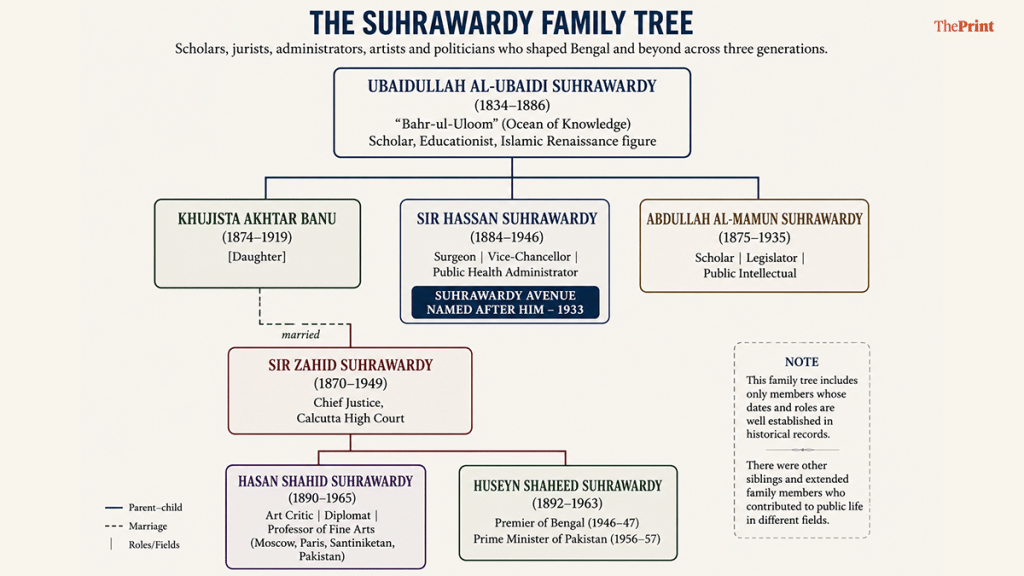
The family’s modern history begins with Ubaidullah Al Ubaidi Suhrawardy (1832–1886), an Arabic and Persian scholar who came to be known by the honorific Bahr al-Ulum or ‘Ocean of Learning’. At a time when Bengal’s Muslim landed elite were only beginning to engage with Western education after the upheavals of the revolt of 1857, Ubaidullah represented a new generation of reform-minded intellectuals who believed that modern education would determine the future of Indian Muslims.
“Muslim scholars and reformers of Bengal also adopted different reformist approaches in order to arrest the decline of Islamic thought and culture, and reinvigorate Muslim societies of Bengal,” Muhammad Mojlum Khan wrote in his biographical entry for Bengal Muslim Research Institute in the UK on Ubaidullah and other scholars of the time.
Educated in both Islamic and Western traditions, he taught at Hooghly College before becoming the first superintendent of the Dhaka Madrasa in 1874. His writings ranged across Arabic, Persian and English.
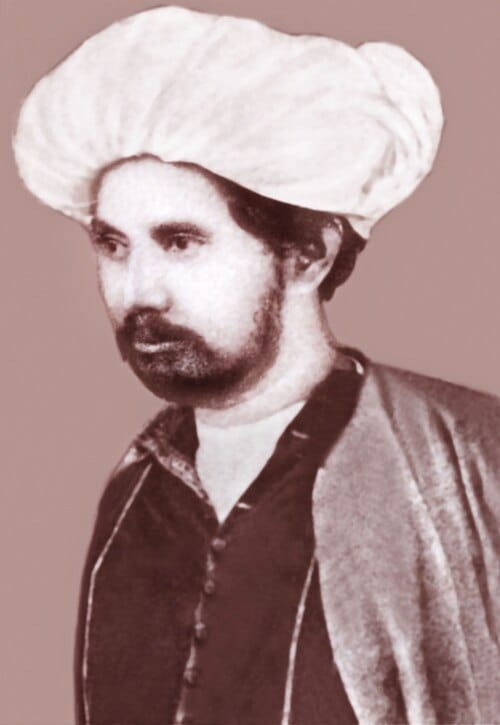
The Suhrawardys traced their ancestry to the Suhrawardiyya, one of the major Sufi orders that spread across Persia and the Indian subcontinent from the medieval period. Like many prominent Muslim families of 19th century Bengal, genealogy carried social prestige. But by the time Ubaidullah catapulted to a public figure, the family’s standing rested more on education and public service than lineage.
Within a few decades, the Suhrawardys had become one of colonial Bengal’s most accomplished Muslim families. Their children entered institutions that had only recently begun admitting Indians into positions of influence. They studied at Calcutta University, St Xavier’s College and later Oxford University in the UK, qualified as barristers, served in the Indian Medical Service, presided over universities and courts, and participated in the constitutional debates.
It was also a family that consciously invested in education across generations.
Ubaidullah’s daughter, Khujista Akhtar Banu, was among the earliest educated Muslim women of Bengal, remembered as a writer and educationist at a time when female literacy within elite Muslim households remained limited. She later married her cousin and eminent jurist Justice Sir Zahid Suhrawardy (1870–1949) of the Calcutta High Court, who was knighted in 1928.
From this household came two brothers whose lives would take dramatically different paths.
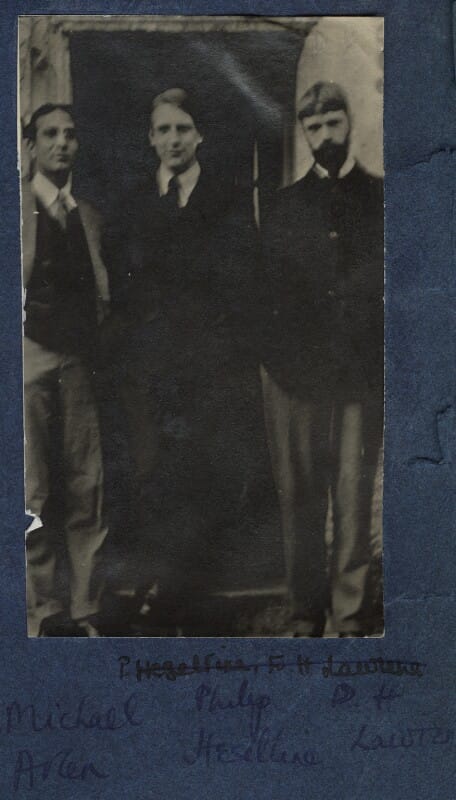
The elder, Hasan Shahid Suhrawardy (1890–1965), immersed himself in literature, art and international diplomacy, eventually becoming one of the subcontinent’s earliest art critics and a prominent cultural figure. Returning to India in the 1930s, he became the Rani Bageswari Professor of Fine Arts at the University of Calcutta, where he lectured on aesthetics and modern art. Fluent in several languages, Hasan Shahid represented the cosmopolitan aspirations of the Bengal Renaissance and had friends in high places.
Author DH Lawrence, his friend from Oxford, wrote in a letter to Lady Cynthia Asquith on 5 December 1915: “It is pleasant to see with all kinds of eyes, like argus. Suhrawardy was my pair of Indo-Persian eyes. He is coming to Florida.”
He was also an art-critic for The Statesman and introduced the works of iconic painter Jamini Roy to the world. His posthumous book The art of the Mussulmans in Spain (2005) was lauded by critics.
“It is a meticulously detailed study of every aspect of the artistic expression through architecture, artefacts, and the practical arts, produced in the centuries of Muslim rule in the country,” Bangladeshi scholar and translator Kaiser Haq wrote about the book.
The younger, Huseyn Shaheed Suhrawardy, chose politics, a decision that would ultimately redefine his own legacy and that of his whole family.
Between them stood another figure: Lt Col Sir Hassan Suhrawardy.
A generation older than the brothers and their paternal uncle, Hassan took the family’s first great leap into public life. Trained as a surgeon, he joined the Indian Medical Service, was knighted in 1932, and appointed an Officer of the Order of the British Empire.
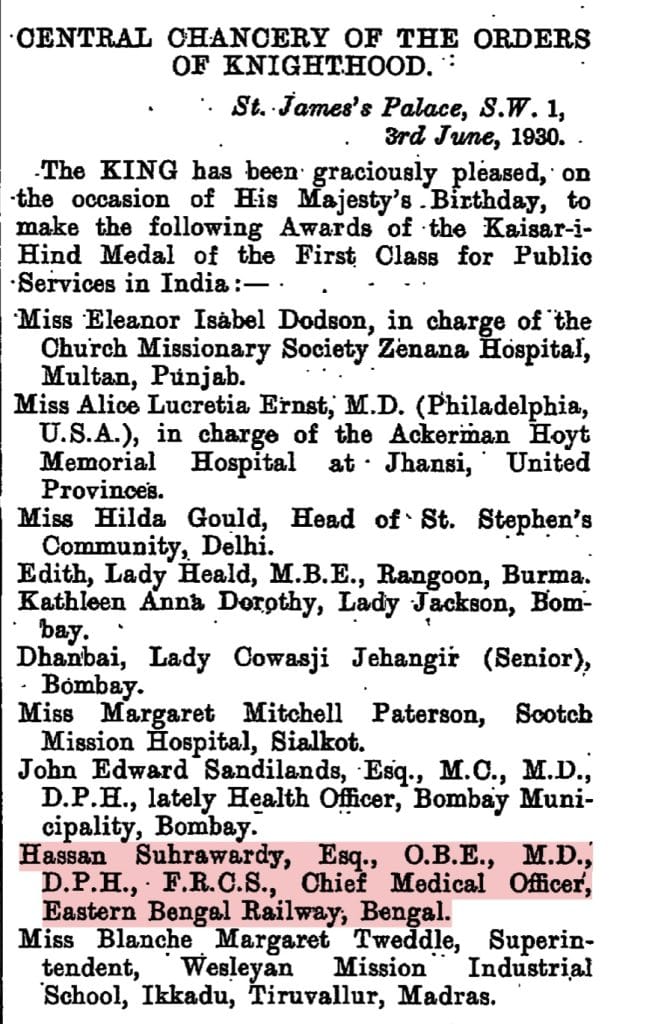
On 3 June 1930, The London Gazette announced that Hassan Suhrawardy, Chief Medical Officer of the Eastern Bengal Railway, was awarded the Kaisar-i-Hind Medal (First Class) for public services in India.
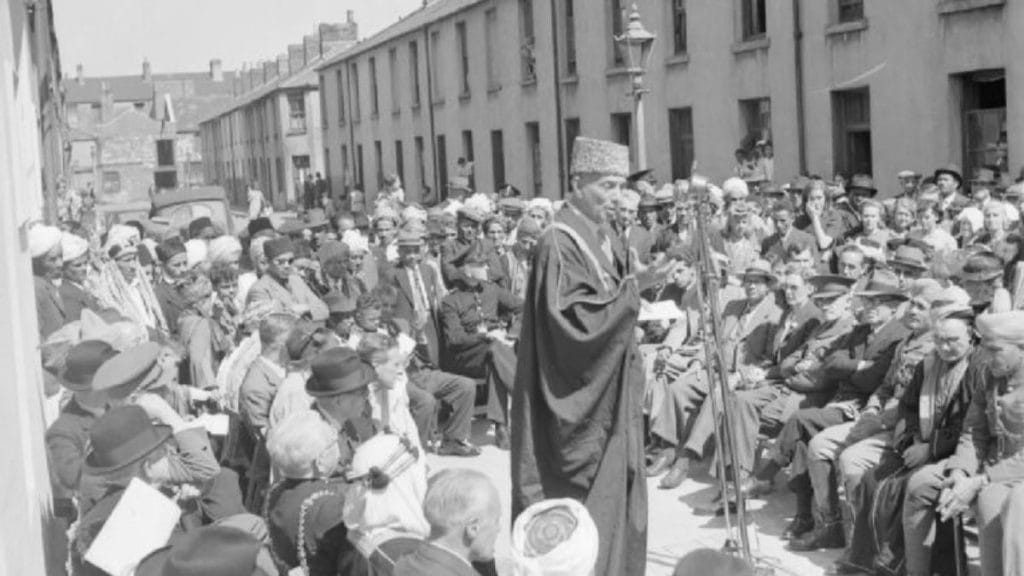
His influence also helped establish the East London Mosque, among Britain’s earliest permanent Muslim institutions.
Hassan’s elder brother, Abdullah Al-Mamun Suhrawardy (1875–1935), was among the earliest Bengalis to earn a doctorate from the University of Calcutta. Abdullah built a distinguished career as a scholar of law, philosophy and Islam, later serving in the Bengal Legislative Council.
It was Hassan, the uncle — not Huseyn — whose name Calcutta back then chose to commemorate in 1933 with a road renaming, right where the family’s ancestral house stands.
Huseyn Shaheed Suhrawardy: The politician
If Sir Hassan Suhrawardy followed the family’s path to institution-building, Huseyn Shaheed Suhrawardy marked its entry into mass politics.
Called to the Bar at Gray’s Inn in 1918 after studying at Oxford, Huseyn returned to Calcutta in 1920 and briefly practised as a barrister before entering public life. His earliest political influence was Chittaranjan Das, one of Bengal’s most prominent nationalist leaders. Along with Subhas Chandra Bose, he joined Das’s Swaraj Party which sought greater Indian participation in government while also attempting to address long-standing imbalances in the representation of Bengali Muslims through the 1923 Bengal Pact.
For a young Muslim lawyer entering politics in the aftermath of World War I, the pact represented an effort to reconcile nationalist politics with the demands of a community that had long argued it was underrepresented in government services and educational institutions. Although the agreement ultimately failed to secure wider acceptance within the Congress, it shaped a generation of Bengali Muslim politicians who believed constitutional reform alone would not resolve questions of political representation.
Suhrawardy’s politics, however, evolved rapidly over the following decade.
After the collapse of the Swaraj Party with Das’s death in 1925, he gravitated towards organisations that articulated Muslim political interests more explicitly, including the Central National Mohammedan Association, before eventually joining the All-India Muslim League.
Historian Chandrachur Ghose sees this progression as significant.
“The political journey of Huseyn Shaheed Suhrawardy from CR Das’s Swaraj Party to the communal Central National Mohammedan Association, followed by the Muslim League underscored a hardening communal attitude,” he told ThePrint.
The Government of India Act, 1935, introduced provincial autonomy and set the stage for the elections of 1937, the first in which ministries would exercise significant powers. In Bengal, however, the verdict produced no clear majority. Instead, it revealed the province’s fractured political landscape, where agrarian interests, communal identities and constitutional questions intersected in complex ways.
At the centre of that churn stood AK Fazlul Huq and the Krishak Praja Party.
Founded in 1936, the party sought to represent Bengal’s overwhelmingly agrarian population, particularly Muslim cultivators burdened by tenancy disputes, indebtedness and the power of large zamindars. Its emergence challenged the dominance of both the Congress and the Muslim League by arguing that class and rural distress deserved as much political attention as communal representation.
The election that followed produced an uneasy coalition between Fazlul Huq’s Krishak Praja Party and the Muslim League. It was within this coalition that Suhrawardy emerged as one of the League’s most effective organisers and administrators, steadily expanding his influence in provincial politics.
Over the next decade, that influence would place him at the centre of almost every defining event in Bengal’s modern history — from the famine (when he was the Civil Supplies minister) and wartime administration to the elections of 1946, the United Bengal proposal and, ultimately, Direct Action Day.
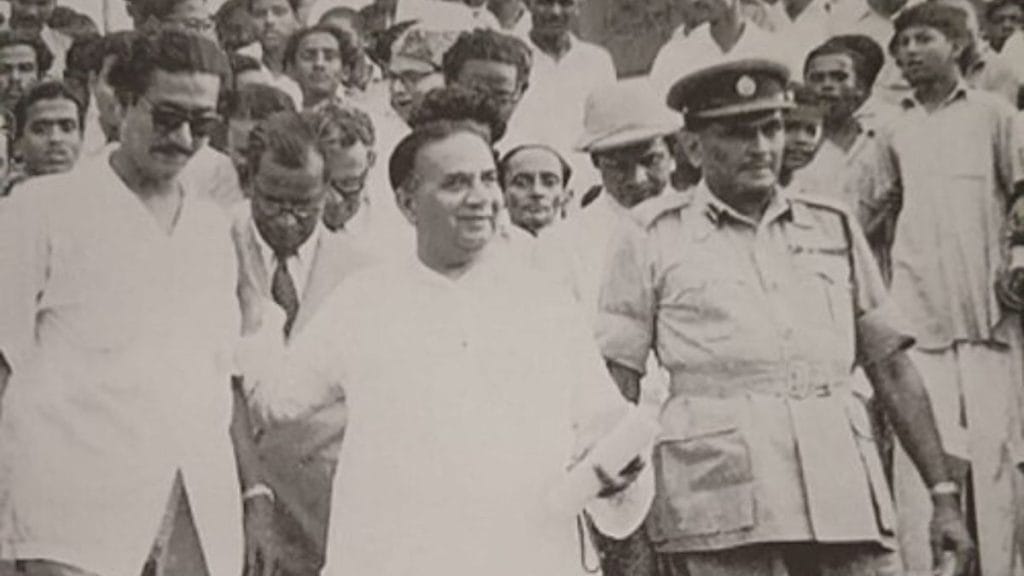
Bengal’s last premier
If the 1930s established Huseyn Shaheed Suhrawardy as an important provincial politician, the 1940s transformed him into one of the most consequential — and controversial — leaders in the final years of British India.
The Muslim League’s Lahore Resolution in March 1940 called for “independent states” in the Muslim-majority regions of the subcontinent. Although the demand would later crystallise into Pakistan, Bengal occupied a unique position within the League’s calculations. It was the largest Muslim-majority province in British India, but also one of its most economically and socially intertwined, with Hindus and Muslims living, working and governing in interconnected spaces.
As the League expanded, Suhrawardy emerged as its most prominent leader in Bengal. A gifted campaigner and political organiser, he helped consolidate the party’s influence in the province ahead of the watershed elections of 1946. Around this time, he had also emerged as one of Mohammad Ali Jinnah’s most trusted lieutenants in Bengal.
Those elections were widely seen as a referendum on the League’s demand for Pakistan.
The League swept the Muslim-reserved constituencies in Bengal, securing a decisive mandate and paving the way for Suhrawardy to become Premier in April 1946. At 53, he inherited one of the most politically fragile provinces in British India. The Bengal Famine had ended barely three years earlier. Communal tensions had deepened. Constitutional negotiations between the Congress, the Muslim League and the British had reached an impasse.
The political atmosphere grew increasingly charged after the Cabinet Mission Plan faltered in July 1946. On 29 July, the Muslim League Council withdrew its earlier acceptance of the plan and announced that it would observe Direct Action Day on 16 August to demonstrate Muslim support for Pakistan.
What followed in Calcutta remains one of the defining episodes of the Partition era.
Violence erupted across the city on 16 August and continued for several days, leaving thousands dead and many more injured. The killings triggered retaliatory violence elsewhere in the subcontinent and deepened communal mistrust in the months leading to Partition.
Research scholar Monidipa Bose Dey, in an article for Firstpost in 2022 wrote: “Jinnah was clear enough in his indications of his intentions when he boldly stated he will have ‘India divided or India burned’, and the Muslim League had said ‘goodbye to Constitutional methods’ and was ready to ‘create trouble’.”
She added that this was supported by Suhrawardy who reportedly said “no actions were to be taken against the armed Muslims should they decide to unleash their activities in the city (Yasmin Khan, ibid, p 65).”
No official transcript of Suhrawardy’s address at the Direct Action Day rally exists today. In a confidential report to Viceroy Lord Wavell, Governor Frederick Burrows noted that intelligence officers differed slightly on the wording but agreed on its substance.
One report recorded Suhrawardy as saying he had “seen to police and military arrangements who would not interfere”; another said he had “been able to restrain the military and the police”. Burrows concluded that, whatever Suhrawardy intended, the remarks could have been understood by the crowd as “an open invitation to disorder”.
Suhrawardy’s critics at the time accused his administration of failing to prevent the violence and alleged that sections of the provincial government were sympathetic to League mobilisation.
Among the sharpest critics was Syama Prasad Mookerjee, then Leader of the Opposition in the Bengal Legislative Assembly, who argued a month later that the violence was “not the result of a sudden explosion” but “the culmination of an administration, inefficient, corrupt and communal”.
“A minister who comes forward and says ‘I am helpless, I could not save the people of the city because the Commissioner of Police would not listen to me’ will declare Bengal an independent state! Now, that was Mr Suhrawardy. He said he was going to carry on a no-rent campaign in this province. He was going to disobey law and order. His speech before the Legislative Council goes to show that he knew fully well that troubles were ahead,” Mookerjee said on 20 September 1946.
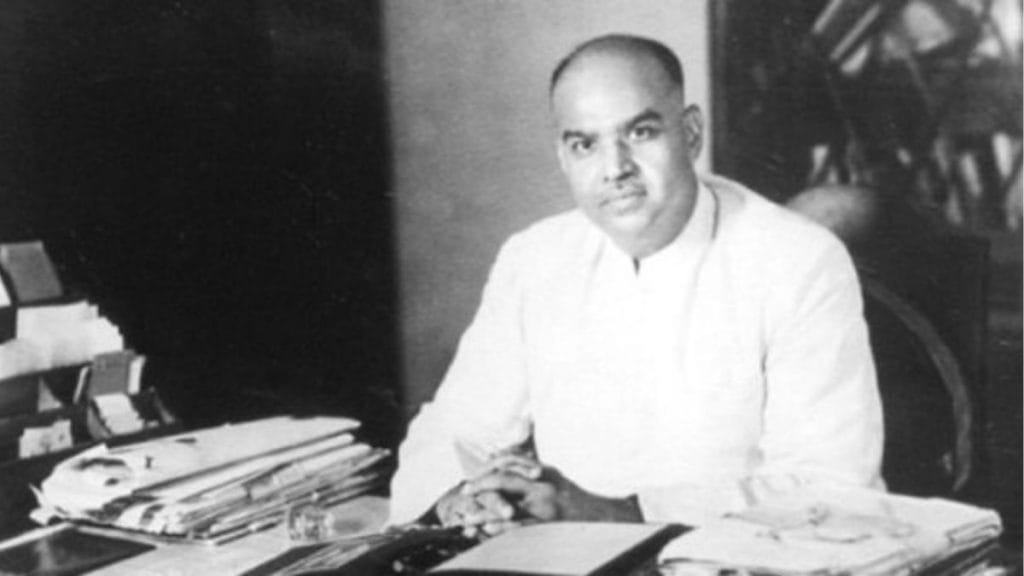
Those accusations would define Suhrawardy’s public image in much of India.
Historian Chandrachur Ghose argues that Direct Action Day fundamentally altered Suhrawardy’s political standing among Bengal’s Hindus.
“His involvement in the communal pogrom that commenced on the Direct Action Day of 1946 made the Hindus more distrustful of his intentions,” Ghose told ThePrint. “That was a key reason why his plan for a sovereign Bengal, delinked from both India and Pakistan, failed to find sufficient support in 1947.”
Yet the months that followed revealed another side of Suhrawardy’s politics.
As Partition became increasingly inevitable, he emerged as one of the strongest advocates of an undivided, sovereign Bengal — a proposal developed with Sarat Chandra Bose that sought to keep the province outside both India and Pakistan.
The proposal found little support.
The Congress leadership opposed it. The Muslim League’s central leadership remained committed to Pakistan. Many Hindu leaders, still traumatised by the violence of August 1946, distrusted Suhrawardy’s assurances that a sovereign Bengal would protect minority interests.
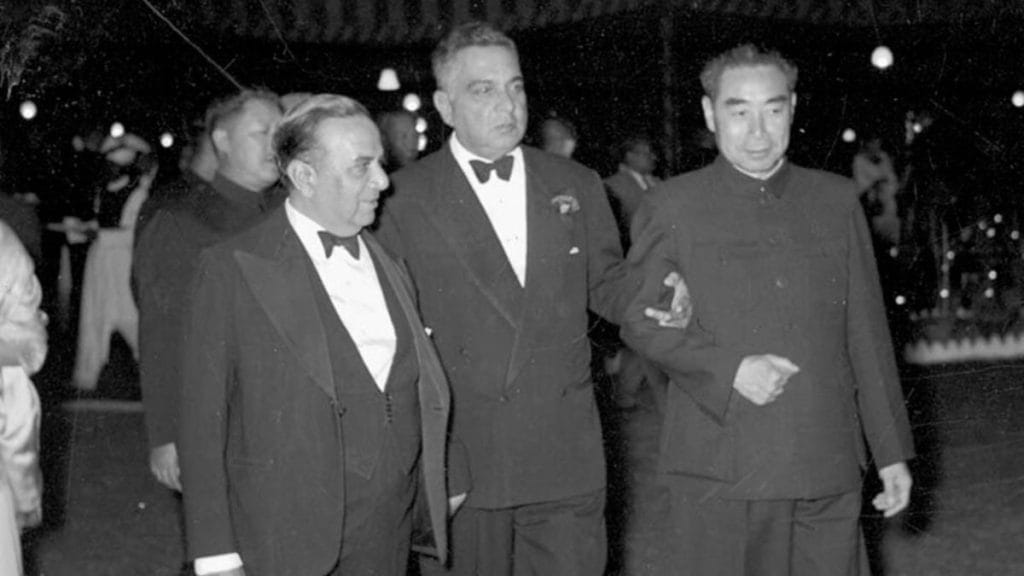
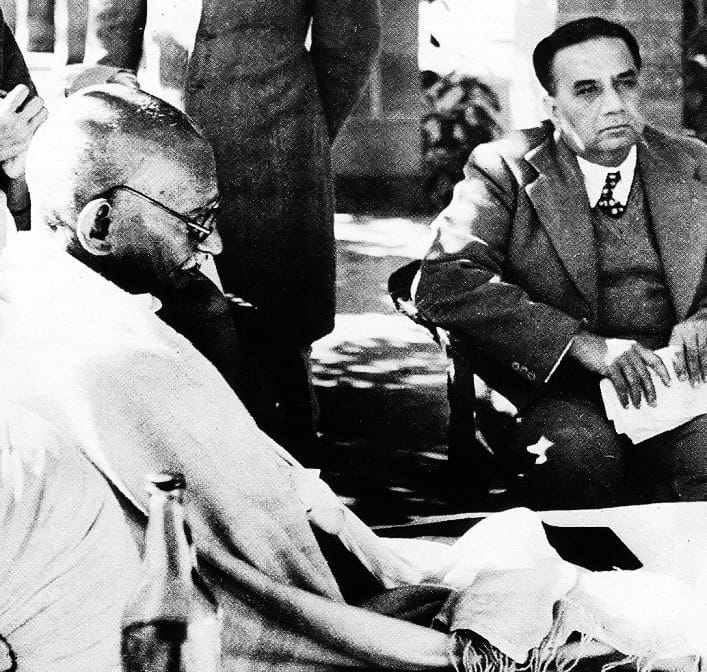
The proposal collapsed within weeks. In the run-up to Independence, Gandhi arrived in riot-scarred Beliaghata in Calcutta on 9 August 1947 instead of travelling to Delhi for the celebrations. Much to the surprise and anger of many residents, Gandhi chose to stay at Hyderi Manzil (now Gandhi Bhawan) with Suhrawardy. Gandhi argued that if peace was to return to Calcutta, those seen as responsible for its breakdown also had to be part of the reconciliation.
“I will remain if you and I are prepared to live together. We shall have to work till every Hindu and Mussalman in Calcutta safely returns to the place where he was before. We shall continue in our effort till our last breath,” Gandhi had told Suhrawardy.
His decision to stay with Suhrawardy drew protests outside Hyderi Manzil but over the following weeks, the two toured affected neighbourhoods together, appealed jointly for communal harmony and met delegations from both Hindu and Muslim communities. The effort culminated in what came to be known as the “Calcutta Miracle”.
Also Read: 1800s Kolkata is key to Modi’s Act East policy. It needs imagination, not just bureaucracy
A second political life
While the Partition ended British India, it did not end Huseyn Shaheed Suhrawardy’s political career. If anything, it marked the beginning of a second, and in many ways more consequential, political life.
Unlike several leaders of undivided Bengal who faded from public life after 1947, Suhrawardy relocated to Pakistan and quickly emerged as one of the country’s most experienced civilian politicians. His challenge, however, was very different from the one he had faced in Bengal.
The politics of Pakistan was increasingly shaped by a new contest between East and West Pakistan.
Although East Bengal, renamed East Pakistan, contained a majority of the country’s population, political and administrative power was concentrated in Karachi, and later Rawalpindi, where the civil bureaucracy and military establishment exercised growing influence. The imbalance soon generated tensions over language, economic policy and political representation.
Few politicians understood those contradictions better than Suhrawardy.
Begum Shaista Suhrawardy Ikramullah, his cousin and the author of Suhrawardy’s biography published in 1991, described him in the synopsis as “perhaps the only politician to straddle the East and West wings of Pakistan.”
That balancing act defined his politics through the 1950s.
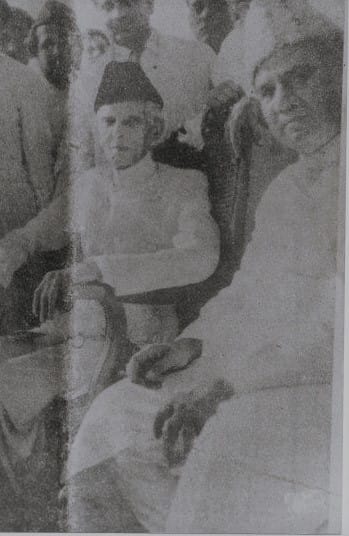
Unlike many leaders who viewed Pakistan primarily through the lens of religion, Suhrawardy increasingly argued that the country’s survival depended on accommodating its regional diversities within a democratic constitutional framework. His stature, too, grew steadily.
In 1956, President Iskander Mirza — widely acknowledged to be a descendant of Battle of Plassey’s Mir Jafar (now a byword for betrayal after Jafar infamously deceived Bengal’s last nawab Siraj-ud-Daulah) — invited Suhrawardy to form the government, making him Pakistan’s fifth prime minister. His tenure lasted barely a year.
Suhrawardy had inherited a deeply unstable political system. Coalition governments were fragile, provincial rivalries had intensified and disagreements over the constitution remained unresolved. At the same time, Pakistan’s military and civil bureaucracy had begun to emerge as powerful centres of authority, often operating independently of elected governments.
As prime minister, Suhrawardy attempted to strengthen parliamentary institutions while navigating competing pressures from East and West Pakistan, the presidency and the armed forces. His government also grappled with questions of foreign policy as Pakistan deepened its relationship with the United States through Cold War military alliances while trying to maintain regional stability.
His own parliamentary speeches reveal a politician preoccupied with institutional questions. Defending parliamentary democracy, Suhrawardy argued that Pakistan could not rely on inherited authority to hold together a diverse federation.
“The goal can be achieved only through elections,” he told an audience in London in June 1957, rejecting claims that Pakistan was “not ready for the democratic process”.
His critics, however, accused him of inconsistency and excessive political compromise.
Facing mounting political pressure, Suhrawardy resigned on 17 October 1957. Within a year, Pakistan’s parliamentary experiment itself came to an abrupt halt. Martial law was imposed for the first time by a civilian with President Mirza’s declaration in October 1958. He then appointed General Ayub Khan as Chief Martial Law Administrator.
In ‘Friends not Master: A Political Autobiography’ (1967), Gen Khan called Suhrawardy a “complex character who loved the gay life of night-clubs and had tremendous energy and drive”. He blasted him for his supposed political failures in undivided Bengal as well.
“…even before Independence the Muslims of the province (Bengal) had been fairly vocal in politics and had produced men like Fazlul Haq, Suhrawardy, and Khawaja Nazimuddin, who were associated with the government in one capacity or another. All of them had been Chief Ministers of undivided Bengal, but they had been unable to do anything for their people. It must be admitted that the task was stupendous,” he wrote.
Days after martial law was declared, Ayub Khan removed President Mirza and assumed power himself, ushering in Pakistan’s first prolonged period of military rule.
Suhrawardy became one of its most prominent civilian critics.
Disqualified from politics under the new regime, he spent periods under detention before eventually leaving Pakistan. He died in Beirut, Lebanon on 5 December 1963 while in self-imposed exile, ending a public career that had spanned more than four decades and two countries.
Gopal Patha: Hero or vigilante?
Now, more than six decades later, Suhrawardy’s surname has once again entered Bengal’s vocabulary. If CM Adhikari’s proposal goes through, Suhrawardy Avenue will instead commemorate Gopal Chandra Mukherjee — better known as Gopal Patha, another man whose legacy remains fiercely debated nearly eight decades after Partition.
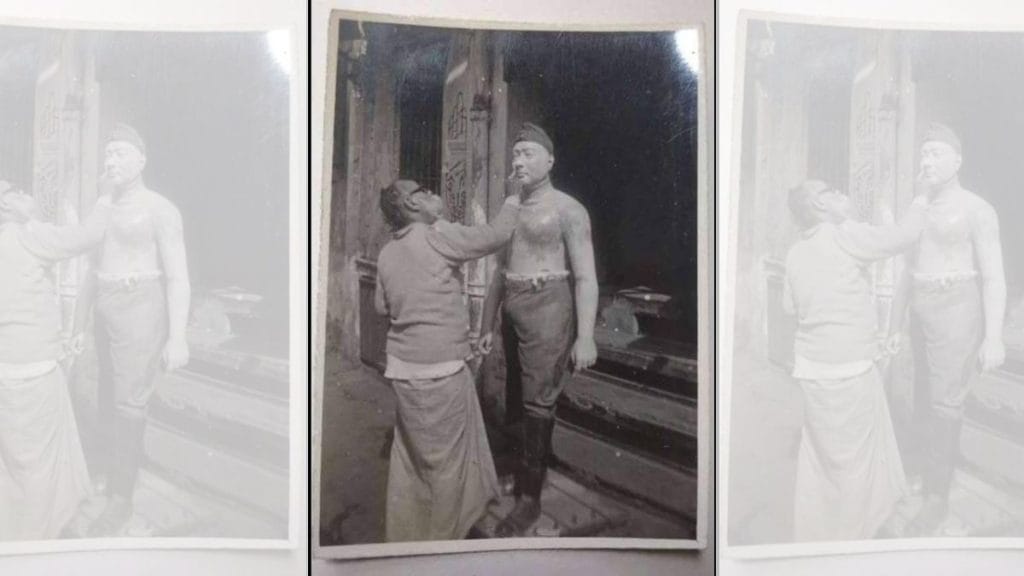
According to his family, Mukherjee organised the Bharater Jatiya Bahini, a volunteer force comprising Bengali, Bihari, Odia and Punjabi Hindus after communal violence engulfed Calcutta during the Direct Action Day riots.
His grandson, Santanu Mukherjee, told ThePrint in 2023 that Gopal Patha took up arms “to save Hindus from marauding Muslim rioters”, but insisted that “he bore no ill will towards Muslims”. Santanu also claimed that his grandfather sheltered Muslim neighbours during the riots and instructed his followers not to target women, children, the elderly or unarmed civilians.
Gopal Mukherjee even met Gandhi after the 1946 riots. According to Santanu, Gandhi urged his grandfather to lay down his arms as peace returned to the city.
“He [Mukherjee] believed that if you are attacked, you have to pick up arms to defend yourself. Gandhi’s sermons on non-violence won’t save you during riots,” Santanu said.
Historians, however, place Gopal Mukherjee within the wider cycle of retaliatory violence that followed the initial outbreak of the killings. While many acknowledge his role in organising Hindu resistance after the first attacks, they also argue that the violence quickly escalated, killing thousands across both communities.
“In Calcutta, although the violence was started by the [Muslim] League, the main sufferers were the Muslims of the city. Out-numbered and out-gunned, they lost more lives and had more homes burnt than their Hindu adversaries,” wrote historian Ramachandra Guha in a 2014 article for The Telegraph titled ‘Divided or Destroyed — Remembering Direct Action Day’.
In the decades since, Gopal Mukherjee’s legacy has increasingly moved beyond historical accounts into popular culture (The Bengal Files, 2025) and now, names of roads. Filmmakers urge caution against this hero worship.
“We have this tendency of making heroes and villains [out] of historical figures. That is propaganda. Gopal Patha did save a lot of Hindus indeed during the Great Calcutta Killings,” filmmaker Subhrajit Mitra told ThePrint in 2023.