



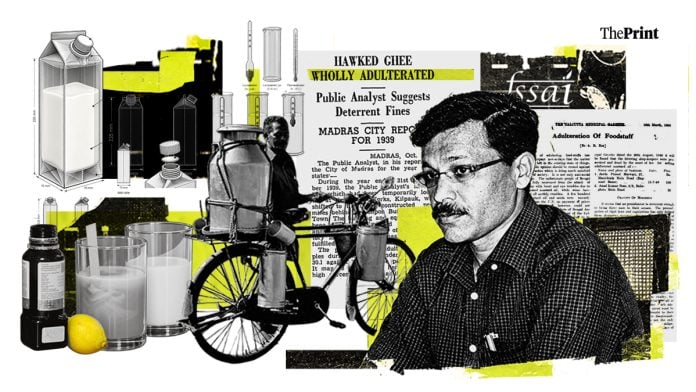
“Singham Cop” Maharashtra FDA commissioner Tukaram Mundhe’s uncompromising crackdowns have ignited a frenzy over India’s relationship with the food on its plate and front-of-the-pack labels.
Yet this anxiety over food safety isn’t new. There was a time when the devil was far easier to spot: water in milk, brick dust in chilli powder, vanaspati masquerading as ghee. The battle was against adulteration — food being diluted, coloured or substituted.
In all this, if India’s food-safety story had a protagonist, it could well be milk—diluted, tested, inspected, seized. It was hotly debated in the Constituent Assembly and Parliament eight decades ago and, somehow, is still making headlines now.
Tukaram Mundhe has spent 2026 turning dairy godowns and Mumbai’s eateries into a crime scene. Between June and August 2026 alone, the state unleashed an unrelenting blitzkrieg, testing 2,766 dairy samples and seizing dairy stocks worth Rs 5.4 crore.
Compromised dairy, in fact, was already a blight long before independent India took charge of its own destiny.
The Bhore Committee, set up by the colonial government to survey health planning in India, found that every sample of milk and milk products tested in the Central Provinces and Delhi in 1937 was adulterated.
The context of food safety has changed from preventing adulteration to making food which is safe for consumption of the people
– Tukaram Mundhe, Maharashtra FDA commissioner
So, how did the country travel from adulterated India to the FSSAI of today?
The answer lies in the India that had just won its freedom, a patchwork of colonial-era rules and a generations-long attempt to clean up the food on the nation’s plate.
Before the 2006 single-window revolution created FSSAI, India spent decades trapped in a dizzying legal maze — layer upon layer of laws and authorities, sometimes plugging gaps, sometimes creating new ones.
Also Read: The Mundhe phenomenon
An adulterated India
On 29 March 1947, as the scent of freedom swept through the country, Rajendra Prasad, then food minister in the interim government, stood before a crowd at the Food and Nutritious Diet Exhibition with a chilling warning.
“The crying need of the times is prevention of adulteration of food… Adulteration has been reduced to a fine art and there is hardly anything which cannot be and is not adulterated,” he said. Rice, he added, was mixed with “coarse sand, or fine stone chips”, undetectable until they caused “a most unpleasant sensation” between your teeth. Milk, ghee and oil were “notorious.”
This was the food-safety inheritance of a country on the brink of freedom. Yet, this was not a lawless land. Colonial India had built what looked like an ironclad legal rampart.
Sections 272 and 273 of the Indian Penal Code already criminalised food adulteration with a six-month jail term or a fine of Rs 1,000. Provinces had erected their own legal fortresses — from the Bengal Food Adulteration Act of 1919 to Bombay’s Prevention of Adulteration Act of 1925. To bridge national gaps, the Agricultural Produce (Grading and Marking) Act, 1937, brought in the Agmark system.
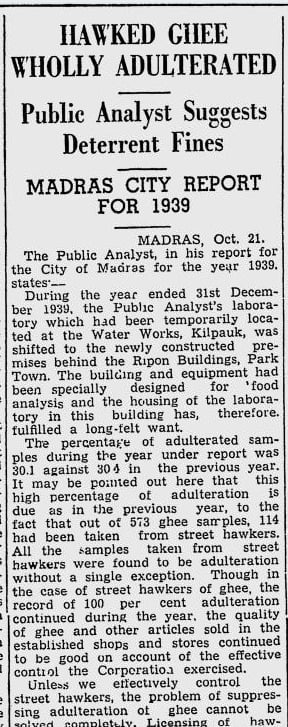
On the streets, however, greed was outpacing the law. On 21 October 1940, an Indian Express headline read: “Hawked Ghee Totally Adulterated.” The Madras Public Analyst found all 114 ghee samples collected from street vendors in 1939 adulterated.
And so, a young, poor and hungry India had two jobs on its plate: feed more than 300 million mouths — and make sure what it fed them was actually food, sans milawat.
What followed was a legislative marathon: from the Constituent Assembly to Parliament, from fiery debates to pit stops at Select Committee rooms, over several years, before India finally forged its own elephantine adulteration law. The first phase, however, was a jurisdictional tug-of-war, and a question that touched India’s jugular vein: Who gets to control the plate?
The battle for the lists
Fresh off its tryst with destiny, the Constituent Assembly faced the staggering task of drafting a Constitution for the young republic. Naturally, some of its fiercest battles were over federal powers. Who controls what? Almost every subject could trigger a Centre-State tussle.
And then, on 2 September 1949, milawat entered the ring.
Brajeshwar Prasad of Gaya, Bihar, fired the opening salvo. Food adulteration, he argued, had assumed “scandalous proportions in this country” and had to be tackled on an “All-India basis”. His solution was to shift adulteration to the Concurrent List, which would empower both Parliament and the states to make laws on it.
But the fiercest push came from Pandit Lakshmikanta Maitra of West Bengal, who knew the problem from the inside. As a member of the Central Advisory Board of Health (1937), Maitra had seen how India’s patchwork of food rules worked — or failed to.
“Each one of the provincial Governments had almost its own set of standards,” he said. “The result was nothing short of confusion.”
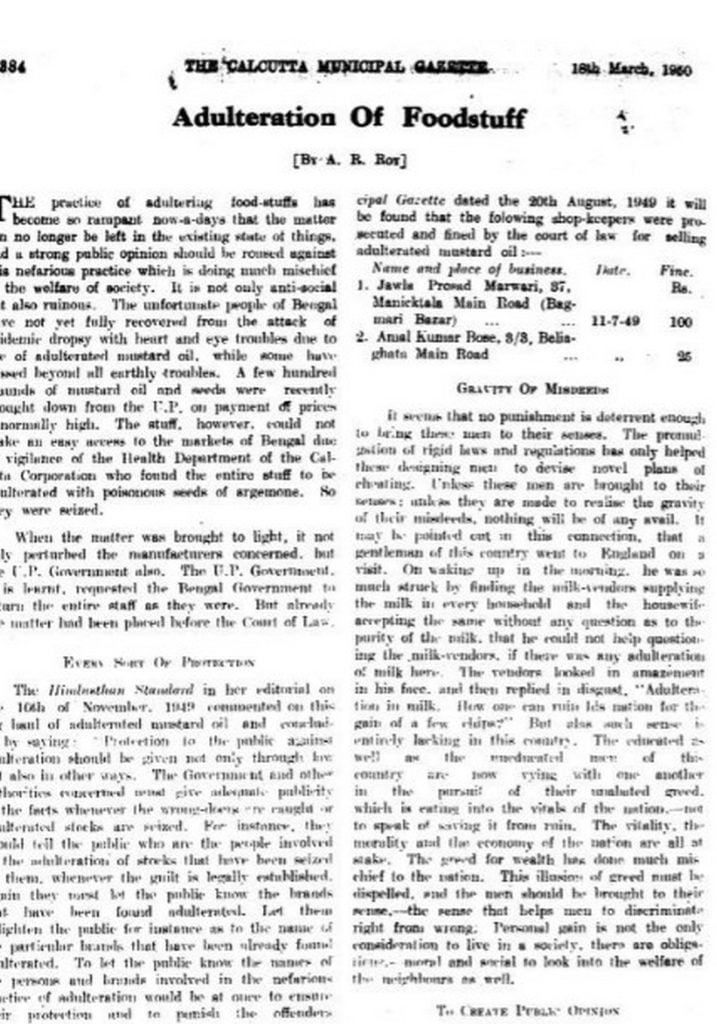
Maitra then reminded the House of the “scandal about mustard oil” in Bengal.
The Calcutta Corporation’s Public Health Department had warned that mustard oil was being mixed with argemone seed, which was unfit for human consumption and linked to dropsy, a disease that causes severe swelling and can be fatal.
The crying need of the times is prevention of adulteration of food… Adulteration has been reduced to a fine art and there is hardly anything which cannot be and is not adulterated.”
– Rajendra Prasad, food minister in the interim government
Catch the retailer in Patna or Calcutta, Maitra argued, and he could simply say: “What have I done? I have purchased these fifty or sixty or two hundred tins from such and such place in UP.” The retailer could be prosecuted. But the province had no power to go after the supplier beyond its borders.
TT Krishnamachari from Madras, wasn’t having it. He said the Union List already gave the Centre “ample power” to deal with standardisation of goods and there was no need to move adulteration to the Concurrent List.
Dr PC Deshmukh pushed back: “By placing it in the Concurrent List, we do not deprive the States…but so far as may be necessary, the Centre will have the power to interfere.”
Eventually, the pendulum swung and adulteration made its grand entry in the Concurrent List. The next step was drafting a law.
The Prevention of Food Adulteration Bill was eventually introduced in 1952 but went on a two-year hiatus in Select Committee chambers. When it finally returned to the Lok Sabha in 1954, a new concern took centre stage — the untamed power of the Food Inspector.
Maginot Line against milawat
What if those policing adulteration became a menace themselves? That was the burning question in the Lower House on 26 August 1954.
MS Gurupadaswamy argued that samples and other action by inspectors should happen in the presence of witnesses. Otherwise, he warned, official power could become “a great engine of oppression”.
Tek Chand took an even bleaker view of it. Inspectors and sellers, he said, could sometimes be “in league” — leaving behind a sham of small fines and occasional convictions while adulteration simply carried on.
The debate soon snowballed into a clash over punishments. SV Ramaswamy warned against “dead uniformity” when adulteration came in “types and gradations”. And, once again, milk made a cameo.
For that simple act are you going to place him before a magistrate of the first class? It would be preposterous
– SV Ramaswamy, MP, on a milkman adding water to milk
Ramaswamy pointed to the milkman who added water to milk. It was adulteration, he conceded, but asked: “For that simple act are you going to place him before a magistrate of the first class? It would be preposterous.”
A counter to this came from health minister Rajkumari Amrit Kaur, who made the case for deterrence.
“Even the most illiterate person knows that when he is mixing water with milk… it is an offence,” she said.
After years of drafts, arguments and revisions, the Bill was finally passed on 29 September 1954, becoming the Prevention of Food Adulteration Act (PFA).
At last, India had its legal fortress — an army of food inspectors empowered to seize, sample and shutter, a Central Committee for Food Standards for technical specifications, and a Central Food Laboratory.
On paper, it looked formidable. But as the years rolled on, India’s grand Maginot Line against milawat began to crack.
The cracks
In a country already battling malnutrition and still latched to the PL-480 American food-aid umbilical cord, India could hardly afford a tainted food supply. By the mid-1960s, Parliament was already patching holes in the new anti-adulteration law.
The 1964 amendment admitted that eight years of experience had shown the Act’s machinery was “inadequate”. Parliament’s answer was steeper fines and a wider penal net.
But a dozen years later, the problem seemed only to have grown. The 1976 amendment called adulteration “rampant” and “a grave menace to the health and well-being of the community”. The response was a major offensive, with punishment ranging from three years to life imprisonment for offences causing death or grievous harm.
The law was getting tougher. But was it actually getting any teeth? Not really.
Alan M Katz, in The Law against Adulteration (1977), pointed out that the first three Five-Year Plans barely addressed food adulteration. Even the Fourth Plan’s allocation was slashed from Rs 12 crore to Rs 4 crore.
And the food inspectors? Often, they never even reached the hinterland. Where they did, another problem arose.
“The period before 1991 was actually license-quota-inspector raj,” said Ashwini Mahajan, co-convenor of the Swadeshi Jagran Manch. Inspectors could enter shops, take samples and launch criminal cases against anyone.
Bureaucratic tangles were another menace.
“Despite High Court rulings placing food safety and hygiene with food safety commissioners, municipal authorities continued to exercise overlapping powers,” said Pawan Aggarwal, former CEO of FSSAI.
Sometimes, the law itself left wide scope for arbitrariness. Pushpa Girimaji, a veteran consumer law journalist, recounted that when the PFA banned calcium carbide for ripening fruit, inspectors had no way to test for it in the fruit. They were told to hunt for packets of calcium carbide and prosecute. When traders asked what they should use instead, she said, the department was “literally clueless”.
Meanwhile, India kept adding laws. The PFA sat alongside the Essential Commodities Act, its control orders, the Fruit Products Order, the Milk and Milk Products Order and parameters set by the Bureau of Indian Standards (BIS).
Milk, mustard oil, movies
A legal labyrinth was taking shape. More laws. More agencies. More standards. And, somehow, more milawat.
A June 1976 Yojana report reported cow dung in chilli powder, poisonous kesari dal replacing arhar, and glucose supplied to hospitals that allegedly “led to several deaths”.
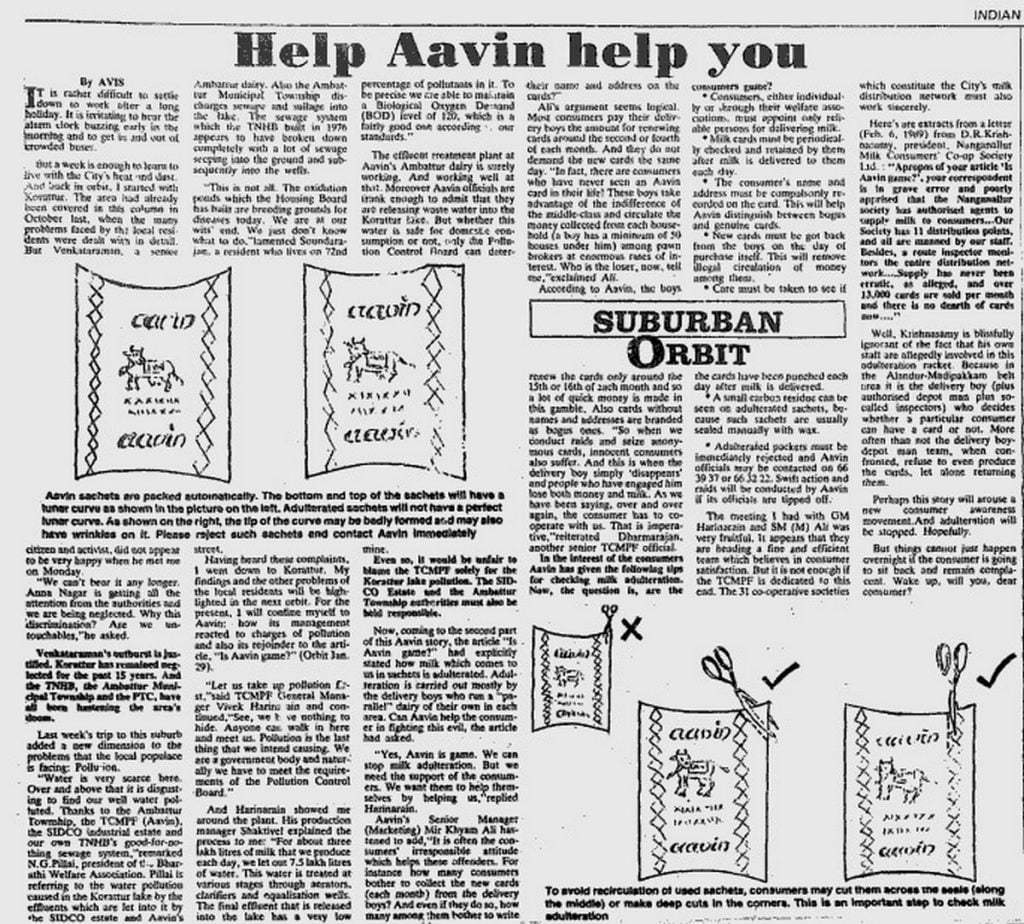
Milk remained the undisputed protagonist. A March 1989 Indian Express piece even offered tips on cutting Aavin milk sachets in Tamil Nadu so they could not be reused and recirculated.
Edible oil also emerged as one of the biggest culprits. In 1988, contaminated rapeseed oil in Behala, West Bengal, left consumers suffering numbness and paralysis — a tragic echo of the warning Lakshmikanta Maitra had delivered in Parliament almost four decades earlier.
Even dropsy, which had struck Bengal in 1949 due to mustard oil adulteration, made a comeback nearly five decades later. In August 1998, Delhi was suddenly in the grip of an epidemic of the disease caused by mustard oil adulterated with prickly poppy, another name for argemone.
“The zing went out of Indian cooking,” read a Down To Earth headline on 30 September 1998, as mustard oil — India’s favourite cooking medium — was banned.
At least 60 people died and 3,000 were hospitalised in Delhi. Worse, Girimaji pointed out, the old law offered no compensation to victims — a flaw corrected only in 2006.
Meanwhile, the government’s immediate reaction to the dropsy epidemic was yet another layer on the sprawling pile: the Edible Oils Packaging (Regulation) Order, 1998.
As the government kept adding bricks to its legal fortress, Hindi cinema held up a mirror to the country’s grim reality — turning national tragedy into comedy, satire and some unforgettable milawat moments.
In Julie (1975), Om Prakash was celebrating a new car with his family when the conversation took a very Indian turn: milawat.
“Milawat is mulk ki sabse badi bimari hai…” (Adulteration is this country’s biggest disease) he said, before jesting that if people were mixing water into whisky, what on earth were they putting in milk?
In Dus Numbri (1976), Hema Malini complained her dal was “still so expensive even after adulteration”. By Swarag Se Sunder (1986), Kader Khan was literally “Milawat Ram”. And in Mr India, Mogambo’s men ran an entire racket by mixing coloured kankars in foodgrains.
But as the dawn of the new millennium broke, India was changing — and its food was about to change with it.
The new ‘safety paradigm’
The 1990s arrived with a rush of globalising energy. But even before the floodgates fully opened, packaged food had already slipped quietly into Indian bazaars and kitchens.
An India Today headline on 30 June 1987 announced: “Packaging revolution finally arrives in India.” Tetra Paks, foil pouches and aerosol cans wrestled for shelf space. Frooti debuted in 1985, nudging consumers from fresh, loose and local toward packaged and processed. Maggi’s “two-minute” promise entered the national vocabulary.
And as the food changed, so did the threats. The old adulterants – papaya seeds in black pepper or mud in gur – were becoming more invisible.
Pawan Aggarwal called it a “massive paradigm shift” — from an “adulteration paradigm” to a “safety paradigm”. The question had evolved from whether something had been mixed into food to whether it was safe to eat at all. Even farms became subject to scrutiny.
“Food safety issues are more about what happens upstream in the farms: the pesticide residues, antibiotic residues, aflatoxin residues, heavy metal residues,” said Aggarwal. The entire food chain had to be controlled, according to him.

But India was still viewing a new food economy through an old legal lens. “Adulteration had become a catch-all word,” says Aggarwal.
And there was another force pushing for change. Ashwini Mahajan told ThePrint that the arrival of multinational corporations brought demands for a regulatory overhaul — including protection from inspectors and easier conditions for doing business. FSSAI, he argued, emerged as part of a “wholesale legislative change”, along with reforms to patent, property and other economic laws.
Food safety issues are more about what happens upstream in the farms: the pesticide residues, antibiotic residues, aflatoxin residues, heavy metal residues
– Pawan Aggarwal, former CEO of FSSAI
Over the years, official reviews — from Justice ES Venkataramaiah’s 1995 PFA review task force to a 2005 parliamentary standing committee report — converged on the need for a single, unified law.
The ultimate breaking point arrived on 15 February 2003, when a Centre for Science and Environment (CSE) study found pesticide residues in major brands of bottled water — all proudly carrying the ISI quality mark.
The verdict was written on the wall: the old regime was struggling against its modern opponents. In July 2006, after years of bureaucratic hesitation, the push for a unified food law finally reached the floor of Parliament.
The final act: One law, one window?
When Union minister Subodh Kant Sahay took to the floor of the Lok Sabha in July 2006 to introduce the Food Safety and Standards Bill, he framed it as a long-overdue modernisation of India’s agricultural economy.
“Until now, under 16 laws, ‘Inspector Raj’ prevailed… Today we are going to create a single law and a single regulatory authority that will govern food standards and quality, from the national level down to the panchayat level,” he said.
Yet the ministry’s pitch of an empowering reform was met with immediate suspicion across opposition benches. The liberating “single window” was seen as favouring multinational giants.
“It does not assist the unorganised sector, the aam aadmi… You have created a Food Authority under this Act. It is a central hegemony. Your rule, your court,” said Dushyant Singh.
B Mahtab feared that imported notions of food safety could criminalise centuries-old community traditions — langars, zakat and bhandaras.
And then came the ghost from the past — the food inspector.
MPs warned that handing local bureaucrats the power to levy fines of up to Rs 1 lakh without rigid oversight would not eliminate the “Inspector Raj”. Avinash Rai Khanna cautioned that an SDO or magistrate with zero field experience would simply tell a vendor, “‘I will reduce your one-lakh-rupee fine, just pay me some money.’”
Sahay held his ground for a single-window system directly connecting farms to market floors.
“This Bill is going to become historic in its own right,” he proclaimed.
The Food Safety and Standards Act, 2006 received Presidential assent on 23 August 2006, promising a single, integrated, science-based regime. Yet FSSAI only became fully operational in 2011, with full regulations trailing even further behind.
New food, new regulator
By the time FSSAI actually got into gear, India’s food economy was transforming. New categories of food, delivery apps and cloud kitchens were entering the market.
The job was no longer just about catching dishonest milkmen or hunting out oil adulteration units. As FSSAI itself put it, the law marked a fundamental shift from a focus on adulteration to the “assessment and management of systemic risks”.
But regulating an industry that keeps reinventing itself in brand new avatars is no simple task. And so, the rulebook began multiplying.
In 2018 came regulations on food fortification, advertising and claims, and packaging. That same year, FSSAI launched Eat Right India — bringing what and how Indians ate into its remit as well.
When the pandemic forced the country online, FSSAI followed. In 2020, it replaced its ageing licensing system with FoSCoS, an online platform linking licensing with inspections, complaints, imports, laboratories and training.
And as food itself kept acquiring new identities, FSSAI lumbered behind – vegan foods received a formal regulatory identity in 2022, Ayurveda Aahara got its own regulations.
But outside the statute book, on the streets, the old India refused to die.
Also Read: Indira Gandhi, Zail Singh and a fire in Mohali—the story of India’s chip dream that almost was
Old ‘milk’ in new bottles
Every Eid, every Diwali, television screens still light up with raids on synthetic khoya rackets. Faux paneer being passed off as the real thing is a hot-button issue. News of filthy kitchens or mass food poisoning outbreaks continues to make headlines.
“The context of food safety has changed from preventing adulteration to making food which is safe for consumption of the people,” Tukaram Mundhe told ThePrint.
But adulterators, too, have adapted. Milk, as ever, is the ultimate benchmark.
We are good at making laws, but we are bad at enforcing laws
– Pushpa Girimaji, veteran consumer law journalist and author
Mundhe said the risk starts right after milking. The clock starts ticking. Milk begins developing acidity within two hours, making rapid chilling to around 4°C crucial.
“Does it reach chilling centres? That’s the first question,” he said.
Then there are ‘fake milk’ products such as analogue paneer. Consumers may buy it for protein, but “what they are eating is trans fats,” Mundhe said.
Enforcement is another problem.
In July 2026, Maharashtra FDA suspended a four-star hotel’s licence over cockroaches in its kitchen. But the Bombay High Court, in Sanjay Baburao Nirbhavne v. State of Maharashtra & Ors., quashed the suspension, stating, “We are in India, we have to take realistic stand”.
“We are good at making laws, but we are bad at enforcing laws,” said Girimaji, pointing to vacant posts, inadequate laboratories and states not giving food safety enough importance.
As of now, Mundhe says, there are 22 regulations governing the food sector that still have to be implemented on the ground.
“Are we doing a 100 per cent? I think we are lacking there,” he said.
Mahajan sees another imbalance: a corporate tilt in standard-setting. Consumer voices, he said, make up barely 1 to 2 per cent of FSSAI meetings.
“Obviously, the overwhelming view in the room would swing in favour of big industries,” he added.
The right to safe and wholesome food is a fundamental right under Article 21, yet FSSAI remains more manufacturer-focused than consumer-focused, according to Girimaji.
“Unless the labels are easier to read, maybe in local languages, it doesn’t serve any purpose,” she said, adding that the larger problem is a system that remains reactive when it needs to be proactive.
After nearly eight decades, the vocabulary has changed — from adulteration to risk assessment, from food inspectors to FoSCoS. But the old question survives: Can India make its law as safe as the food it promises to protect?
More importantly, when will something as basic as milk stop being the centrepiece of our anxiety?
(Edited by Asavari Singh)