





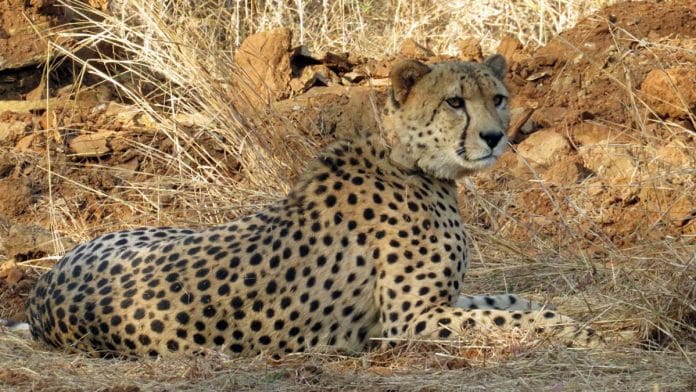


The historic reintroduction of Namibian cheetahs in Kuno on 17 September 2022 set the ball rolling and for project implementation to start after decades of thought and planning. It also paved the way for the arrival of 12 cheetahs in Kuno from South Africa in February 2023 eventually.
The cheetahs were also given Indian names in April 2023. When Prime Minister Modi invited entries for their names in his popular radio programme Mann Ki Baat, over 11,500 entries were received, showing just how keenly people in India were following the project and were excited about it. For the Namibian cats, the names given were Pavan (Oban), Gaurav (Elton), Shaurya (Freddie), Nabha (Savannah), Jwala (Siyaya) and Dhatri (Tbilisi), while Aasha kept her name. Sasha had died due to a kidney ailment in March 2023.
Initial challenges
One of the challenges the project faced initially was high mortality. The rainy season of 2023 was particularly trying, when three cheetahs were lost, one of the reasons indicated being septicaemia. The causes mentioned in media reports for the deaths of other cats were cardiac failure, drowning, complications after tranquilization and, in one case, violent interaction during mating.
Right from the beginning, it has been amply clear to all involved that cheetah mortalities were to be expected. While every loss has felt heavy, valuable lessons have been learnt. One clear indication that the project is on the path to gradual stabilization is that the number of adult mortalities came down significantly in 2024 and 2025 as compared to 2023.
The brighter aspect, and a truly remarkable measure of success, has been the birth of a good number of cubs, which is a clear indication that the cheetahs have been able to settle comfortably in India, have been stress-free and have been able to adapt to the Kuno conditions. Interestingly, Siyaya (Jwala) gave birth to two litters of four cubs each, in March 2023 and January 2024, and a third litter of five cubs in March 2026. While three cubs of her first litter died, the surviving cub, the first cheetah born in India, is doing well and is lovingly called Mukhi, the miracle cub. Aasha also gave birth to a litter of three in January 2024 and a second one of five in February 2026. In a remarkable milestone, Mukhi herself gave birth to five cubs in November 2025. The first cheetah born in India having given birth to the second generation of ‘Indian’ cheetahs proves successful adaptation. As per reports, so far 45 cubs have been born, of which 33 have survived. This is the world’s highest survival rate for cheetah litters for comparable conditions.
During the visit of President Droupadi Murmu to Botswana in November 2025, it was agreed that Botswana would also provide eight cheetahs to India. This will help diversify and enrich the gene pool of cheetahs in India. These eight cheetahs arrived in India in February 2026.
The total number of cats as of March 2026 stands at a remarkable 53 now, which includes 33 India-born cubs.
Also read: 3 Kuno’s cheetahs will now be sent to Gujarat. They’re part of the Botswana batch
Letting the cats roam free
In the past three years, valuable insights have been gained by the team on the ground about managing the population. Cats have been released in the national park, where they roamed freely. They maintained their wild and predatory behaviour during those periods, making kills. At times they had to be brought back to their enclosures for reasons such as health checks. Sometimes the cheetahs have ventured outside the park boundaries, getting into the periphery of towns and fields. Tracking them, bringing them back, providing veterinary care to them as also to the newborns – all this has provided valuable lessons for the teams monitoring them. By December 2025, 16 cheetahs, including sub-adult cubs, were free-ranging in Kuno. Two males, Prabhas and Pavak, have also been introduced to the Gandhi Sagar Wildlife Sanctuary in April 2024 and are adapting well. They were joined by female Dheera in September 2025.
When Jwala (Siyaya) and her four cubs were released into the wild in Kuno in February 2025, pictures of the family frolicking in a river captivated people. It also put paid to all the hoopla over whether Siyaya would be able to hunt in the wild and teach these skills to her offspring. Having given birth to three litters so far, her contribution to sustaining the project has been tremendous.
Every move of the cheetahs, or developments such as births or deaths, makes national media headlines, which goes to show the enormous interest the people of India have in them, and it encourages a healthy conversation around conservation matters.
In the meanwhile, as anticipated, the reintroduction is resulting in additional protection to the ecosystems. The MP government has cleared a proposal to add another 542 sq. km. of area to be protected under Kuno National Park. Besides Gandhi Sagar in Madhya Pradesh, which is being developed as the second major cheetah sanctuary, Mukundara Reserve in Rajasthan is also proposed to be utilized for project expansion, and the three areas may together form a cheetah metapopulation conservation landscape across 17,000 sq. km. over the coming decades.
India’s reintroduction of the cheetah has been keenly followed across the world. In a most interesting development, Saudi Arabia started its own National Cheetah Conservation Programme in 2023 to bring back cheetahs to the wilds of Saudi Arabia. Kazakhstan has embarked on a novel project to reintroduce Amur tigers that it had lost completely. Similarly, Cambodia has requested India for assistance in reintroducing tigers.
In the meanwhile, India has taken the lead to launch a unique initiative – the International Big Cat Alliance (IBCA) – for the conservation of the seven big cats in the world: lions, tigers, leopards, snow leopards, cheetahs, jaguars and pumas.
Also read: 4 cheetah cubs found dead in Kuno National Park, bodies partially eaten
A decade-long project
A complex undertaking like the Project Cheetah needs to be seen over a time horizon of not just two or three years, but in the medium- to long-term perspective of several years, even decades, to establish itself successfully. It will also require the political will, resources and support of the people of India, which India has amply demonstrated that it has.
Sometimes I am asked: What was the need for us to get the cheetah back in India? In a lighter vein, I ask the questioners if they desired that India’s riches, like the Kohinoor diamond, which were all lost during the colonial times, should be returned to India. The answer is an overwhelming yes. I then tell them that getting back an apex species like the cheetah is no less than having the Kohinoor come back to us. We have to be proud of our resolve and efforts to get them back and of course be proud of them as well.
Let there be no doubt that India is richer with the return of a species it had once lost.
 This excerpt from ‘Bringing the Cheetah Back to India’ by Prashant Agrawal has been published with permission from Hachette India.