







When California’s Proposition 8 amendment, which revoked the right of same-sex couples to marry, came up for consideration before the Court of Appeals for the Ninth Circuit in Perry v. Brown, Judge Reinhardt chose to frame the issue not merely in legal jargon but through the language of poetry:
Groucho Marx’s one-liner, “Marriage is a wonderful institution… but who wants to live in an institution?” would lack its punch if the word ‘marriage’ were replaced with the alternative phrase. So too with Shakespeare’s “A young man married is a man that’s marr’d,” Lincoln’s “Marriage is neither heaven nor hell, it is simply purgatory,” and Sinatra’s “A man doesn’t know what happiness means until he’s married. By then it’s too late.” We see tropes like “marrying for love” versus “marrying for money” played out again and again in our films and literature because of the recognized importance and permanence of the marriage relationship.
Yet another interesting case arose before the United States Court of Appeals (Ninth Circuit) in Mattel, Inc. v. MCA Records, Inc., decided on 24 July 2002.
The dispute concerned the popular Barbie Doll allegedly copied and caricatured by a Danish music band in their dance performances in their hit album Aquarium. The matter related to intellectual property rights.
Justice Alex Kozinski, a Romanian-American judge who served on the US Court of Appeals for the Ninth Circuit from 1985 to 2017, was renowned for his rare style of judgment writing—marked by wit, humour and satire. Indeed, a separate chapter deserves to be devoted to his judgments alone. Justice Kozinski opened his judgment with this ‘unconventional’ line:
If this were a sci-fi melodrama, it might be called SpeechZilla meets Trademark Kong.
Honestly, only God can explain why the learned judge chose such an opening. Nevertheless, the judgment makes for fascinating reading as it navigates the tension between trademark law and the First Amendment right to freedom of speech and expression in the US Constitution.
Justice Kozinski goes on to describe Barbie in unnecessary detail, even citing M.G. Lord’s Forever Barbie: The Unauthorized Biography. His adulation for the doll is barely concealed: ‘With Barbie, Mattel created not just a toy but a cultural icon.’
After playfully and elaborately narrating all the details about the doll—including quoting the song, ‘I’m a blonde bimbo girl, in a fantasy world/Dress me up, make it tight, I’m your dolly…’, which appears to have no apparent connection to the legal issues to be resolved in the dispute he was deciding—the learned judge ultimately dismissed both the plaint and the counterclaim by finally advising the parties with: ‘The parties are advised to chill.’ A good advice, no doubt, but an unusual closing line in a judicial opinion.
In United States v. Syufy Enterprises, Judge Kozinski decided an antitrust appeal brought by the US Government against a Las Vegas movie-chain owner, Syufy Enterprises. The Judge’s 14-page opinion—holding that Syufy’s acquisition of theatres from failing competitors was not anti-competitive—was liberally laced with movie titles woven into its narrative.
Although Judge Kozinski refused to confirm or deny suspicions of his being a movie aficionado, an enterprising law review later republished the decision, highlighting no fewer than 215 movie titles that could be traced to a well-known film guide to which the judge had made only a fleeting reference in an obscure footnote. An even more playful judgment emerged from the US District Court for the Southern District of Texas in Bradshaw v. Unity
Marine Corp., Inc., which concerned an action for personal injury. While the facts are of little relevance here, what Judge Samuel B. Kent opened his judgment with makes for interesting reading. For the lawyer involved, however, it was nothing short of public humiliation and evisceration. Whichever wise sage said ‘sticks and stones may break my bones but words will never hurt me’ clearly never met an irritated judge with a penchant for sarcasm.
Also read: Australia to UK—there’s a global campaign to cancel Hindu identity. It’s not Hinduphobia
Judge Kent wrote:
Before proceeding further, the Court notes that this case involves two extremely likable lawyers, who have together delivered some of the most amateurish pleadings ever to cross the hallowed causeway into Galveston, an effort which leads the Court to surmise but one plausible explanation. Both attorneys have obviously entered into a secret pact complete with hats, handshakes and cryptic words to draft their pleadings entirely in crayon on the back sides of gravystained paper place mats, in the hope that the Court would be so charmed by their child-like efforts that their utter dearth of legal authorities in their briefing would go unnoticed. Whatever actually occurred, the Court is now faced with the daunting task of deciphering their submissions. With Big Chief tablet readied, thick black pencil in hand, and a devilmay-care laugh in the face of death, life on the razor’s edge sense of exhilaration, the Court begins.
Having described the lawyers appearing before him and while granting the summary judgment to the defendant, Judge Kent continued in the same vein:
Defendant begins the descent into Alice’s Wonderland by submitting a Motion that relies upon only one legal authority. […] A more bumbling approach is difficult to conceive but wait folks, There’s More! Plaintiff responds to this deft, yet minimalist analytical wizardry with an equal gossamer wisp of an argument. The Court cannot even begin to comprehend why this case was selected for reference. It is almost as if Plaintiff ’s counsel chose the opinion by throwing long range darts at the Federal Reporter (remarkably enough hitting a nonexistent volume).
He thereafter concluded:
After this remarkably long walk on a short legal pier, having received no useful guidance whatever from either party, the Court has endeavored, primarily based upon its affection for both counsel, but also out of its own sense of morbid curiosity, to resolve what it perceived to be the legal issue presented. Despite the waste of perfectly good crayon seen in both parties’ briefing (and the inexplicable odor of wet dog emanating from such) the Court believes it has satisfactorily resolved this matter. Defendant’s Motion for Summary Judgment is GRANTED.
The moral of this story? Never appear unprepared before any judge, much less one with a literary bent, a sharp tongue and a lack of patience. Failing to do the basic preparation risks having one’s incompetence immortalized in biting judicial prose and preserved as a part of history in law journals for generations of law students, lawyers, and judges to read.
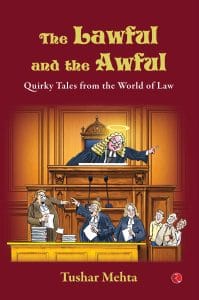
This excerpt from ‘The Lawful and the Awful’ by Tushar Mehta has been published with permission from Rupa Publications.