





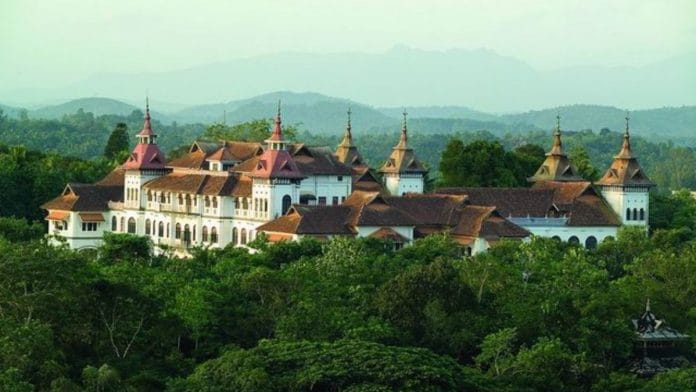


CP’s ambition was boundless, and his devotion to the Travancore royal family absolute. He dreamt of Travancore as an independent nation, convinced it had the economic and military strength to stand on its own.
By June 1947, he had secured two significant endorsements. On 20 June, Jinnah on behalf of the Muslim League wrote: ‘Pakistan will be glad to have your representative and will be ready to establish relationship with Travancore which will be of mutual advantage’.
The same day produced a telegram from Hindu Mahasabha president V.D. Savarkar: ‘In the very interest of Akhand Hindustan itself, I strongly support the Maharaja and the far-sighted and courageous determination to declare the independence of our Hindu State of Travancore. The Nizam has already proclaimed his independence and other Muslim States are likely to do so.
Hindu States bold enough to do have the same rights.’ In Baroda in April 1945, at a session of the All-India States Hindu Mahasabha, Savarkar advised the Mahasabha units in princely states not to join ‘any subversive movements aimed at destroying the Princes’. He, however, clarified that this didn’t mean they shouldn’t demand responsible government.
It was one of history’s ironies that the Hindu Mahasabha and the Muslim League, bitter rivals, both endorsed the princely states’ right to resist integration. CP wasted no time turning these endorsements into political capital. He lashed out at Gandhi, Nehru and other Congress leaders in lengthy letters to newspapers and to critics.
To the editor of The Hindu, which had a day earlier run an editorial critical of Travancore’s ambitions, he pointed out the double standards of the Congress.
‘Pathanistan with 1/3 the population and less than 1/3 of the revenues of Travancore can of course be independent. Nepal with less than the population of Travancore and less resources can of course be independent, and Pandit Nehru can appoint an ambassador to Nepal without too much scrutiny of its internal administration and without demanding a referendum.
‘Siam [present-day Thailand] can be independent, Burma can be independent, Switzerland can be independent, but it is a cardinal sin for Travancore to ask for the fulfilment of what British statesmen have said and undertaken to do,’ CP scoffed.
Attacking Nehru, Kripalani and others, he said their ‘utterances however have been of great assistance to Travancore as they have unified public opinion and in effect solved the problem of independence. I am hoping your leading article will complete the process.’
He quoted Savarkar approvingly, ridiculed the Congress and courted his allies in the Mahasabha. Ashutosh Lahiri, general secretary of the Mahasabha, who was tasked with starting its newspaper from Delhi, met CP in June. CP urged that the Mahasabha come out forcefully against Gandhi’s confused ideology. He also wrote to L.B. Bhopatkar, the Mahasabha leader who would later defend Savarkar in the Gandhi assassination case.
He appealed to the Sabha to make up its mind, and ‘If its opinion is unequivocal and unambiguous, support will come from every Hindu State and not the least of such supporters will be the Ruler and the people of Travancore.’
By the third week of June, an official statement from Travancore said that ‘as a result of personal discussions and correspondence between Mr Jinnah and the Dewan’, the state was appointing an envoy to the yet-unformed Pakistan. The statement detailed how this alliance would facilitate the supply of rice and petroleum products to Travancore and provide a market for the state’s tea, spices and coconut products.
CP named the retired Inspector General of Police, Abdul Karim, as the state’s envoy to Pakistan. Karim had earned a reputation as CP’s hatchet man who oversaw state suppression of the political agitations of 1938 and 1939.
A telegram sent to Nehru from Travancore warned: ‘Kindly pay particular attention to the activities of [CP] and his agent Abdul Karim Sahib … They are in league with Jinnah and Bhopal in creating trouble. Karim is a notorious man and had just returned from Karachi … 5000 Muslim National Guards are being raised in Travancore by Karim’s men. Unless the underground activities of these men are checked immediately there will be great danger in Southern India also.’
Travancore also appointed an envoy to Delhi to negotiate, ‘pending the establishment of permanent relations between the Hindustan Dominion and this State’.
As CP launched his frontal assault on the idea of a united India, Nehru’s patience snapped. He declared that the presence of Travancore’s envoy in Delhi was ‘undesirable and objectionable’.
Nehru knew the danger: never in history had so many ruling families been forced to relinquish power in such a short span of time. Never had a movement built on the principle of non-violence confronted not just the world’s mightiest empire, but also hundreds of mini-empires.
The threat to India’s unity and independence was no longer from the British Raj, but from the princely states with their fortified palaces, foreign allies, money power and, as in Travancore, leaders bold enough to dream of defiance. And even as CP plotted openly, another princely figure—whose charm masked his audacity—was preparing the next challenge to India’s unity.
 This excerpt from Josy Joseph’s ‘Birth of a Nation’ has been published with permission from Westland Books.