



Artificial intelligence isn’t the first technology to challenge our world. We’ve been here many times before. The online Pessimists Archive is an amusing catalogue of past panics about everything from telephones to teddy bears.
Yes, even teddy bears. In 1907, the Reverend Michael Esper preached that the teddy bear, by distorting traditional male and female nurturing roles, was ‘a national peril, threatening to result in race suicide to an unprecedented degree’. Fortunately, he was wrong.
A better example than the teddy bear is the telegraph. This nineteenth-century technology shrank the world and sped it up. But the pessimists of the telegraph era were worried about something far more fundamental: the collapse of human character itself. Critics argued that instant communication would make people impatient, superficial and addicted to speed over substance. They predicted that the telegraph would create a generation unable to engage in deep, sustained thought. This is probably sounding all rather familiar.
The telegraph doomers were right. The telegraph was transforming how people communicated. It was introducing new pressures into our society for speed and efficiency. But their predictions of imminent civilisational collapse were, we can see now, premature.
Fast-forward to 1964 and we encounter one of the closest parallels to today’s concerns about artificial intelligence. President Lyndon Johnson received a memorandum from the oddly named Ad Hoc Committee on the Triple Revolution.
This predicted an impending catastrophe from computers and automation. The warning was signed by some of the most brilliant minds of the era, including Nobel Prize winners Linus Pauling and Gunnar Myrdal. The memorandum argued that these technologies would create mass unemployment on a scale never before seen. The committee predicted that the economy would undergo a transformation as fundamental as the shift from agriculture to industry, but at a speed that would leave millions of workers stranded.
Also read: The one job that will disappear by 2062 — the job of fighting wars
The mass employment that never came
What makes this warning so interesting is that the experts weren’t wrong about the scale of change. Since 1964, computers and automation have radically transformed the global economy. Entire categories of jobs have vanished. New skills have become essential. The workplace of 2024 would be unrecognisable to someone transported there from 1964. Offices no longer have typing pools and filing cabinets. Warehouses often have no people in them.
But the predicted mass unemployment? It never materialised. In fact, the American workforce more than doubled in the decades following the report. The experts writing the report had made the same error as the telegraph doomers: they had accurately identified a genuine transformation but assumed that transformation necessarily meant doom, not boom.
We should not judge this prediction too quickly. In the last couple of decades, we have started to see stagnation in real wages, declining workforce participation and a shift of income from labour to capital. Perhaps AI will be the new entrant that finally tips the balance?
Indeed, many will argue that this time is different. Previous waves of technology automated our muscles. But that left our minds. AI now threatens to automate our decisions. What does that leave for us humans that machines can’t now do?
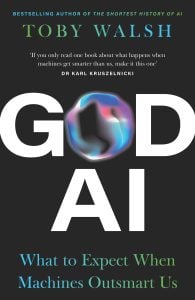
This excerpt from ‘God AI’ by Toby Walsh has been published with permission from MacMillan.