



In January 2023, I attended a Pongal celebration in a village near Madurai. The entire community had gathered—farmers, teachers, shopkeepers and students. There was music, rangoli competitions, traditional games and, of course, the ritual of cooking the sweet Pongal in clay pots as the sun rose. What struck me most was not the celebration itself but the conversation afterward.
An elderly man, Murugesan, spoke with pride about the harvest, about the traditions passed down through generations, about the Tamil language and its ancient literature. He spoke of Thiruvalluvar, Kambar and Subramania Bharati with the same reverence others might reserve for gods.
Then a young college student, Aravind, joined the conversation. ‘Grandfather,’ he said respectfully, ‘I am proud to be Tamil. But I am also proud to be Indian. Why must these be in conflict?’
The old man bristled. ‘Who said they are in conflict? I am saying we must protect what is ours. If we don’t, Hindi will swallow us. Delhi will swallow us.’
Aravind replied, ‘But isn’t it possible to honour Tamil and also engage with the rest of India? Isn’t that what Tamil poets did—take from Sanskrit, take from other traditions and still create something uniquely Tamil?’
I watched this exchange with a sense of both hope and concern. Hope, because the young man represented a generation that is comfortable with multiple identities. Concern, because the old man’s fear was not irrational—it was born of real experiences of linguistic and cultural imposition.
The Resilience of Tamil Identity
What makes Tamil identity so enduring? It is not just the antiquity of the language, though Tamil is one of the oldest living languages in the world, with a literary tradition spanning over two thousand years. It is not just the pride in Sangam poetry, in Thirukkural or in the philosophical depth of Shaiva and Vaishnava traditions. It is something more elemental: a sense of cultural self-sufficiency that does not need external validation.
Tamil Nadu’s social reform movements—from Mahakavi Bharatiyar’s fight for women empowerment and an inclusive society, Periyar’s Self-Respect Movement to the anti-Hindi agitations—were not mere political events. They were assertions of cultural sovereignty. They said that they will define themselves on their own terms. That they will not accept a hierarchy that places their language, their traditions and their way of life below anyone else’s.
This is a powerful and necessary impulse. Every culture needs the confidence to assert its value, to resist homogenization, to preserve what is unique. But this impulse, if not tempered with openness, can also become a fortress—one that keeps out not just threats but also opportunities for growth, exchange and enrichment.
This is the tightrope that India walks: how to be one nation while remaining many peoples.
The Politics of Language
Language is the most emotionally charged dimension of Indian identity. For Tamil Nadu, the imposition of Hindi has always been a flashpoint. The anti-Hindi agitations of the 1960s were not just protests; they were a declaration that Tamil identity was non-negotiable. That history has left deep scars.
Even today, every discussion about a national language, about central government communications in Hindi or about the three-language policy triggers anxiety in the South. This anxiety is not about Hindi as a language, it is about what Hindi represents: the dominance of one region’s culture over others.
I understand this anxiety because I have felt it. When I see central government job advertisements primarily in Hindi and English, with Tamil an afterthought, I feel it. When I see national media defaulting to Hindi as if it were the language of all Indians, I feel it.
But I also understand the perspective of a Hindi-speaking Indian who sees Hindi as simply the most widely spoken language, a practical lingua franca that can unite a diverse nation.
The solution is not to impose one language or to reject all common tongues. The solution is genuine multilingualism—where every Indian language is respected, where learning another Indian language is seen not as a threat but as a bridge and where official communication happens in all major languages without privileging one.
Our diversity is not a problem to be solved. It is a gift to be celebrated. But celebrating it requires more than platitudes. It requires policy, resources and political will.
Caste: A Wound That Will Not Heal
Despite decades of considerate policies for the upliftment of the Dalit community, social reform movements and constitutional guarantees, caste remains the most persistent and pernicious fault line in Indian society. It determines, more than any other factor, the life chances of hundreds of millions of people—their access to education, employment, social networks, marriage partners and even basic dignity.
I met a young Dalit man named Senthil in Villupuram who had earned a degree in commerce and secured a government job through reservation. By every conventional measure, he had made it. But the daily humiliations continued. His colleagues made casual remarks about his qualification. His landlord in the city asked his caste before renting a room.
The cruelty of caste is that it follows you even after you escape it materially. You can change your economic status, but in the eyes of many, you cannot change your birth. This is why caste is not just a social issue—it is a moral emergency that strikes at the very foundation of the Republic’s promise of equality. If language divides us horizontally, caste divides us vertically.
For all our talk of modernity and progress, caste remains the most persistent and pernicious form of inequality in India.
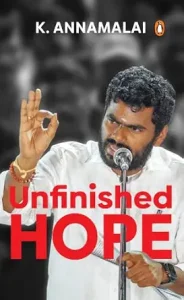 This excerpt from ‘Unfinished Hope: A Political and Governance Book on Indian Democracy, Public Institutions, Civic Action and Nation-Building’, by K Annamalai has been published with permission from Penguin India.