





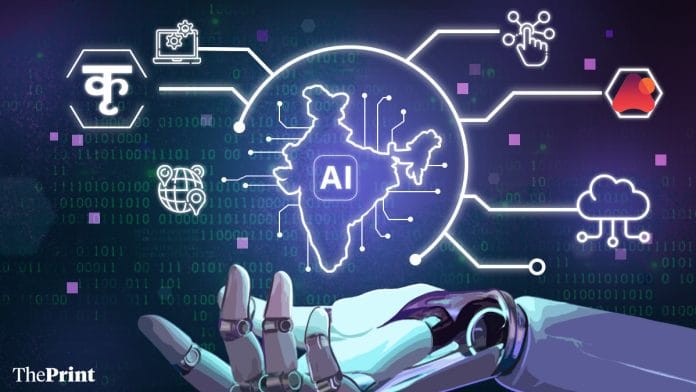


As India invests in economic infrastructure to build a new future, ensuring its economic security becomes a priority. In today’s world, the security of a nation doesn’t depend only on rockets and tanks. It depends on financial security, food security, health security, energy security and now tech security. Underlying all this is the importance of the emerging technologies that are redefining all dimensions of security. As a result, India must enhance its capabilities for technological sovereignty.
For nearly every sector, the private enterprise and government organizations depend on technology and digital platforms. Technological sovereignty means that India should ensure that it is not over-reliant on other countries for technologies that are strategic or can be weaponized. In recent times India has taken strong steps to develop domestic telecommunications hardware. It has encouraged the development of power generation equipment. And there has been a concerted effort to increase domestic production of pharmaceutical ingredients, electronics and defence equipment. The development of domestic satellites, drones and a long-term plan to manufacture semiconductor chips is also an effort towards technological sovereignty. Without technological sovereignty, India will struggle with cyberwarfare threats, foreign manipulation of military hardware, and daily vulnerabilities. A strategic push toward self-reliance is crucial for prosperity and security.
The international payment system SWIFT was weaponized when it switched off services to Russia. In another example, Microsoft and SAP suddenly stopped its services to energy company Nayara Energy because it buys oil from Russia. The decision by Microsoft and SAP to switch off services to Nayara Energy has highlighted the dependencies India has on global technology companies. While the top technology companies like Google, Amazon and Microsoft have strong development centres in India, these companies can be pressured by the EU and the US to take steps that can hurt Indian organizations.
While Microsoft resumed its services later, the message was received. Every technological service offered by an international company can be weaponized for geopolitical interests.
Also read: My darshan of god is always through my camera: Raghu Rai
Sanctions are weaponizing digital platforms not just for organisations and countries but for individuals too. The U.S. blacklisted several International Criminal Court (ICC) judges. As a result, the judges found themselves cut off from American financial systems and services. Their Gmail and Amazon accounts were shut down, their credit cards stopped working, and they were unable to book hotels, trains, or flights through platforms linked to the U.S. banking ecosystem.
The recent years have shed light on the negative impact of the global dominance of a handful of tech giants. At one level, they have been accused of misusing their size by crushing competition and reducing the accountability and choice to consumers. However, these companies are predominantly under the legal jurisdiction of North American and European governments.
Indian digital systems are also dominated by the global giants that grew in the legacy economies. The recent efforts to weaponize digital platforms have led the government of India to make efforts to reduce its dependence on them.
A holistic approach to economic and political sovereignty must include technology. From software to hardware. From AI to robotics. From smart ports to autonomous drones. India will need strong capabilities in every field.
The concerns about tech sovereignty are spreading to many regions of the world. For a while now the dominance of the big tech companies of the US has been a global concern. Even the US government has been actively forcing the big tech companies to reduce their monopolistic behaviour.
The Department of Justice (DOJ) and Federal Trade Commission (FTC) have filed major antitrust lawsuits and monopolization claims against Google, Meta, Apple, Amazon, and others, targeting practices like search engine exclusion, app distribution barriers, and marketplace dominance. Many European leaders too are questioning their over dependence on global tech platforms. At the World Economic Forum’s annual meeting at Davos, business leaders questioned Europe’s tech sovereignty.
AI is evolving so rapidly that every policy maker and business leader will have to be on high alert. Technology is no longer a sector. It is the foundation on which India’s next phase of growth will be built. Over dependence on external suppliers will be weaponized in novel ways in the future. Sovereignty in every aspect of critical technology has to be a security priority for India.
 This excerpt from ‘India Innovates: Technological Sovereignty in a Weaponized World’ by Pranjal Sharma has been published with permission from Vikas Publishing House.