



Justice N.V. Ramana’s tenure as chief justice was marked by a peculiar paradox: administrative energy coupled with judicial stasis.
He was concerned about infrastructure, about filling vacancies in the lower judiciary and about the physical conditions in which courts operated. But the Supreme Court itself was, in a phrase I heard from more than one quarter, ‘lying dead’.
There were no constitution benches. Matters that required larger benches sat unattended. The court functioned, cases were heard, but there was no intellectual energy being directed towards the great constitutional questions of the day.
The prevalent philosophy in the Supreme Court was that some matters were perceived as ‘sensitive’. What the method for classifying a matter as ‘sensitive’ was, was a matter for the registry to sniff out based on their assessment of the chief justice’s own preferences. In the ordinary course of proceedings, there is a roster in the Supreme Court where certain types of matters are assigned to certain benches. For example, if the roster assigns tax appeals to one particular two-judge bench, then the appeals that come up in that area will be heard by that bench, with the registry simply performing the administrative tasks of preparing the cause list and so on. However, when a matter is marked as ‘sensitive’, it is shown to the chief justice for his final decision before being listed. This discretionary and almost arbitrary power had grown to unreasonable proportions by the time Justice Uday Umesh Lalit took over. Over 1,000 cases lay unlisted. It was impossible to tell why on earth some of those matters had been marked as sensitive when they were positively mundane. It was Chief Justice Lalit who began to assign some of these matters.
Even today, it is quite clear that many important matters that are hanging fire are due to this black hole process by which one person has the power to postpone indefinitely. This includes a matter that I had hoped to hear during my tenure and about which more will be said later: the issue of whether certain questions decided in a matter regarding the Prevention of Money Laundering Act (PMLA), 2002, should be referred to a larger bench.
I had first entered the collegium during Justice Ramana’s tenure, when Justice Nageswara Rao retired in June, joining the first five.
Owing to retirements that occurred in quick succession, I joined the first three not long after that. But no meeting was held in July because Justice Ramana was retiring in August. The whole month passed without any meetings.
When discussions did take place, I had a firm view about how the collegium should function. I had told Justice Ramana: ‘I have no difficulty discussing names for appointment. But the judgments and disposals must be circulated first.’
This was, I felt, elementary. How could we assess a judge’s suitability for the Supreme Court without reading their prominent judgments? I felt that we judges did not appreciate how bizarre it would sound to a member of any other profession that this was not already the case. The task of a judge is to write judgments. Almost every judge up for elevation to the Supreme Court, with very few notable exceptions from the bar, already has a long track record behind him. That elevations were made based on ‘soundings’ and purely informal impressions – just or unjust – that had been formed about a candidate did not sit right with me. I even felt that proper analysis should include not just judgments but also disposal rates. Were judgments being delivered on time? Was there a delay? Both quality and quantity matter.
Justice Ramana argued that this had not hitherto been the practice and that it would be difficult to gather this material quickly.
I had no choice but to hold fast to my view: ‘I am sure this is not what you are happy with, but I cannot let the collegium proceed without it.’
I knew that I was blocking the process, and I knew it was not making me popular. But this was a conviction I had carried since my earlier years as a judge. I had once asked Justice Ramesh Chandra Lahoti, the former chief justice of India, how collegium meetings happened. At the time of that conversation, the collegium itself was a relatively newfangled entity only about a decade in existence. He said assessments took place and discussions occurred.
‘Are judgments put before the collegium?’ I asked.
‘Well’, he said, ‘we broadly know what someone is writing. Integrity is something you can find out … reputation you can find out.’
I was somewhat taken aback: ‘But judgments? How can five people say they know what a judge is writing? They may have come across some work, but surely there must be a system.’
He confirmed there was none. No structured mechanism existed for collecting and analysing judgments before considering appointments. What also troubled me was the absence of constitution benches. The Supreme Court had accumulated dozens of pending constitutional references – fundamental questions about rights, federalism, the scope of legislation, etc. – and they sat there year after year. The regular work of appeals and SLPs dominated the court’s calendar. Constitution bench matters were perpetually deferred. It was left to his successor, Chief Justice Lalit, in just two months, to show what could be done.
One important development during the Ramana-to-Lalit transition was the elevation of bar judges – advocates appointed directly to the Supreme Court bench, bypassing the High Courts. For a long time, there had been no bar judge appointed. Sporadically, there had been a few cases where Justices Kuldip Singh and N. Santosh Hegde had been elevated. But during Justice Rajendra Mal Lodha’s brief five-month tenure as chief justice, he had pushed for five direct bar appointments. The first two went through: Justice Uday Umesh Lalit and Justice Rohinton Fali Nariman took office in 2014.
Elevations directly from the bar began to gather steam. During my time on the court, Justices Indu Malhotra, P.S. Narasimha and K.V. Viswanathan joined directly from the bar.
I believe that bar appointments are important for the intellectual diversity of the bench. A good bar judge brings a different perspective – the advocate’s understanding of what it is like to stand before the court, to wait for orders, to have one’s professional life depend on institutional efficiency. But the process by which they are selected has been too ad hoc in some respects and too dependent on the personal preferences of whichever chief justice happens to be in office. Interestingly, the Constitution also provides for a third type of appointment to the Supreme Court – that of ‘distinguished jurists’. No criteria are laid down for this category of appointment, but it is ordinarily understood that it would have to be a legal academic of very high standing. In the past, Professor P.K. Tripathi’s name was once considered as a possible appointment under this category when he had served as a member of the Law Commission. But no such appointment has ever actually been made.
The bar is owed a certain courtesy in such matters. Judges must not have an entitled attitude when searching for talent. Our task must be to see that the best come to the bench rather than treating judicial service as some sort of homage that successful lawyers are bound to render to the fraternity. The case of Gopal Subramanium, the former solicitor general, is well known. I also think often of Arvind Datar, one of the country’s finest tax and constitutional lawyers who was once asked, gave his consent and was then simply never approached again, such that when, later, his name came up afresh, he rather understandably declined to move forward with the whole thing. Justice Nageswara Rao had earlier declined and then had to be persuaded to agree. If we ask a good person to give up a flourishing practice, the least we can do is to get back to her or him on the outcome of the candidature.
When the work of the collegium resumed in earnest upon Justice Lalit taking office, he agreed wholeheartedly with my position. From his time, soft copies of judgments were circulated before collegium meetings. All the members of the collegium could have access to a candidate’s judicial record and the opportunity to scrutinize it before making up their minds – a process that was continued and entrenched by Justice Dhananjay Chandrachud during his long tenure. While entirely just criticisms of the collegium’s opacity and accountability deficit remain, this one reform at least brought a semblance of professionalism to the process. It has been a lasting legacy and a practice that has, thankfully, not fallen out of use since it was institutionalized.
Justice Lalit’s tenure as chief justice was brief – just two months – but I considered it among the most impactful of any I served under. He had prepared meticulously, and I had advised him to ‘board the train running’ to lay his groundwork in advance because two months left no time for a learning curve.
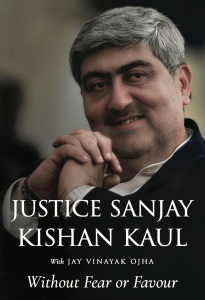 This excerpt from ‘Without Fear or Favour’ by Justice Sanjay Kishan Kaul and Jay Vinayak Ojha has been published with permission from Juggernaut Books.