




The Yuvraj Singh Centre of Excellence (YSCE) positions itself as an integrated 360-degree sports development institute that, apart from setting up high-quality academies, also aims to identify and support technology solutions to enhance sports and pitch intelligence. Renowned players and the BCCI-certified coaches, physios and trainers, customized sessions, video analysis to correct and improve the technical aspects, and mental conditioning and fitness sessions are among the standout features, as per its claims.
Even beyond those associated with cricketers, there are many academies that offer high-end services. Some have upscale gymnasiums. Some have modern cafeterias with Italian marble flooring, offering protein-rich diets tailored to trainees’ requirements. Some even offer exchange programmes with foreign clubs. The list of add-ons continues.
Cricket’s popularity notwithstanding, it remains a costly game, often beyond the reach of the average Indian. At a prominent academy in Uttarakhand, for instance, theone-time cost runs to nearly INR 6 lakh. Training and accommodation inflate the bill by another INR 70,000 per month. Even without boarding, it costs around INR 50,000.
For Kamala, too, the coaching centre for her son did not come cheap. She earns INR 12,000 per month and spends nearly INR 5000—about 40 per cent of her salary—on herson’s coaching.
The coaching fee is only part of the problem. Add to that equipment costs—bats, shoes and kit—and the bill rises sharply. To play even at club or district level, a basic bat and kit can cost around INR 20,000. A high-qualitybat can cost around INR 50,000.
To give perspective on these expenses and their affordability, the Per Capita Net National Income, as per the Government of India, was INR 8197.83 per month for the Financial Year 2022–23. For a country that has among the greatest disparities in earnings, this paints only part of the picture. The top 1 per cent of the population owns40 per cent of the wealth, while the bottom 50 per cent owns only 3 per cent. Earning even INR 25,000 per month places an individual among the top 10 per cent of earners in the country.
It is not just in Uttar Pradesh that parents are enrolling their kids in coaching academies in large numbers—it is a pan-India phenomenon.
The demand for cricket coaching has led to a proliferation of academies across India. What is more worrisome is that many of these coaching centres are unauthorized and driven solely by pecuniary motives.
‘Noida cricket academies have a business model—enrol young cricketers, play with their future,’ according to a November 2024 report by ThePrint. As many as 28 academies operating without authorization and‘without offering adequate services or caring about theirchild’s progress as a cricketer’ had received notices from the Noida district administration.
Also read: Nuclear scientist, single mother, breadwinner of the family. Kerala woman did it all
A flourishing corporate cricket culture, affordability and swathes of farmland in the region encouraged the rapid growth of such unregistered academies, the report said.
For parents across India, however, that seems a small price to pay. Nonchalant and dismissive of concerns, parents with a singular obsession are enrolling their wards in cricket academies—some as young as four or five. Inspiration is not hard to find.
Vaibhav Suryavanshi (14), who made headlines during IPL 2025 as the youngest cricketer to score an IPL century, started practising at four. He was picked by Rajasthan Royals at auction for INR 1.1 crore.
Vaibhav’s journey began in Tajpur village, Bihar, when his father, Sanjiv, noticed his passion and built a small playing area in the family backyard. Vaibhav’s father sold his farm in Motipur to fund his son’s dreams, and his mother subsisted on three hours’ sleep, waking at 2 a.m. to prepare Vaibhav for a long day of training.
A few days before Vaibhav made headlines, seventeen-year-old Ayush Mhatre turned out for Chennai SuperKings. Ayush’s ease with the bat as a six-year-old convinced his family they had an extraordinary cricketing talent to nurture. In pursuit of that, his grandfather, a retired railway employee, accompanied Ayush daily by local train from Virar, a northern Mumbai suburb, to Oval Maidan in south Mumbai for practice—a one-way journey of 80 km.
To make the trip, Ayush and his grandfather would wake at 4:15 a.m. to catch the 5 a.m. local. Attempts to persuade the grandfather to forgo the early start proved futile.
Such sacrifices are not rare.
Indian all-rounder Nitish Kumar Reddy’s father, Mutyala, placed a punt on his son’s talent at age twelve. He quit his job at Hindustan Zinc to ensure his son’s cricket was not disrupted. To make ends meet, he invested in a business that failed, and the family scraped through, surviving on Voluntary Retirement Scheme (VRS) benefits. Even with meagre earnings, he was content to devote his entire focus to his son’s cricket. The move paid off: in October 2024, at twenty-one, Nitish made his debut for India.
In 2013, eight-year-old Musheer Khan made headlines as the youngest player to feature in the Kanga League. Two years earlier, he had played Giles Shield, an Under-14 inter-school tournament in Mumbai. Videos of him bowling to Yuvraj Singh were recorded by news channels and comparisons were made to Bishan Singh Bedi. In just over a decade, he became part of India’s 2024 Under-19 WorldCup-winning campaign and later secured an IPL contract.
Prashant Shetty, Ayush’s coach, is vehemently against initiating children under ten with the leather ball. ‘Parents will come with hopes of turning their kids into the next superstars, but it is the responsibility of coaches to decline them. The cricket ball can really hurt and injure kids. Even if they have potential, early exposure can instil fear and leave them scarred long before they are ready,’ he warns.
Ironically, Prashant coached Prithvi Shaw, who began competitive cricket at seven. He recognizes the inconsistency in his argument, yet maintains his position: ‘Prithvi was a unique talent. Everyone can’t be like him. Extraordinarily talented cricketers do start early, but their training sessions need to be managed well. Even when you see youngsters like Ayush and Vaibhav succeed after early starts, they are exceptions. It cannot be the responsible approach for everyone.’
On social media, wrapped in 45-second clips, these stories abound—of children taking to cricket early, parental sacrifice, and the rags-to-riches narrative. The details in between are often lost, and narratives are peppered with factual inaccuracies.
On the face of it, these inaccuracies seem harmless. But in a sea of information, for those unable to distinguish between fact and fiction, such tales can foster misplaced hope. Fictionalized success stories spread as soon as players make a mark, feeding unrealistic expectations.
Glancing at the national team, such stories seem numerous, yet they represent only a fraction of the lives the game has altered. What appears as overnight success is often decades in the making—away from the limelight and without guarantees. When these long labours are clubbed with eventual success, the narrative becomes romantic and hope proliferates.
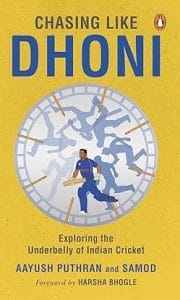 This excerpt from ‘Chasing Like Dhoni’ by Aayush Puthran and Samod has been published with permission from Penguin Random House India.