



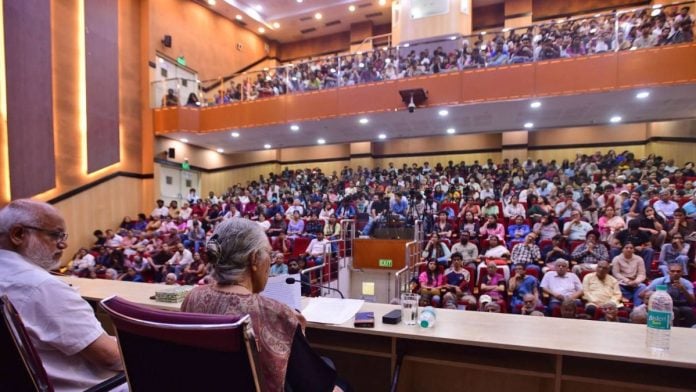
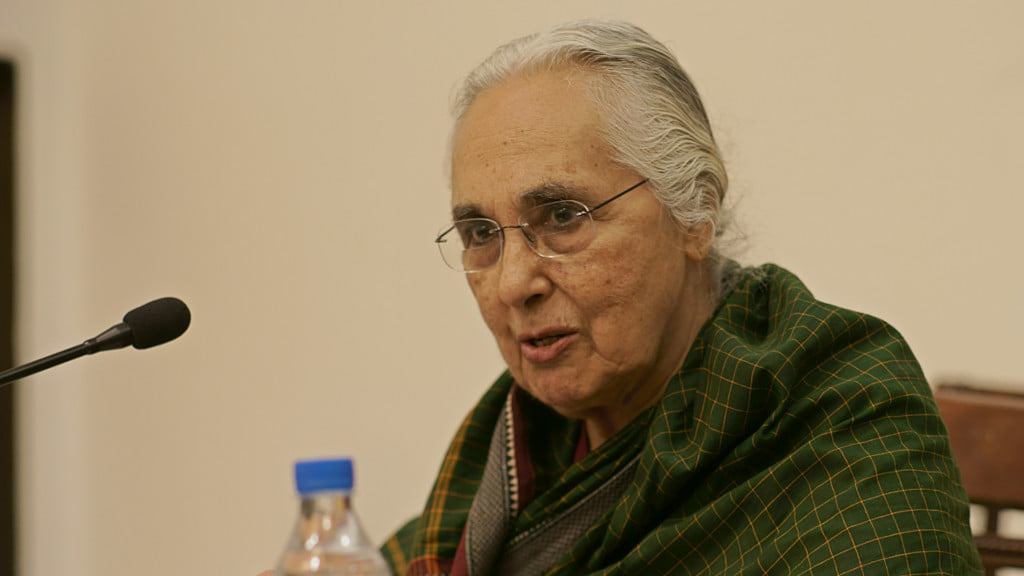
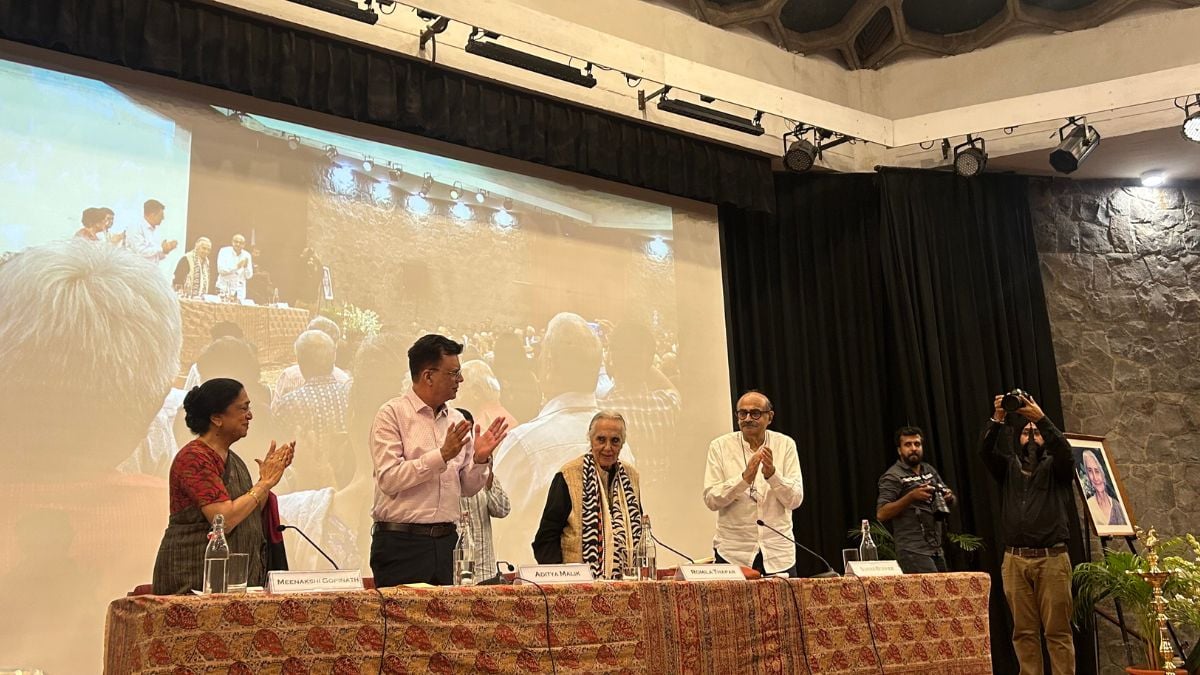
Romila Thapar delivered the Second Sitaram Yechury Memorial Lecture in New Delhi on 25 October 2026, speaking on the theme ‘Historiography and Early Indian History’.
She spoke about decolonisation of Indian history, the conflation of nationalism and religion and how the Hindutva reading of history is not to explain what happened in the past but instead to construct statements for contemporary political use.
Here’s the entire speech:
I would like to begin by thanking the Sitaram Yechury Memorial Trust for the invitation to deliver a lecture. You do me a great honour, which I much appreciate. Thank you very much indeed. Thank you also for your kind introductory remarks, both yours and the professor’s.
The subject that I have chosen to speak on is one on which I did have a small, short conversation once with Sitharam some time back. We did not have the opportunity to develop it into a larger conversation or discuss it at length. Nevertheless, it was, even briefly, a very informative conversation for me and, in a sense, I am speaking this evening on a subject which is a kind of act.
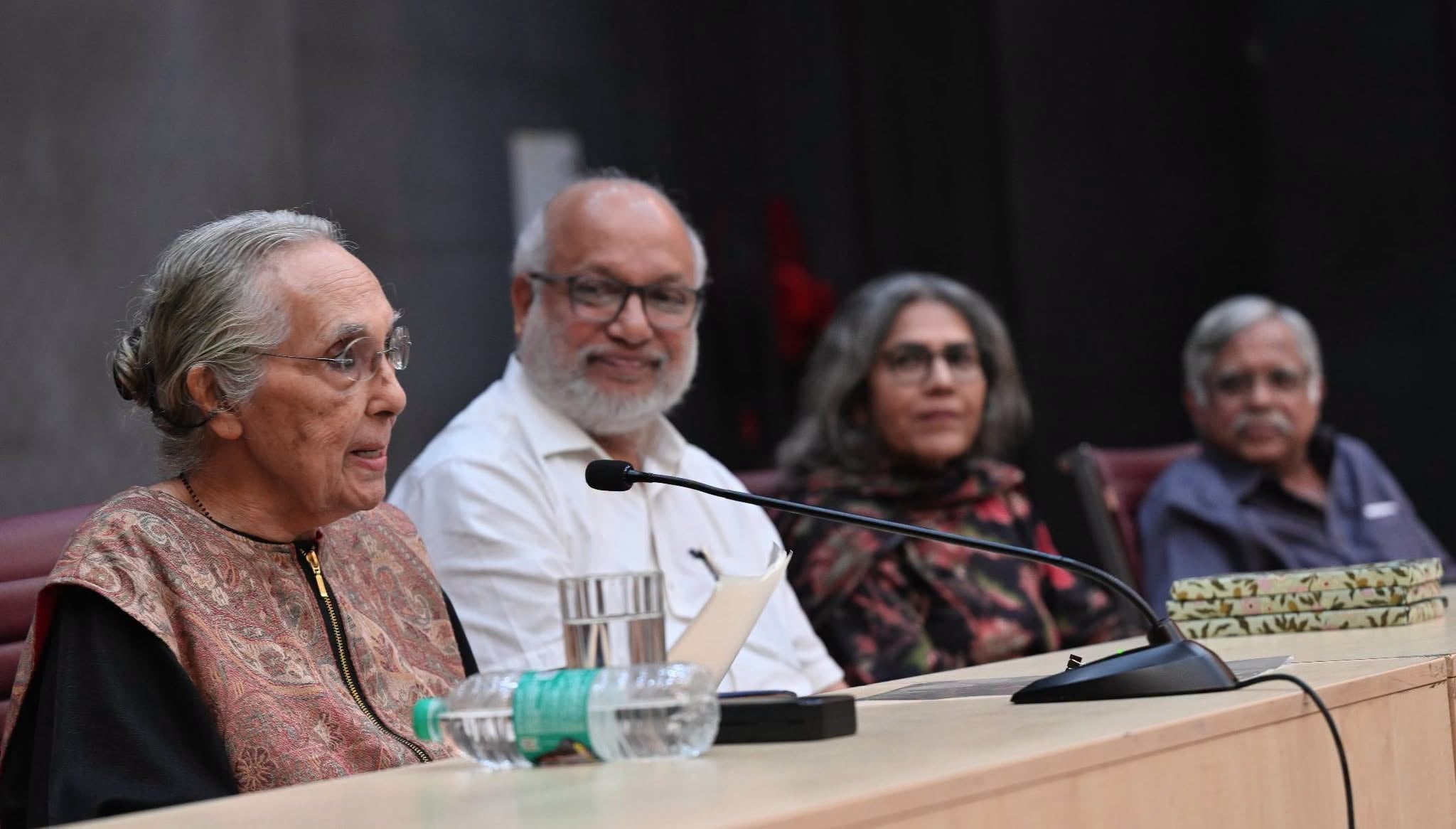
Many decades ago, when I was still young, I decided that I would study ancient Indian history. I was curious about the remote past, which in those days was studied quietly.
As a historian of ancient times, I envisaged my future life as being a quiet, tucked away, undisturbed study of a subject that didn’t interest too many people.
I envisaged my future life in this quiet formation.
However, slowly the opposite happened.
The version of history propagated by the Hindutva ideology, for example, is characterised by taking Hindu majoritarianism as the primary social factor of the past, with its interpretation becoming the history of the nation. This requires that history be interpreted only in one particular way that makes this intention plausible and inevitable.
Some of us who wrote about the new questions being asked by historians of the ancient past have been endlessly attacked on social media and similar outlets.
This is because we question the past as constructed initially by colonial officers reading Indian history. It is now being largely continued in the readings of ideologies such as that of Hindutva.
However, there are also many who have read our historical writings and viewed them as pointing to worthwhile directions to pursue.
Pre-modern history has consequently become highly controversial. How did this happen? This is a question which we need to ask ourselves.
I belong to the generation of historians who were questioning the colonial interpretation of Indian history. A reading about which we had many doubts.
In the post-colonial period, explaining historical events based on reliable evidence and rational explanation had a more authentic trajectory.
Implicitly, therefore, there was a turn to historiography with reference to early Indian history. We inquired into who the people were who influenced historical interpretation and why they think in the way that they did.
This is what I would like to speak about this evening. Historiography and its relevance to early history.
The interpretation of Indian history underwent substantial change from the mid-20th century onwards. What earlier was a bare narrative of where and when events happened now faced two more incisive questions: Why and how did events happen and what were the consequences?
All fundamentally important questions.
We were therefore required to look more questioningly at the known evidence, and this in turn led us to look at various other relevant sources. A process now normal to historical research. Inquiring into the many facets of a society, including analysis of its social structure, its economy, and its belief systems, became essential and normal.
What changes were affected and were significant, and was the interface between them?
Treating them as separate, self-contained compartments of society, static over time, ignored their interconnections, which were apparent and extremely significant.
The changes that came about and shaped society had to be explained. Equally important was knowing more about the authors of the sources and their orientations. Were these authors providing some explanations of the evolving society? Did they have an agenda that influenced their questions and explanations?
Historiography asks questions that help analyse the data and this became more central to historical writing. The systematic investigation of the past meant the use of an acknowledged method and therefore a method gradually evolved.
People often say, “We know that there is a method for studying science, but how does history have a method?”
But it does, and the method is now recognisable and accessible in most disciplines. The method requires determining a theme to be researched and locating the sources to be consulted, both textual and material objects where they exist.
Yet, evidence from diverse sources cannot be used indiscriminately. Disciplines have specific methods to assess the reliability of both the source and its reading. Insistence on using only proven reliable evidence differentiates professional historians from those who write what they claim to be history, but where personal views, whether verified or not, are often upfront.
The next step is correlating the evidence with the event to provide a logical and rational causal explanation of the event. This helps explain the how and the why that I referred to earlier, [which] leads to historical interpretation.
I am not arguing against the application of an ideology to a historical explanation. But I am arguing that the explanation has to be based on reliable evidence and open to questioning before it can be adopted.
We today are in the midst of a telling example of this situation. I am referring to the contention between the professional historian who uses the historical method and the many others who write without verified evidence. The latter give us what is often called pop writing on history, most frequently aired on social media, and such.
They are unfamiliar with using a method of analysis. They can be ignored, as they have been so far.
However, when these pop versions of history become the basis of history, especially history textbooks, and are co-opted into the teaching curriculum and official presentations of history with the intention of furthering an ideology, a specific recognisable ideology, then the professional historian has to assess their validity and that’s a bit of what I’m going to try and do today.
The historical analysis of those who view history as a social science is based on relevant and reliable data and tested explanations.
The version of history propagated by the Hindutva ideology, for example, is characterised by taking Hindu majoritarianism as the primary social factor of the past, with its interpretation becoming the history of the nation. Defined as Hindu and by justifying the establishing of a Hindu Rashtra on the basis of this history.
This requires that history be interpreted only in one particular way that makes this intention plausible and inevitable.
Primacy has to be given to the Hindu community dominant in the early period when society is said to have been idyllic.
This, it is said, was reflected in a very long golden age.
This is said to have continued until the arrival of various Muslim rulers and their cohorts, who were responsible for encouraging the victimisation of Hindus.
There is strong evidence to the contrary in the work of professional historians, but this evidence is ignored or dismissed as prejudiced.
Those who do not accept this reading of the Indian past are all interestingly now dubbed Marxists. As are those who research social and economic history of any kind.
Irrespective of whether their reading is actually Marxist, or not at all. There is little recognition that social scientists across the spectrum use methods of analysing evidence, and that analysis as a preliminary step is essential to any historical explanation whatsoever.
The historical analysis of those who view history as a social science is based on relevant and reliable data and tested explanations.
What is implicit in official versions of history today is a rather stagnant and barren historiography. There is no reflection of the diverse debates on the kind of social change associated with the Indian past, whether it be Marxist modes or the Weberian theory of culture relating to religion, or any other. Nor do they seem to be aware of the analysis of other social sciences exploring events connected to social and economic history.
Let me turn now to the second major change implicit in the historical method. This is that history slowly moved from being a subject in the humanities towards being included in the social sciences. This evolved from searching for explanations and using comparative data across histories and cultures, as well as using the kind of questioning suggested by the social sciences.
The social sciences, as you all know, consist of disciplines like anthropology, sociology, demography, etc. This, in turn, encouraged interdisciplinary studies. Archaeologists and historians of early India have found it important to analyse the patterns of a society under study, sometimes involving a multidisciplinary approach.
Thus, today researching the history of the Vedic period for instance, the search is not limited to only the evidence of the Vedic texts. Although these are primary sources, other sources that have to be consulted include archaeology for data on material culture, linguistics for deeper language research, and most recently, genetics to ascertain the peoples that came together to create a new culture.
This points obviously to fresh questions and requires some acquaintance with these different disciplines and the kind of evidence that they provide.
An aspect that requires greater attention is knowing the intellectual approach or ideology of the historian or anyone claiming to write history. This requires historians to defend their generalisations with adequate and proper data and have a viable explanation for their readings.
Historiography, therefore, becomes significant.
An obvious question now is whether the author’s historical generalisation is based on how he or she has interpreted the evidence, or is the reading intended to affiliate the author’s loyalties to a particular way of thought?
Unless the history is based on reliable evidence, it becomes unacceptable.
This raises a historiographical question. Is the interpretation of an event made only to explain a happening in the past, or does that reading have an agenda that also relates to present times?
This is a fundamental question given the public use of history in our times. It’s quite amazing and surprising how much history is playing a public role today, which it never did in the past.
Or does that reading of history have an agenda that also relates to present times?
This is a fundamental question given the public use of history in our times. The answer lies partly in how the writing of history was introduced to us in colonial times. And partly in how that history, although proven to be erroneous, nevertheless continues in some explanations and theories, even if dressed up in a slightly different language.
The history written in colonial times is well known, but let me repeat it briefly. The European understanding of Asian history two centuries or so ago was summed up in the phrase oriental despotism.
It was argued that all of Asia was under the control of oriental despots. It maintained that all Asian societies lacked being a state, as they were governed by despotic rulers who controlled a vast peasantry that labored to produce immense wealth for them.
The peasants were controlled by a bureaucracy which brought the wealth to the despot. It was an unchanging, static society, [and] therefore required no history to legitimise it or to provide continuity. It was distinctly different from European societies.
Recognising historical change was imperative for 19th-century thinkers. European history registered change, not Asian history. Marx worked out modes of production, mutating from primitive communism to slavery and then to feudalism, followed by capitalism.
The question was whether all societies go through these modes, or were there differences in the structures of European society that disallowed one single uniform pattern?
To refer to a historical reading as Marxist requires testing the applicability of these modes that he discussed to a historical mode. An extensive debate in India in the 1970s and 80s focused on whether the early medieval period, that is a period post-Gupta to [the] early second millennium AD, was characterised by feudalism.
So, there was the big feudalism debate that was going on. It did not produce a definitive answer, but the debate was extremely instructive. It triggered new and effective investigations of what earlier had been called the dark period of Indian history.
This is an important distinction because it does show us the difference between merely repeating a pattern again and again and saying, “Oh, this happened over and over and over, over time.” And trying to see the changes that occurred in the historical pattern from early periods to later periods.
However, colonial interpretations specific to Indian history went off on another tangent altogether. It was insisted that there was an absence of a sense of history in India, and therefore what was the answer?
Also, there was an absence of histories similar to those of Greco-Roman cultures.
“In India, as elsewhere, there was the need to record the past and treat it as part of a pattern, to facilitate understanding it, and perhaps even controlling the reading of the past.
It was not what we call history nor was it just mythology.”
We must remember, therefore, that early Indian history was based on colonial perceptions because they sat and then they wrote the history of India from their own perceptions.
Yet, had they looked more carefully, they would have recognised some texts from the past as having a small strand of historical perception.
The term Itihasa, thus it was, suggests a way of looking at or representing the past. In India, as elsewhere, there was the need to record the past and treat it as part of a pattern, to facilitate understanding it, and perhaps even controlling the reading of the past.
It was not what we call history nor was it just mythology. The Vishnu-Purana for instance, composed in the early mid-1st millennium CE, narrates in one section reasonably reliable genealogies of some historical dynasties.
From a mythological start, it goes to the history of Magadh and continues to the Guptas. Post-Gupta inscriptions often carry succession lists of ruling dynasties known to both colonial and Indian scholars. This partially correct narrative of the Indian past was nevertheless included in what came to be called the Itihasa-Purana, the Indian historical tradition.
It was developed further in the historical biographies of the post-Gupta times, such as the 7th-century Harshachararita of Bhanabatta and the biography of Harshavardhana of Kannauj. And the later one of the Pala king Ramapala was the Ramacharitram written by Sandhyakar Nandi.
These were not just hagiographies, as colonial scholars dismissed them. They had small comments on royal authority. The first mentions complaints from rural folk about the upsets caused during campaigns by the encampment in the area of the huge army of camp followers.
It’s actually very impressive when you read it. The size of the camp that constituted the encampment even for a campaign. The second mentions a revolt interestingly by buffalo-riding leaders, local leaders who rode buffaloes, and historians have read the evidence variously.
Some have read it as a peasant revolt, and some have read it as opposition from feudal lords. In addition to these biographies were the Vamsha Charitra, the chronicles, some referring casually to local dynasties, and others being more mature histories, such as the much-admired Rajatarangini, written by Kalhana in the 12th century.
This was not just a historical narrative, very good, high-quality historical narrative I might add, but was thoughtful writing about rulers and governance in the history of Kashmir.
The past changes in form and content over time in keeping with historical change, and this influences altered perceptions. Historians search for a pattern in explaining the changes. There must have been much discussion in the courts of the time as biographies and chronicles were forms that continued into the second millennium CE.
Those written in Sanskrit continued the previous tradition, and parallel to them were texts in Persian for the courts of the Sultanate and the Mughals.
Was there any overlap in these forms?
Curiosity about the past continues and is evident. For example, Feroz Shah Tughlaq is curious about the pillars of Ashok Maurya, presumably thinking of them as symbols of power.
Remember that the inscriptions on these pillars could no longer be read. So, they didn’t know what these pillars were all about, but they were just impressive remains from the past. One of them commands the highest point of his citadel in Delhi. If you go to Feroz Shah Kotla, you see this pillar right at the top.
Were the pillars also viewed as symbols of legitimation from the past. The new rulers were legitimising themselves by paying attention to, or giving respect to, objects of the past.
The Mughal rulers either wrote their own memoirs or supervised their biographies. Sanskrit texts were translated into Persian.
Given all this activity, it can hardly be said that a sense of history was absent in pre-colonial India. Yet there was one major source of history which did not enter the discussion on historical writing in early India until much later.
This was the multitude of long inscriptions that have surfaced through the research of both Indian and colonial scholars. Inscriptions were engraved on stone and on copper plates, many as royal records, some concerning important events.
They carried genealogies of ruling families with accompanying dates, which in most cases were based on a mathematically oriented chronology, which differed from mythological time, as it is given in the texts.
Had the inscriptions been consulted at the outset as the main source of Indian history, the Indian past may have been read very differently from the way it was read by using religious texts only.
Inscriptions provided a variety of evidence. The edicts of Ashoka were the earliest and were already unique in propounding the ethics of Dharma.
Early inscriptions gave bare information on rulers with some exceptions. The titles are grand. The ancestry is brief. But from the post-Gupta period onwards, inscriptions record a variety of events and give us a full description of the kind of society that existed.
Dynastic genealogies, land relations, villagers defending themselves against cattle raiders, fiscal arrangements such as taxes, procedures of governance, commercial tax actions, caste relations, women becoming Satis, donations to religious organizations and much, much more.
Thus, the body of information for writing histories was not sparse. The data from inscriptions gave an impetus to social and economic history, since many inscriptions were concerned mainly with just these aspects of society.
Given that some were deciphered by colonial scholars, one wonders why they argued so vehemently that there was an absence of history in early India. Was it that many inscriptions were authored by non-Brahman scribes so automatically received less attention?
Texts such as those may well have been in the custody of bards and genealogists with a lower social status than Brahmans associated with religious texts.
By insisting on an absence of history, this made it easier to impose a colonial reading of Indian history. And that is precisely what happened.
Colonial officers deciphering scripts, reading ancient texts, investigating artifacts and sources were revealing a very complex past which had to be carefully understood, and it was becoming difficult to understand the complexities.
However, those writing the history of the colony were putting together a narrative of their own invention geared to their colonial concerns. An influential imprint came with the work of James Mill: The History of British India, which is the title published from 1817 onwards.
He argued that India consisted of two nations, the Hindu and the Muslim, and that these nations were permanently hostile to each other. It’s a curious invention. His qualifying of nationalism with religion is a serious confusion.
Whereas religion has existed since millennia and has to do with belief, the concept of nation emerged only three centuries ago in Europe, identified with territory, a unified community and an independent political unit.
That Mill refers to the permanent hostility of the two nations defined by religion is again incorrect. There were many kinds of hostilities in past times. Hindu rulers fought each other in pre-Islamic times, sometimes over territory or over political control. Kingdoms grew from conquests.
Religion was also a cause of violent conflict between the shramana religions, Buddhism, Jainism, Ajivikas, questioning Brahmanical belief and practice and these were referred to by the Brahmana texts as religions of the Nastikas, non-believers. Jainism was gradually confined to Karnataka and Gujarat. Buddhism was finally exiled and the Ajivakas faded away. So the Nastikas were taken care of.
Later, the conflict was between Hindu and Muslim rulers, but as before was not invariably a religious confrontation, as maintained by the two nation theory of Mill, and endorsed later by Hindu and Muslim communalism.
Conflict was more often over territory and access to power. Such conflicts are never monocausal. The historiography of the conflict makes this clear, as does the fact that Hindus and Muslims sometimes confronted each other. But at other times the one fought in support of the other for reasons other than religion.
“To maintain that every conflict was an expression of religious antagonism and that this antagonism pervaded all activities is utterly untenable. The causes were differentiated and this has to be both understood and explained.”
As for instance, at the Battle of Haldighati. This battle took place in Rajasthan in 1576, between the army of Rana Pratap and the Mughal army. The conflict was centrally concerned with territorial rights, the regaining of kingdoms, and the exertion of power over territory.
The vanguard of Rana Pratap’s army was a substantial contingent of Afghan soldiers, led by Hakim Khan Suri, who was trying to re-establish Suri power in the middle Ganges plain.
The Mughal army was commanded by the Rajput Raja Man Singh and was victorious. This battle has now been converted into a crucial confrontation between Muslim invaders and Hindu rulers with the latter fighting to defend Hinduism.
To maintain that every conflict was an expression of religious antagonism and that this antagonism pervaded all activities is utterly untenable. The causes were differentiated and this has to be both understood and explained.
Mill’s theory provided an origin for the much-proclaimed two-nation theory, which was common in the 19th and 20th centuries. This was present in colonial and historical writing and was discarded in later the 20th-century writing.
“Decolonisation would need to question the Hindutva ideology itself and refute it.”
By then the politics of Muslim and Hindu nationalism were being formulated by the Muslim League and the Hindu Mahasabha and their successors. There was opposition to it among secular nationalists, but perhaps it was not articulated strongly enough. It became a historical support for the partition of 1947.
It is still being drawn upon to encourage religious conflict. The supporters of the Hindutva ideology speak of the need to decolonise history. Certainly a very crying need. This has been and is being done already by professional historians.
Decolonisation would need to question the Hindutva ideology itself and refute it. Religious nationalism bases itself on religions projected as monotheistic, and this negates the historical investigation of the interface of communities, of which there was much interface, enormous amounts.
Historiography requires that both the conflictual situations, and the friendly ones, would have to be explained. Each contributing variously to shaping the historical situation, and also shaping one another.
Mill’s theory was also what led to the first periodisation of Indian history into the Hindu, Muslim and British periods. A periodisation which I might tell you has now been totally discarded by historians.
Religious factors, even where relevant, should not monopolise historical explanation.
The other colonial theory that had a substantial influence on the writing of early history and continues to do so, is the theory of Aryan race. That Sanskrit, Greek and Latin appear to be closely related languages was argued by William Jones and later by Frederick Max Mueller and others.
It was assumed by some that those who spoke related languages indicated descent from the same race. Even though Max Mueller did criticise this assumption, it remained a belief among many even after the concept of race had been set aside by social scientists.
Inevitably, the prevalence of race meant a hierarchy in social categories. Upper castes claimed descent from the Aryans. This led to a rather amusing and entertaining aside, when it was said, largely by Indian writers, that the British, as Celtic Aryans and the upper-caste Indians, as Indo-Aryans, were actually parted cousins.
More importantly, the foundations of Hinduism were said to lie in the Vedic texts and virtually the Vedic texts alone. This was the view of ancient India prior to the fresh information that came from excavations.
Archaeology revealed the Indus civilisation as a highly evolved urban literate culture quite different from what is described in the Vedic texts. The Vedic texts depicted a pastoral society practicing some little agriculture, but not an urbanised literate society as was the Harappan.
Some scholars have argued more recently that Indo-Aryan seems to carry hints of the presence of another language. This would suggest some cultural interface between the speakers of the two languages. This argument needs further exploration.
It doesn’t need, unfortunately, what it is meeting with, a total denial. Were the Aryan speakers migrants who spread gradually across the subcontinent? If so, what urged them to spread?
Did caste ensure separation in this early stage? Or was Hindutva, given its ideology, right in insisting that the Aryan speakers were indigenous to the subcontinent?
Genetic evidence tends to seriously question this view, and we await definitive genetic readings in helping to solve a historical problem.
History was drawn into nationalism as it often and everywhere is. Initially, Indian historians followed many premises of the colonial historians without fully questioning their implications.
This agenda of the colonial view was hardly probed. It would have made the exploration of the past much more purposeful, especially when exploring earlier polities and socioeconomic history.
These questions were, and are, inevitable, whether one is a Marxist or not. Everybody, every historian has to ask these questions.
“A golden age of a largely unblemished civilisation was believed to have authored India’s long past with achievements of every kind under the sun.”
Nevertheless, the need for an intellectual defense of nationalism incorporated arguments from history with hints from historiography. This recognition was to become something of a turning point in reading history in our times.
However, historiography was not forefronted. Indian nationalism as with nationalisms elsewhere was enhanced by using a historical argument for support.
A golden age of a largely unblemished civilisation was believed to have authored India’s long past with achievements of every kind under the sun. Some colonial scholars were positive about aspects of Indian civilisation, but frequently with a comment that the Greco Roman civilisation was really more advanced.
There was, however, a change with the generation of Indian historians who came to history from the 1960s. Let me preface this by saying that this is not self-praise. This is actually a change that did take place from the 1960s.
They emphasised new factors introducing the historical method of analysis and theories of explanation to improve the accuracy of history. The past was not just stated, it had to be explained.
“Every society aspires to a past that explains how it came into being. Inevitably, this sometimes draws from the present and legitimises the present. The claims vary as there is a difference between different sections of society.”
Colonial interpretations were questioned and even some of the generalizations of nationalist history were re-examined. The incorporation of historiography led to questions of a very different kind. Historiography involved asking who the authors of the sources were and what gave a direction to historical interpretations.
The prevalent colonial theories were debated. One maintained that British rule had protected Hinduism from severe hostility from Islam.
The second endorsed the idea that Indian culture was defined by that of the upper-caste elites, especially learned Brahmins. These reinforced the religious orientation of history.
Every society aspires to a past that explains how it came into being. Inevitably, this sometimes draws from the present and legitimises the present. The claims vary as there is a difference between different sections of society.
The questions we have to ask are: whose past are the sources referring to? Who are the authors of the sources and why and how do they want to appropriate the past? How authentic is their vision of the past?
New historical perspectives now prevail. Slowly, the importance of historiography is being recognised in questions such as: who is investigating the past today? How is the past being propagated with what intention?
This was to be expected in the process of decolonising. We had to be clear as to what we were decolonising. Were we just replacing Mill and Max Mueller with a partisan perspective on the past, where Indian commentators were often basing themselves on colonial theories anyway?
Or were we going to open up the analysis of the past to a range of explanations that were needed to comprehend a complex society?
A more analytical understanding of the past society was required, as also an awareness of what it was being replaced with, and by whom. Theories of explanation surfaced in these readings.
Those discussed more widely were not only the Marxist but also others. For social history, the very different readings of Max Weber were also appraised. Clarifying the functions of social and economic institutions revealed fresh facets of history in the analysis of texts.
Thus, the political use of the past has become apparent in the adaptation of history to the ideology and requirements of contemporary movements, such as that, for instance, of Hindutva.
“Now secular nationalism is fighting for survival.”
Historiography led to better-directed questions on the social infrastructures. Many questions began to surface. For example, did the polity change? Were there only kingdoms for four millennia? Or did some chiefships, the Ganasanghas, change into kingdoms, the Rajyas? With a few kingdoms becoming the hub of empires in different periods?
That all empires are highly centralised and uniform may be a convenient theory to underline political control. But does it explain the actual functioning of empires?
The most substantial change was when, in modern times, kingdoms and colonies mutated into democratic nations, or at least hoped to do so. The new national identity brought diverse groups into a single nation, which was also a historical process of change.
Nationalism, or some aspects of nationalism in India, splintered into a Hindu and a Muslim nationalism. Now secular nationalism is fighting for survival.
‘Society was not static’
“Colonial scholars explained Hinduism as a somewhat exotic religion. It was assumed that all religions were monotheistic. But the religions of India were, in belief and practice, largely pluralistic, with many sects emanating from diverse teachings.”
History was read differently by secular nationalists from those insisting on either a Hindu or a Muslim nationalism. Recognising patterns of political control in history, whether of chief ships, kingdoms, or empires, required investigating the social basis of their economy, among other aspects.
This is common sense. It doesn’t need a theory to say so. If land relations were based on a different pattern in post-Gupta times from that of pre-Gupta times, as the evidence from inscriptions suggests, then how did that change happen?
What permitted the Mauryan administration to control large parts of the subcontinent even beyond its borders? What was the impact of the very lucrative long-distance trade both overland and maritime?
There were impressively large mosques and temples in the second millennium CE. On all of which much wealth was spent. Where did kings and devotees get the finance to get the wealth to finance these monuments?
References to Varnas, Jatis and castes go back to early times, but curiously there is no mention of them in Ashoka’s edicts, centrally concerned with society right through the subcontinent.
But some sources register changes through the centuries. The cause of this may be variations in regional economies and social norms, diverse kinship systems, changing ownership of resources with religious sects also having a presence.
Society was not static. So change would be expected. The change has to be explained. For example, why did the two Semitic religions, Christianity and Islam, although professing the equality of all as a major aspect of their religions, nevertheless permit the continuance of caste discrimination by their converted elite groups against the lesser castes?
Colonial scholars explained Hinduism as a somewhat exotic religion. It was assumed that all religions were monotheistic. But the religions of India were, in belief and practice, largely pluralistic, with many sects emanating from diverse teachings.
Some were flexible and some rigid. Some were more agglutinative and some pared down. Some shone in their extensive plurality, whereas others stayed close to a narrower single belief.
Religious sects were prolific and juxtaposed, and proximity meant that some exchanges between them were inevitable as also the evolution of new sets. This suggests the need for new ways of studying the religion and comprehending the diverse patterns that it produced.
The pluralism of the religion is even more evident in the absence of restriction in the range and form of devotion. As is evident from the multiple Bhakti sects, the rituals of worship could be particular to a sect. The projection of the same deity could be exclusive to a region.
As for example, Vishnu as Jagannath in Odisha, and as Vitthal in Maharashtra, the two are not identical. Each had different identities. The idiom of worship was devotion but the form could differ.
It was later in colonial times that new kinds of institutions evolved in religion. The samadhis, that seemed closer to an organized religion. The Shramana religions held views that differed from the Hinduism of the puranas, and from Brahmanical religion, as also did the materialist philosophy of the Charvaka.
The same goes for some of the Bhakti teachers. Dissent was expressed, even if occasionally, it led to serious conflict. Debating opposing views on a subject was recognized as a philosophical procedure, the outcome of which could bring a possible solution. A procedure somewhat similar to the dialectic in philosophical ideas for the historian.
Therefore, the history of Hinduism as also of Indian Islam, Christianity and other religions, evokes formulations and explanations from diverse backgrounds when to the contrary it is maintained that there is only one strand to Hinduism and that it is a simple monotheistic religion.
One does rather wonder which religion is being discussed. This kind of formulation does not reflect the historian’s research into the history of the religion where history is different from belief. It reflects belief but not history.
It is more appropriate to the manner in which a religion can be put to political use. arguing for the priority claimed for the majority community aspiring to establish a nation, in this case, a Hindu Rashtra.
These questions in relation to a religion have to be asked, if its history is sought. They are not anti-religious, but are simply reiterating that religion is always embedded in a society, and knowing the ambiance of that society is necessary to even fully comprehend the religion.
Let me say in conclusion that the facets I have spoken of are but a part of what historians are investigating. These questions, so essential to studying the past, have their genesis in historiography. We need to give historiography the intellectual status that it is entitled to.
This will not happen through a Hindutva reading of Indian history, which is single and fixed with no scope for further discussion. In this interpretation, the purpose of history is not to explain what happened in the past, but instead to construct statements for contemporary political use.
These statements deny the centrality of secularism and democracy as essential components of the new nation emerging from a colonial experience. However, the denial is already being challenged, despite the malicious attacks at various levels on those who challenge the denial.
Professional historians and some among those associated with them are researching the historical evolution of Indian society and economy, quite distinct from that imagined and propagated by groups like Hindutva.
We look forward very much to the new dimensions that historiography will reveal about our history.
Thank you.
Romila Thapar has authored or co-authored close to 28 works of non-fiction and scholarly books. Views are personal.