





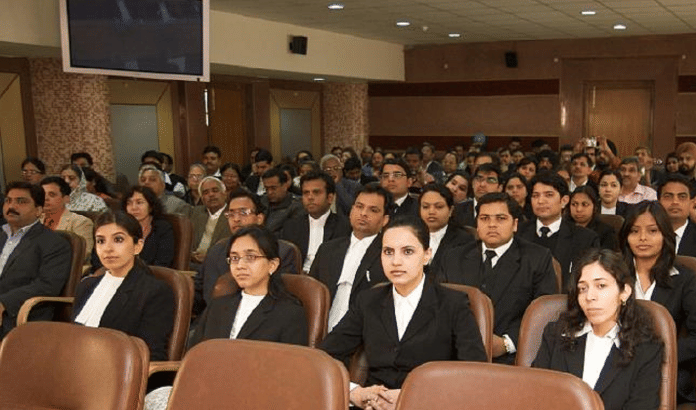

Over the years, the issue of gender diversity in the Indian judiciary has received growing attention from scholars, research organisations, journalists, and judges. There also have been efforts to curate datasets and reports, which, among other things, shed light on the historical trend concerning gender diversity in Indian judiciary. However, the conversation on this issue has had two very specific deficits.
Firstly, the conversation has been dominated almost entirely by concerns regarding the higher judiciary in India consisting of the Supreme Court and the high courts. There has been limited effort to examine the issue of gender diversity in the district judiciary. Some of the efforts are also limited to a status report on the gender demography of the district judiciary at a fixed point of time. The excessive focus on the higher judiciary diverts our attention from the fact that the district judiciary in India has more than 23,000 judges, while the high courts and the Supreme Court have only around 800 judges combined. While it is important to question the skewed gender demography in the higher judiciary, the district judiciary reflects a more representative social reality. Also, for the majority of the litigant public, the substantive experience of the judicial process is in the district courts.
Secondly, there has been no systemic and empirical enquiry into the career of female judges after their induction into the judiciary. This gap exists in relation to both district and higher judiciary. A couple of years ago, ThePrint published a series of articles on the lived experience of female judges in the district judiciary. However, there is a clear need to assess the experience of female judges at an institutional level. Such an enquiry is premised on the understanding that the mandate of gender diversity does not end with recruitment, but begins with it.
Odisha’s district judiciary
Over the last two decades, the gender demography of Odisha’s district judiciary has been substantially reshaped. In 2006, female judges comprised 12 per cent of all judges. In 2026, the number has grown to 49 per cent. The turning point was the statutory mandate of 33 per cent reservation in favour of women introduced in 2007. Since then, women have secured more than 33 per cent of seats in every single recruitment cycle. In eight recruitment cycles, they made up more than 50 per cent of the selected candidates.
Institutions dominated by men for several centuries in a society with an even longer history of patriarchal conditioning do not necessarily become inclusive with the entry of female judges. It is important to examine how an institution reacts to the presence of female judges in terms of career progression, policy sensitivities, leadership opportunities etc. Our research is an endeavor to fill this gap by looking at two things. Firstly, the career progression data spanning five decades of more than 700 judges in the state of Odisha across various cadres. Secondly, the distribution of leadership opportunities between male and female judges over a span of 18 years.
Promotion timelines
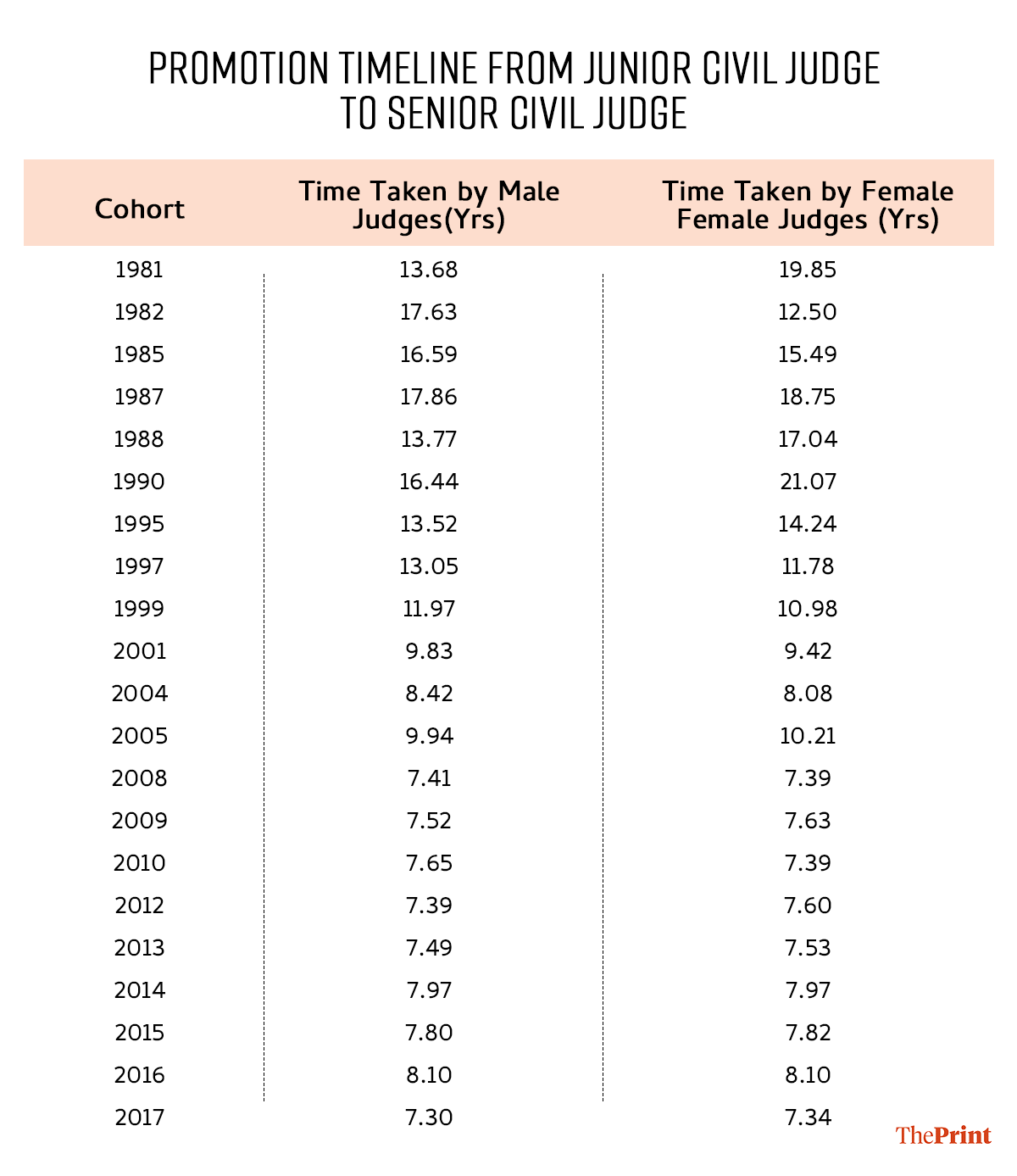
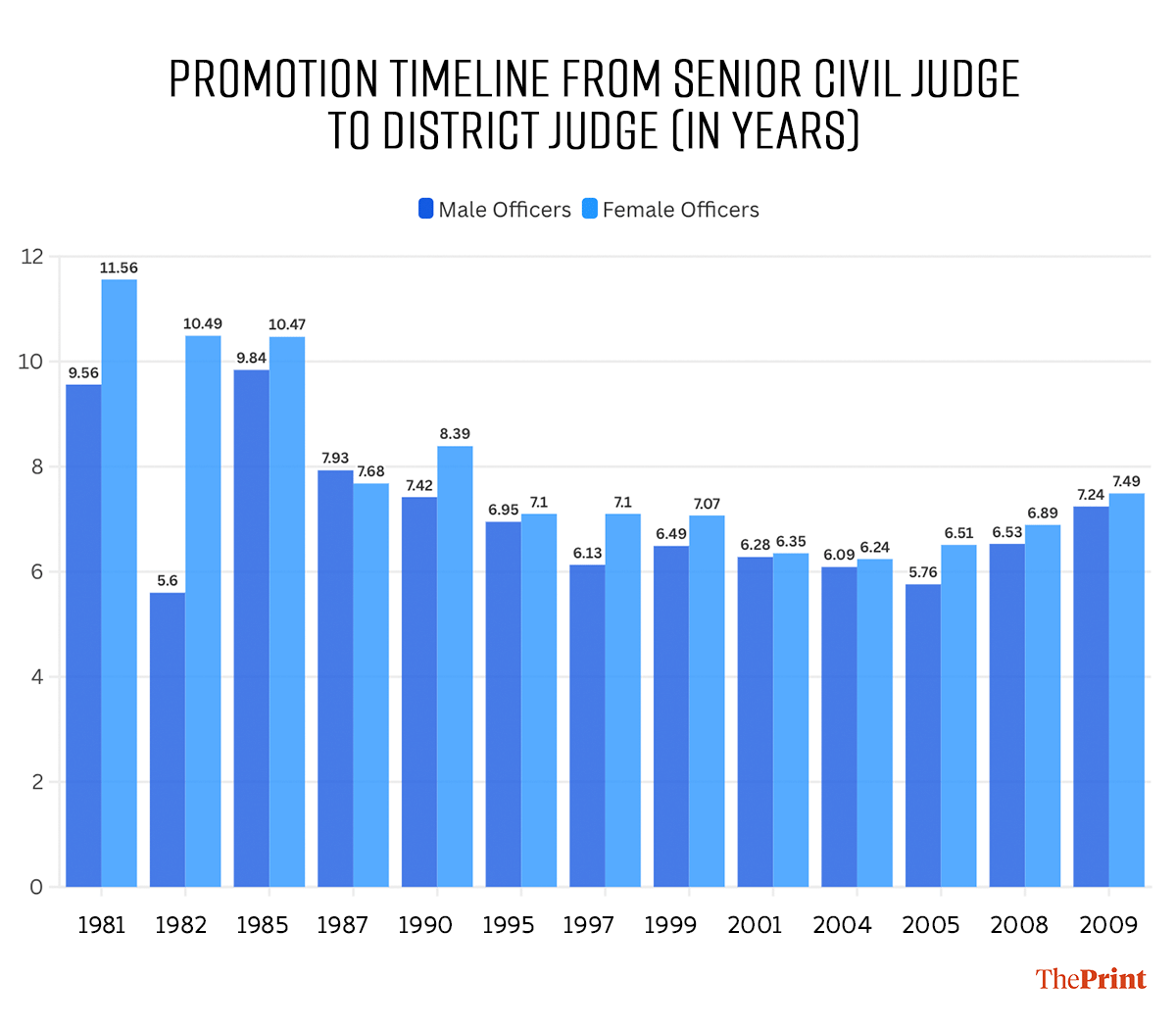
Due to variations in the eligibility conditions for promotions at different periods of time and fluctuation of vacancy in the higher cadre, the promotion timeline across cohorts (entry year in the judiciary) can vary significantly. So, we looked at the promotion timeline of male and female judges from the same cohort in two stages of promotion; promotion from the cadre of Junior Civil Judge to Senior Civil Judge and from the cadre of Senior Civil Judge to District Judge.
This data is not available for download as such and had to be extracted from the Civil Lists of Judges published periodically by the Orissa High Court. The Civil List mentions the current cadre of a judge, along with the date of entry into the current cadre and the date of entry into the judiciary. Thus, tracking the individual-level data of judges across 13 Civil Lists published between 1992 and 2025, we were able to ascertain the exact promotion date of more than 700 judges. For 384 judges, we could determine the dates of their promotion from Junior Civil Judge to Senior Civil Judge and also the date of their promotion from Senior Civil Judge to District Judge. For 331 judges, we had the dates of their promotion from Junior Civil Judge to Senior Civil Judge.
The promotion timeline of 445 male and 209 female judges from 21 cohorts between 1981 and 2017 to the cadre of Senior Civil Judge shows that there has been no pattern of disadvantage against the female judges. In eight cohorts, on average, female judges have been promoted earlier than their male counterparts. Also, the difference in the promotion timeline has been decreasing consistently to the extent that in the recent five cohorts, the difference in time is within a range of 15 days. However, the same is not true when it comes to being promoted from the cadre of Senior Civil Judge to District Judge. Data of 268 male and 66 female judges from 13 cohorts between 1981 and 2009 shows that except one cohort, male judges have consistently been promoted earlier than female judges. Unlike in the promotion to Senior Civil Judge, there is no trend toward parity in the time taken by male and female judges.
Leadership opportunities
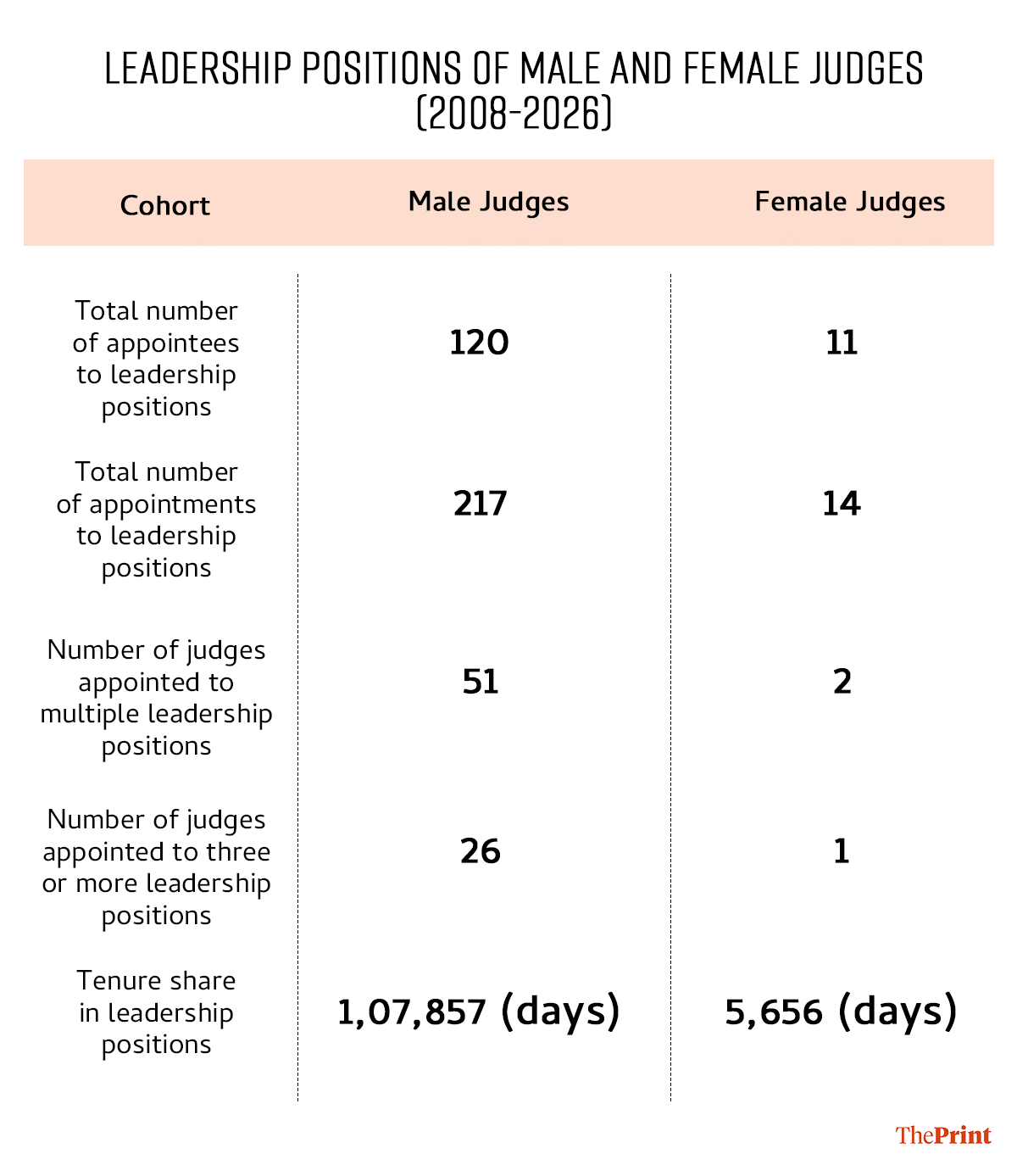
While the trends in terms of promotions reflect a mixed yet progressive reality, female judges face disproportionate marginalisation when it comes to leadership opportunities. We looked at 231 postings in the High Court Registry, Odisha Judicial Academy, State Legal Services Authorities, Principal Secretary, and Law Department from 2008 to 2026, and found that female judges constitute merely 6 per cent of the postings. Apart from leadership opportunities, access to influence, and locational advantages, these postings also play a crucial role in the possibility of being appointed as a high court judge. Of the 23 judges from district judiciary appointed as a high court Judge between 2000 and 2025, 16 had at least one or several of the abovementioned postings. Not a single female judge from the district judiciary has been appointed as a high court judge in this period.
The numbers look dire from every possible perspective. As many as 51 male judges were given these postings more than once while only two female judges got multiple postings. The average tenure gap between male and female judges in these postings is 75 per cent (899 to 514 days). The combined tenure of all female judges in these postings constitutes just 5 per cent of the combined tenure of male and female judges. While a dearth of eligible female judges could be a reasonable explanation 15 years ago, it is no longer a sustainable argument in 2026 when female judges account for 40 per cent of all District Judges and Senior Civil Judges in Odisha but constitute only 12 per cent of leadership positions.
Also read: Subhash Chandra repayment case isn’t the scandal everyone is making it out to be
From diversity to equality
As this research does not rest on multivariate analysis, it would be inappropriate to assume the cause of these disparities. However, what the data shows very clearly is an uncomfortable reality. In light of this reality, the onus is on the judiciary to assure that the causes are not located in institutional policies and entrenched presumptions. There is no doubt that Odisha has made tremendous strides toward a gender diverse judiciary. However, it is also plainly evident that diversity in itself has not guaranteed equality within the judicial system.
Achieving diversity in numbers without equality of access to higher positions frustrates the idea of diversity. It ensures that the barrier of identity endures. More than anything, it underscores the need to acknowledge that the path to diversity does not end with recruitment of female judges but begins with it. There is a need to move the conversation on diversity beyond the realm of mere presence of female judges in the system and toward the assurance of equal opportunities within the judicial system.
Rangin Pallav Tripathy is Professor of Law and Director of the Centre for Public Policy, Law, and Good Governance and Suman Dash Bhattamishra is Associate Professor of Law and Co-Director of the Centre for Public Policy, Law, and Good Governance at National Law University Odisha. Views are personal.
(Edited by Aamaan Alam Khan)