






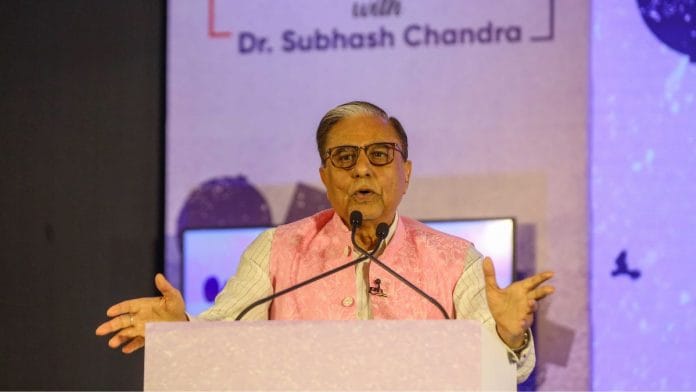

Last week, the National Company Law Tribunal passed an order approving a repayment plan of Rs. 6.50 crore by Subhash Chandra, the founder of one of India’s largest media groups, to his creditors. The headlines are: Rs 22,000 crore owed. Rs 6.25 crore to be repaid. A 99.97 per cent haircut. The numbers have predictably produced outrage, suspicions of political influence. It has raised doubts about the functioning of the NCLT, which approved the repayment plan. It is easy to imagine Chandra as the face of the rogue Indian promoter who borrowed recklessly and walked away from the bill. But the outrage over the size of the haircut is misplaced.
Chandra is before the insolvency tribunal not as the principal borrower, but as a personal guarantor for debts incurred by several Essel group companies. Many of these companies have themselves faced insolvency proceedings. Some have been liquidated; others have settled with creditors; and at least one insolvency application remains pending. Crucially, approval of Chandra’s repayment plan does not extinguish the liabilities of the principal borrowers. The headline “99.97 per cent haircut”, therefore, does not tell us how much creditors have recovered—or may still recover—on the underlying debts.
With this clarification out of the way, let’s get to the central argument of this column. The size of the haircut, by itself, is not evidence that the insolvency process has failed. There are three reasons why.
Haircuts are a feature of insolvency, not a bug
An insolvency situation — particularly one involving debts of infrastructure companies that have been in distress for years — is inevitably going to involve a haircut. This is not an accidental consequence of the Insolvency and Bankruptcy Code (IBC) under which Chandra’s repayment plan was approved.
Once financial distress has set in, the choice before creditors is no longer between recovering the entire debt and taking a haircut. The full amount is usually no longer realistically recoverable. The choice is between competing recovery options. Creditors therefore ask what a repayment plan is likely to yield compared with the alternatives, including liquidation of the debtor’s estate. The question is also no longer what is “fair” recovery. The question is a cold “what is recoverable” under a repayment plan versus a liquidation or bankruptcy scenario. This collective decision-making by the creditors may produce spectacular numbers. A creditor may recover 80 per cent. It may recover 20 per cent. It may recover 5 per cent. In an extreme case, it may recover 0.03 per cent.
A key feature of the IBC is that it brings these facts out in the public domain through the approval process at the NCLT. Earlier restructuring mechanisms, including corporate debt restructuring schemes initiated by the Reserve Bank of India (RBI), often allowed distress to remain within the banking system without forcing a transparent disclosure of what the underlying assets were worth. The IBC, at least in principle, creates a process in which the size of the loss is eventually visible. This is a good thing.
The risk of shaming haircuts
There is a deep danger in treating every large haircut as a scandal. It may create precisely the wrong incentives for the banking system: incentives to postpone recognition of losses and keep bad loans alive.
India has spent decades being uncomfortable with banks recognising losses. Imagine a Rs 100 loan that has gone bad. The bank does not want to admit that it may recover only Rs 30. So the Rs 100 loan is restructured, rolled over, refinanced, evergreened, extended, supported by additional collateral, or otherwise kept alive. On paper, the bank has avoided recognising a Rs 70 loss. Economically, nothing has been solved. The bank continues to carry an asset whose value is questionable. Worse, the eventual loss can become even larger.
This is precisely why insolvency law exists. It creates a mechanism through which losses can be recognised and allocated. Sometimes the result will look terrible. But an ugly loss recognised today can be healthier than a fictitious asset carried at full value for another five years.
If the insolvency resolution process or a repayment plan produces a 99.97 per cent recovery shortfall, the first instinct should not be to conclude that the process is broken. The questions should instead be: why is the estate available for distribution so small; how did creditors value the assets and guarantees they originally lent against; and what happened to that value in the intervening years?
NCLT is not a forensic auditor
The NCLT deserves some credit for resisting the temptation to turn a resolution proceeding into a forensic investigation.
Before the NCLT, the creditors raised precisely the questions one would expect them to raise: Was the personal guarantor’s true wealth being disclosed? Had assets been concealed or transferred? Were some of the creditors who voted for the plan genuinely independent, or were they connected to the guarantor?
These are serious questions. But it is worth noting that the NCLT restrained itself from turning an insolvency resolution process into an open-ended forensic investigation into Chandra’s financial health. The proceedings for approval of a repayment plan are not a fact-finding or investigative proceeding. This is by design. Because if they were, no resolution plan would ever be approved. Since every plan creates winners and losers, the dissenting creditors almost always have the incentive to scuttle a plan approved by the majority. Instead, the NCLT largely stuck to the statutory architecture of the IBC.
For example, one of the creditors made serious allegations relating to Chandra’s wealth by exhibiting an earlier net-worth certificate supplied to Canara Bank in 2018, which placed his net worth at Rs 40,000 odd crore. Creditors argued that this warranted a forensic audit and asset-tracing exercise. The discrepancy clearly warranted questions. But the Tribunal drew an important line between a reason for inquiry and evidence of wrongdoing. An old net-worth certificate did not, by itself, establish that the assets referred to in that certificate still belonged to the guarantor, much less a ground for rejecting a repayment plan approved by a majority of the creditors.
A similar issue arose over the creditors who voted in favour of the repayment plan. Five of such creditors were alleged to be associates of the guarantor. Collectively, they accounted for approximately 61.78 per cent of the voting share in the creditors’ meeting. Their voting behaviour was alleged to be collusive.
The Technical Member on the NCLT bench favoured a broader inquiry into those relationships., The others took a narrower route by going back to the statutory definition of an “associate” under the law, which none of the participating creditors met. That does not mean family connection, business proximity or influence are irrelevant. They may be perfectly legitimate reasons to investigate a relationship. But they are not a reason to create a statutory disqualification that Parliament did not write into the Code.
As much as these allegations raise questions on Chandra’s credibility, this is an important discipline for an insolvency tribunal. The more dramatic the facts, the greater the temptation to substitute a general sense of fairness for the statutory test. The Tribunal resisted that temptation.
If there is a scandal here, it may have happened much earlier
The uncomfortable questions belong at least as much to the lenders as to the personal guarantor. Indian banking has long relied on promoters’ credibility and personal net worth as security for their companies’ borrowings. Indeed, the RBI has traditionally discouraged personal guarantees.
If a personal guarantee ultimately produces Rs 6.25 crore against claims of approximately Rs 22,006.57 crore, one obvious question is why the lenders believed, when they made the loans, that the underlying borrowers and the guarantees they accepted were worth what they thought they were worth. The banks decided how much to lend; to whom to lend; against what security; against whose guarantee; how much value to place on that guarantee; and how aggressively to pursue the underlying borrowers.
A personal guarantee is not magic collateral. A bank accepting a promoter’s personal guarantee is making a judgment about the creditworthiness of that individual and, ultimately, about the recoverability of the individual’s assets.
If the guarantee ultimately produces a recovery of only a tiny fraction of the admitted claim, the quality of the original credit decision, the subsequent monitoring, restructuring and recovery decisions, are as open to question as the promoter’s own behaviour.
Also read: Why NSE must not be brought under RTI
The real lesson of the Rs 22,000 crore haircut
India’s financial system has spent too long pretending that bad loans can somehow be made good by postponing the day of reckoning. The IBC was supposed to change that. It did so by making insolvency a process through which creditors could confront losses, rather than hide them.
A 99.97 per cent recovery shortfall is an extraordinary number. It deserves scrutiny. But the scrutiny should begin in the right places: with the lending decisions that created the exposure; the value and enforceability of the guarantees; the assets actually available to satisfy the guarantor’s obligations; the independence of the creditors who approved the repayment plan.
It should not begin with the assumption that the IBC “facilitates” large haircuts in favour of the promoters. The real failure in Indian banking has never been that creditors took haircuts. It has been our reluctance to let them take them.
Bhargavi Zaveri-Shah is the co-founder and CEO of The Professeer. She tweets @bhargavizaveri. Views are personal.
(Edited by Ratan Priya)