








In June 1984, thousands of devotees gathered at Sri Harmandir Sahib to commemorate the Shaheedi Gurpurab of Sri Guru Arjan Dev Ji. Among them were mothers carrying children in their arms, school-going girls travelling with their families, elderly women seeking spiritual solace, and devotees who had come simply to bow before the Guru. Nobody imagined that many would never return home. The Indian government launched Operation Blue Star, a military assault on the Golden Temple complex in Amritsar, Punjab.
Every year, as the Sikh Panth remembers the Ghallughara or massacre of June 1984, much is said about the events that unfolded at Sri Harmandir Sahib. Yet among the most poignant stories are those of the women and children who became part of that tragedy. Their legacy occupies a special place in Sikh memory because it reflects the resilience, devotion, and courage that have long defined Sikh womanhood.
Sikh history has always accorded immense respect to women. More than five centuries ago, Guru Nanak Dev Ji challenged the discrimination faced by women and proclaimed: “Why call her inferior, from whom even kings are born?”
Guru Gobind Singh Ji carried this vision forward through the creation of the Khalsa in 1699. By bestowing the name “Kaur” upon Sikh women, he gave them an identity independent of caste, lineage, and social status. A Kaur was not merely a daughter or wife of someone else; she was an individual endowed with dignity, courage, sovereignty, and spiritual equality. The women who attained martyrdom during June 1984 embodied these very ideals.
Among the most heartbreaking stories are those of Bibi Satnam Kaur and Bibi Waheguru Kaur of Gurdaspur. The two sisters were in school when they died. According to the account recorded in Kaurnama Part III by Baljinder Singh Kotbhara, when their father, Mohar Singh, witnessed the military assault on Sri Harmandir Sahib and feared the desecration of the sacred shrine, he resolved to resist. The book recounts that during this resistance, he placed his two daughters in the path of the Army tanks. The girls were killed, and the tanks were destroyed. resulting in the destruction of the tanks and the martyrdom of both girls. Whether remembered as an act of sacrifice, defiance, or devotion, the story of Satnam Kaur and Waheguru Kaur occupies a unique place in Sikh memory. Their martyrdom continues to symbolise the depth of faith and commitment that many Sikhs associate with the events of June 1984.
Another deeply moving account comes from Sanghera village in Barnala district. According to testimony recorded in Kaurnama Part III by Baljinder Singh Kotbhara, a group led by Bhai Jagga Singh had travelled to Sri Harmandir Sahib from the village. As the violence intensified, they took shelter in Guru Ram Das Sarai. Bhai Jagga Singh lost his wife, his friend Mithu Singh, his two daughters Binder Kaur and Gurmeet Kaur, and one of his sons. In a matter of moments, an entire family was devastated. Their story remains one of the most heartbreaking accounts associated with June 1984 and serves as a reminder of the immense human cost borne by ordinary devotees who had come to the Guru’s house.
Among the women remembered from those days is Bibi Upkar Kaur of Karnal, Haryana, whose words, preserved in Kaurnama Part III, reflected the spirit of Sikh conviction. Referring to the Sikh tradition of self-defence, she spoke of how Guru Hargobind Sahib Ji wore two swords representing the principle of Miri-Piri. Piri symbolising spiritual authority, devotion, and remembrance of the Divine, and Miri symbolising temporal authority, strength, and the responsibility to stand against injustice. This principle teaches Sikhs to remain connected to Naam while also being prepared to use Shastar when necessary to protect themselves, defend the oppressed, and uphold righteousness. She also recalled Guru Gobind Singh Ji’s teaching that a Sikh should embody both spirituality and courage, balancing devotion with the duty to resist tyranny.
The tragedy crossed regional, social, and caste boundaries. Among those remembered is Sodhaan Devi of Mansa, a woman from a Brahmin family who had travelled to Sri Harmandir Sahib with a religious group. Survivor accounts recall that the group from village Kila Hakeema was sheltering in Guru Ram Das Sarai when firing intensified. During the assault, a bullet struck Sodhaan Devi, killing her instantly.
Perhaps the most haunting testimony is that of two-year-old Surinder Kaur of Batuha village in Sangrur district. According to her father, Preetam Singh, the family had arrived at Sri Harmandir Sahib on 3 June 1984. When Operation Blue Star began, they found themselves trapped inside the complex with no safe way out. For days, they struggled to survive amid fear and severe shortages of food and water. Preetam Singh recalled that the family was forced to drink water flowing through drains to stay alive. As conditions worsened, they even consumed water mixed with blood because there was no other source available. Tragically, Surinder Kaur lost her life amid the shelling and firing that engulfed the complex during the operation. Her story remains a poignant reminder of the immense suffering endured by innocent women and children caught in the violence and the human cost of the events of June 1984.
The daughters of the Panth
Alongside these stories are the names of many other women remembered in historical accounts and family memories: Bibi Jaswinder Kaur of Ferozepur, Bibi Paramjeet Kaur Bhangala of Jalandhar, Bibi Ravinder Kaur of Dingrian, Bibi Kartar Kaur of Cheema, Bibi Paramjeet Kaur of Cheema, Bibi Sukhwinder Kaur and Bibi Mahinder Kaur of Malerkotla, Bibi Gopal Kaur Athwal of Amritsar, Bibi Gurdev Kaur of Lidhran, Bibi Dharam Kaur of Kairon, Bibi Preetam Kaur of Dehradun, Bibi Prakash Kaur of Jaura, Bibi Malkeet Kaur, Bibi Savitar Kaur, Bibi Surjeet Kaur, Bibi Kako Kaur, Amarjeet Kaur, Jarnail Kaur, Simarjeet Kaur, Kuldeep Kaur, Paramjeet Kaur of Misriwala, Raaj Kaur, Surjeet Kaur of Felloke, Gurpreet Kaur of Kot Khalsa, and Manjeet Kaur of Kot Khalsa.
Their stories may be scattered across villages, family memories, and historical records, but their sacrifices remain woven into the fabric of Sikh history. They are remembered not because they were victims, but because they became part of the Sikh tradition of shahadat, martyrdom.
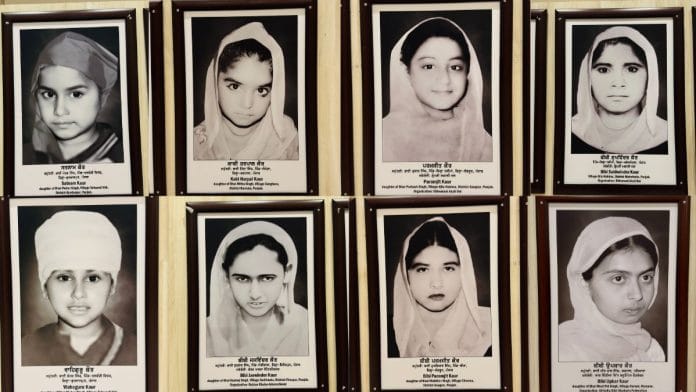
The memory of these women lives on through their photographs displayed in the Shaheedi Gallery (Martyrdom Gallery) located in the basement of the Operation Blue Star Memorial within the Sachkhand Sri Harmandir Sahib complex in Amritsar. As devotees walk through the gallery, they encounter stories of faith, loss, and sacrifice.
“It took me nearly five to six years to gather information about these women. Even today, I believe there is much more that remains undocumented. The women who played significant roles in the events of 1984 and other important chapters of Sikh history deserve to be remembered and studied,” said Baljinder Singh Kotbhara, author of Kaurnama Part III.
“Preserving their stories is a responsibility that belongs to all of us. Institutions, particularly the Shiromani Gurdwara Parbandhak Committee (SGPC), should make dedicated efforts to document, preserve, and promote these accounts so that future generations can learn about the sacrifices, contributions, and historical significance of these women.”
The tragedy of June 1984 was not experienced by armed men alone. Mothers, daughters, sisters, and even young children became part of that painful chapter. Their photographs stand today as enduring symbols of Sikh resilience and remembrance.
“As an Amritdhari Sikh woman, I believe the lives of the women who came before us offer invaluable lessons in faith, courage, and commitment to the Panth. The women who became part of the 1984 Ghallughara upheld that same spirit and made their contribution through shahadat,” said Harsharan Kaur, a journalist.
“The Khalsa is vilakhan, distinct and extraordinary, and remembering these sacrifices is our collective responsibility. At the same time, we must strive to learn from their lives, remain connected to both Baani and Baana, cherish the gift of Amrit bestowed by Guru Gobind Singh Ji, and never allow ourselves to drift away from Gurbani.”
Also read: Menopause is missing from NFHS-6. It says nothing about women between 40 and 59
Their sacrifice, our responsibility
More than four decades have passed since the Ghallughara of June 1984, yet the memory of these women endures. The Shaheedi Gallery at Sachkhand Sri Harmandir Sahib stands as a lasting tribute, ensuring that future generations remember the faces and stories behind those tragic days.
The stories of Bibi Satnam Kaur, Bibi Waheguru Kaur, Binder Kaur, Gurmeet Kaur, Surinder Kaur, Bibi Upkar Kaur, Sodhaan Devi, and many others are not merely accounts of loss. They are stories of devotion, conviction, and steadfast commitment to the Sikh faith.
“The martyrdom of Bibi Upkar Kaur, Bibi Paramjeet Kaur, Bibi Preetam Kaur, Satnam Kaur and Waheguru Kaur reminds us that the equality bestowed by Guru Sahib was not merely a right but also a responsibility. Their courage and willingness to stand against oppression demonstrate that Sikh women have always stood shoulder to shoulder with men in defending their faith and principles,” said Bhai Paramjeet Singh Mand, working president, Dal Khalsa.
Remembering them is not merely an act of remembrance; it is a duty. As long as the story of June 1984 is told, these daughters of the Panth must continue to hold an honoured place in Sikh memory and history.
Damanjeet Kaur is a freelance writer from Punjab. Views are personal.
(Edited by Ratan Priya)
The only martrys of Operation Blue Star are the Indian Army jawans who laid down their lives in service of the nation.
The terrorists holed up inside the Golden Temple and their supporters who attempted to create every possible nuisance for the Indian Army were and are a blot on India. The nation will never ever forgive them.
It’s a completely different matter that the Sikh diaspora celebrates and honours them. As the popular saying goes “Canada banega Khalistan”. Because India, for sure, will never ever be.
Maybe the Sikhs can bargain with Pakistan regarding the possession of Lahore – the capital of Ranjit Singhji.
No they are not. Please stop lying so shamelessly. The only victims were the Indian Army soldiers who died during the operation – all thanks to the incompetence of their commanding officers who planned the lame tactics and strategy.
Rather, the local Sikhs tried everything possible to hinder the armed forces operations and help the Khalistani terrorists. Not a single Sikh cleric or gurudwara condemned Bhindranwale and his gang of murderers.
The entire episode will always be a shameful one for Sikhs. What is even more embarrassing for them is that Bhindranwale has gone on to be celebrated at the Golden Temple. What can be more degrading than deifying a terrorist?