




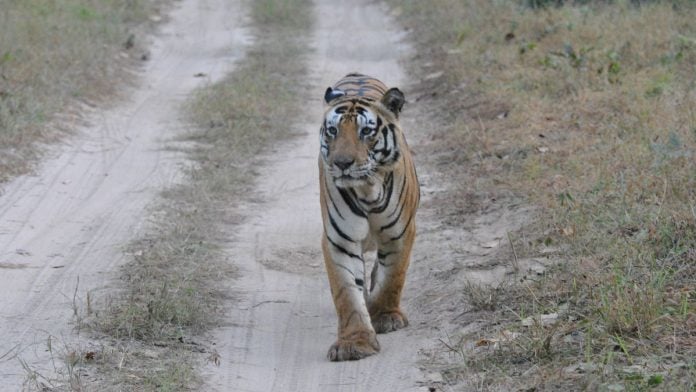

Munna, a male tiger, died at the ripe old age of 19. He spent 17 years in the wilds of Kanha Tiger Reserve, where he held his territory and sired many cubs. He attracted attention as a male in his prime in the late 2000s, bearing perhaps the most iconic of marks borne by any tiger — stripes that resembled the word ‘CAT’on his forehead.
No one can calculate how much revenue the reserve generated from tourists who flocked for a glimpse of Munna alone. A quick internet search, however, shows over three million hits for his photographs, and he is immortalised in many books.
Munna’s story continued after his death. The cubs he sired – Neelam, Chhota Munna, Umarpani male, among the many – became a fixation for visitors. This is not unheard of; people have tracked and mapped tigers’ lineages across several generations. A century ago, the peoples of Central India identified tigers by their features – Lungra, the limping tiger, Tajia bagh, the small-eared tiger, Banda bagh, the tailless tiger, and Dhor bagh, the cattle-eating tiger, were some common names popularised in folklore. Fast forward to today, the essence remains the same – Kankati and Machli, both iconic tigers of Ranthambore, were named after their features.
From being ‘named’ to spread the word about a tiger on the prowl to becoming faces of the species they represent, it has been quite a change, bringing not only the place they call home to global attention but also highlighting their lives with personal, human feelings.
The emotional connection
For conservation of an endangered species, the emotional connection between us and the species is as important as wildlife management. Some individuals of the population have helped make this connection across taxa – tigers, elephants, whales, and cranes. Aptly labelled ‘flagship individuals’ in research published in Frontiers in Ecology and Environment, these are individuals with unique physical and behavioural traits that not only make the animal easily recognisable to people, but also go beyond giving them larger-than-life personalities, making them ambassadors of the species and their habitat.
In Chhattisgarh’s Achanakmar Tiger Reserve, a young tigress was identified to be a litter of Bandhavgarh’s Spotty, a popular tigress. Her presence in Achanakmar, more than 150 km from Bandhavgarh as the crow flies across the Maikal Hills, Son River, farmlands and settlements, is nothing short of a miracle. Named Jhumri, she has littered thrice and is instrumental in doubling tiger numbers at Achanakmar, bringing attention to the area connecting Bandhavgarh and Achanakmar.
When individual wild animals like tigers become highly visible to the public, they play a powerful role in their own species’ survival. By becoming recognisable “characters,” these specific animals drive compelling conservation stories that capture public attention. This emotional connection, in turn, helps trigger the legal actions, funding, and protection policies needed to safeguard their entire species.
On the one hand, there are individuals who highlight the conservation concerns facing the species, such as poaching and habitat connectivity. On the other hand, individuals underscore strained relationships by becoming examples of adverse interactions with humans. In the face of negative attention, how do flagship individuals become torchbearers for the species they represent?
They do not aim to overwrite the concerns of human-wildlife conflict. Adverse interactions with people often shape a species’ narrative. Such incidents, though localised and individual-specific, may shift narratives across native ranges of the species, fostering a generally negative perception. Flagship individuals, which drive positive perceptions, help maintain balance, so negative perceptions do not overwhelm public discourse about the species or population. In rare instances, narratives of recognisable individuals evolve, and negative perceptions do change into positive ones.
Also read: India’s glass buildings are killing birds. We know how to stop them
From Gharial to Great Indian Bustard
In Assam, a solitary elephant known to raid crops was much maligned. Over the years, human tolerance increased toward him as he grew old. There was a sense of curiosity and wonder, and concern when he was not seen for days, and those who shared space with him came to call him Ramu.
On his sudden death due to electrocution, Ramu’s mortal remains received the respects of a relative who has departed too soon. Such homage highlights compassion for an individual and, by extension, the species, symbolising the tenet of human-wildlife relationships despite conflicts.
Beyond tigers and elephants, instances of ‘flagship individuals’ are not common. This may be due to the fact that they are rare, found in remote regions, don’t bear recognisable features, or perhaps aren’t charismatic enough. For such endangered species, identification of flagship individuals may be a gamechanger.
One way to connect with endangered species is for researchers to talk about how – without violating their personal space – individual animals live their lives, not just how a species navigates shrinking habitats. Technologies like camera trapping and GPS-fitted tags (and collars) have changed the way we look at species by allowing a peek into how individuals make decisions, from birds migrating across countries each year to marine turtles navigating the Arabian Sea and the Bay of Bengal, giving personal – emotional even – perspectives.
As we focus on the conservation of a community of species living in vast landscapes, flagship individuals aid in driving big-picture conservation at local scales. Ethical tourism boosts the local economy, and the land they traverse grabs conservation attention. Species such as the Gharial, the Ganges River Dolphin, the Golden Mahseer, the Great Indian Bustard, the Hangul, and many species such as vultures, which we barely connect with on a personal level, require our attention and even emotion.
Despite difficulties in quantifying the conservation impacts of flagship individuals, their legacy has ensured that the species they represent are forever on our minds. It is vital that we expand our minds to species that require our personal attention.
Aniruddha Dhamorikar is a landscape coordinator, Satpura Maikal Landscape, WWF-India. His X handle is @AniruddhaHD. Views are personal.
(Edited by Saptak Datta)