




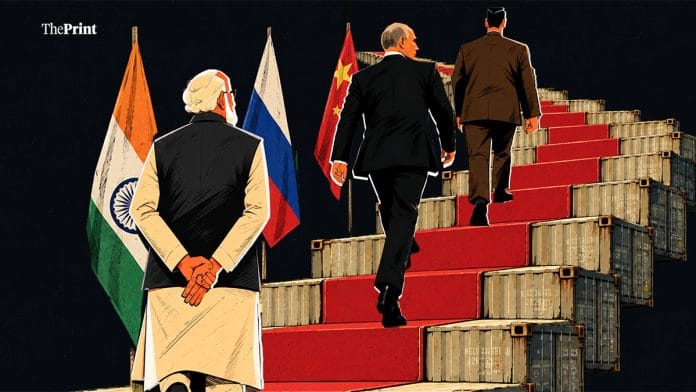

The BRICS summit, held in India in the midst of a massive global reset of economic and geopolitical power equations, has led some commentators to question the very utility of India remaining inside the organisation. BRICS is an accidental grouping of diverse countries with diverse (even conflicting) interests. The term was coined by a Goldman Sachs report of 2001 which suggested that global economic growth could come from Brazil, Russia, India and China (the countries that together constituted BRICs). Today, BRICS has 11 members, including South Africa, Saudi Arabia, Iran, UAE, Ethiopia, Indonesia and Egypt.
The criticism is partially valid, for BRICS countries do not subscribe to any particular set of values or seek economic convergence. The main criticism, though, is that the organisation would amount to little without China. Economist Surjit Bhalla says that BRICS’ economic performance is largely China’s. Take China out of it, and BRICS does not look anywhere like a growth engine, though one must add that India has been stepping to the plate in a small measure in recent years. Bhalla also says that India’s future is not with BRICS, but the US and Europe. There is no doubt that we need to grow trade with Europe. But after the torrid time Donald Trump has been giving us – and also the proposed tariffs on Indian exports proposed by the US Congress to pressure countries that buy oil from Russia – one wonders whether the US can ever be considered a trustworthy partner. More so since US Deep State thinking now favours slowing down India’s rate of rise, and using Pakistan to keep India in check. That’s something China believes in too, though it won’t say so publicly. The larger point is that the US wants vassals, not allies, as it has made clear even to Canada and Europe.
India is in Asia, and China is the current hegemon and manufacturing superpower. Can Indian manufacturing rise without growing Chinese participation? Will the US provide us the kind of market access that it did in the past, when it was building India as a bulwark against China? India has to navigate both the hegemons, China and the US, working out the best deals possible with both without seriously compromising national interest. Staying inside BRICS is one way to do that.
The political criticism, led by former finance minister P Chidambaram, is largely superficial. Chidambaram says that there are no tangible benefits from India being a part of BRICS, or SCO (Shanghai Cooperation Organisation), or QUAD. He is quoted as saying: “We are part of BRICS, we are part of SCO, we are part of G20, and we are part of QUAD. What benefits are we getting out of that? I can’t see. In the last two or three summits, I didn’t see any benefits. Earlier, the BRICS Summits resulted in some tangible benefits.” (That is debatable, for the only tangible benefit is the creation of the New Development Bank in July 2014. That can continue to grow).
Let us take both these criticisms and examine them for their relevance.
First, Bhalla’s. The fact that one country may dominate politically or economically is not an uncommon phenomenon in the history of organisations. In the initial years after the Second World War, the US was the only country that mattered in the non-Communist block. The whole of Europe and Japan were subservient to it. Even today, the US dominates Nato, a military alliance. So, the fact that BRICS is China-dominated is not a good enough argument to force us to de-emphasise its importance. BRICS forces China to think beyond its own narrow interests.
Second, as China slows, and as its exports engine becomes a problem for everybody else, it will have no option but to seek to balance trade and enable others to grow in relative terms. The world can’t keep importing from China when the US is raising barriers. China has to end financial repression at home and seek to boost domestic consumption to hold up growth. This is when countries like India can start growing proportionately more than China, even if the volume of growth may be larger for China for another decade or more, given its huge base. India’s presence in BRICS is what makes the organisation less of a China-dominated forum like SCO. India has to play its cards well to make BRICS more relevant in future, but it will be a slow process.
Third, sometimes one gets into an organisation to prevent it from becoming something of a threat. If India had not been in BRICS, Pakistan would have gained easy entry, and once that happens, a consensus without India will be easy to find. In the current global scenario, even though antagonists like Iran, Saudi Arabia and UAE are in BRICS, we could still manage some kind of consensus declaration. With Pakistan inside, the going would have been tougher for Pakistan’s existential purpose is to stand against India. Now, as a founding member of BRICS, we can ensure that Pakistan is kept out as long as possible.
Fourth, coming to Chidambaram’s argument, that nothing tangible came from being in BRICS, we have to agree, but with a caveat. In a world where two endless wars are drawing in more and more countries, and where globalisation is in retreat, “tangible” outcomes take time and could come in bits and pieces. Most of the BRICS countries want to reduce America’s ability to weaponise the dollar and global forums, while some (India and Brazil) are not keen on de-dollarisation. India would also not like the dollar world to be substituted by a yuan world. The tangible things will first happen bilaterally, where trading happens in national currencies, and then gets substituted by possibly a more neutral currency like the International Monetary Fund’s Special Drawing Rights. Some may also prefer the yuan regime, and others may prefer to keep all three options open: dollar, yuan or trade in national currencies.
The core point to recognise is that India has been dealt a poor hand geopolitically, and how we fare depends on how we play that hand. The western bloc would like to weaponise finance, market access, tariffs and human rights to force us to bend to their will. China would like to weaponise its manufacturing prowess and control of rare earths to bend the world to its will. Outside these blocs, there are two global religious groupings, Christian and Islamic, which see India as the largest addressable population for conversion.
So, religion itself will be weaponised by multiple countries against us.
When predatory ideas vie for the Indian market, whether for trade or religious expansion, it is what Indian does to expand its options that matters. There are no easy choices left before India beyond internal reform and building a political consensus at home to take on the rest of the world.
As mentioned earlier, India is in a tough geography, and has been given a poor hand to play. We have to make the best use of our cards, and leaving or ignoring BRICS because it is China-dominated would not be a wise move. We must stay inside and fight our battles quietly while we build our strengths.
R Jagannathan is an editor and the former editorial director at Swarajya magazine. He tweets @TheJaggi. Views are personal.
This article has been republished from the author’s personal blog. Read the original article here.