




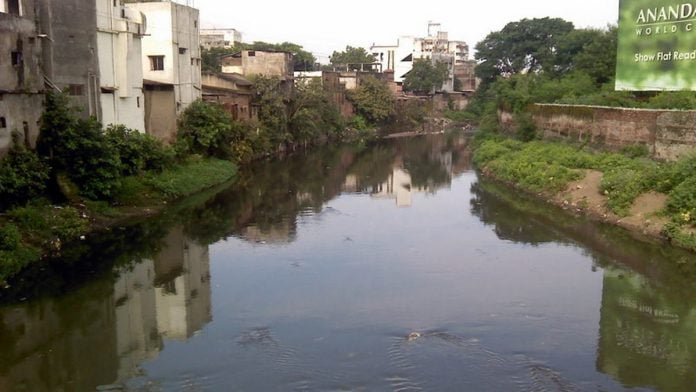

A river is one of a city’s most valuable assets. And yet, it may have no dedicated place in the city’s balance sheet. Indian cities readily recognise roads, bridges, metros, water supply and housing as urban infrastructure, and plan and finance them accordingly. But rivers, which supply water, receive wastewater, buffer floods and support groundwater, are often treated primarily as an environmental concern. What cities do not recognise as infrastructure, they rarely plan, budget or finance as infrastructure.
This is particularly important given the pressure already facing India’s urban finance system. According to a 2022 World Bank report, India needs around $840 billion in urban infrastructure investment by 2036. The same report also pointed out that annual capital investment in urban infrastructure averaged less than $11 billion between 2011 and 2018. The gap is still huge. Urban infrastructure investment is just 0.7 per cent of GDP, less than half of what India needs.
If the existing financing model is already struggling to meet the needs of conventional infrastructure, it cannot be expected to absorb the additional costs of maintaining healthy rivers. In this scenario, urban river management cannot rely primarily on mission-based grants. Cities need to develop a more diversified financing architecture.
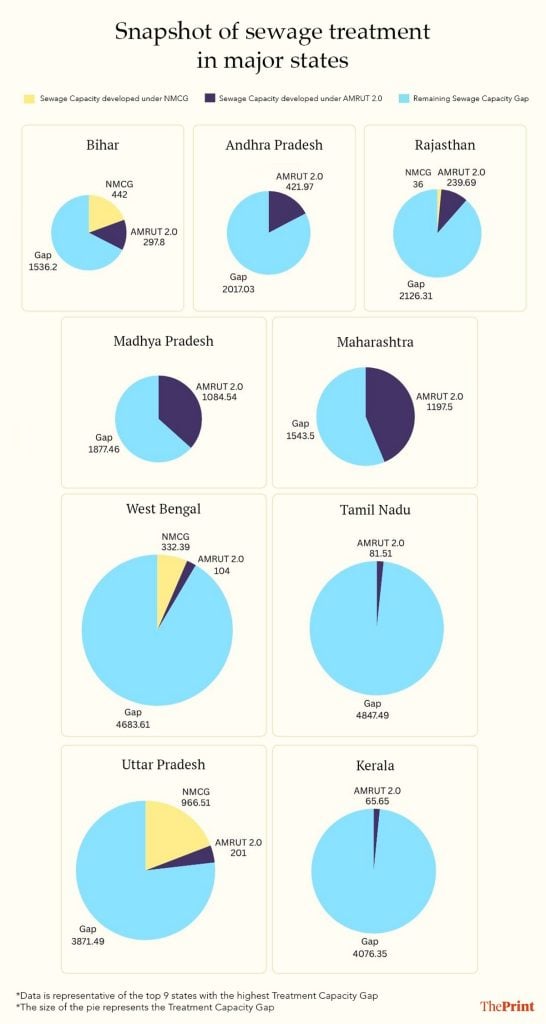
The scale of the challenge is evident when we look at the shortfalls in sewage treatment. In August 2026, a Parliamentary Standing Committee reported that urban India generates around 52,644 million litres per day (MLD) of sewage. Against this, the installed treatment capacity is 31,885 MLD, leaving a gap of more than 20,700 MLD. Even this installed capacity is significantly underutilised, with only around 22,491 MLD actually in operation.
The graphic below shows the nine states with the largest treatment gaps. Between 2021 and 2026, these states received approximately Rs 58,397 crore through the National Mission for Clean Ganga (NMCG) and AMRUT 2.0 for around 5,471 MLD of additional treatment capacity. Of this, NMCG provided Rs 10,894 crore for 1,777 MLD, and AMRUT 2.0 Rs 47,503 crore for 3,694 MLD. However, this addresses only about 26 per cent of the overall treatment gap.
Also Read: A Lucknow RJ is cleaning the Gomti River. Over 177 Sundays, 8 volunteers grew to 8,000
Govt money alone won’t cut it
The financing implications are substantial. The cost of constructing sewage treatment plants in India is estimated at roughly Rs 0.80-3 crore per MLD, depending on plant size and technology. At an assumed cost of Rs 1.5 crore per MLD, closing the 20,700 MLD treatment-capacity gap alone would require approximately Rs 31,000 crore.
But sewage treatment represents only one part of the investment required. Cities also need to finance sewer networks, household connections, interception and diversion systems, pumping stations, sludge management and, critically, long-term operations and maintenance. The National Mission for Clean Ganga estimates that around Rs 5 crore per MLD may be required when treatment systems and associated networks are considered. On this basis, the total investment requirement would exceed Rs 1 lakh crore.
Meeting this will require more than traditional government allocations.
At present, around 75 per cent of urban infrastructure financing comes from central and state governments. Cities contribute roughly 15 per cent, while private sources account for only about 5 per cent. Financing urban river management at scale will require a radical shift in this proportioning.
There are, however, some encouraging signs. The Rs 1 lakh crore Urban Challenge Fund is one example. It provides up to 25 per cent central assistance, while projects are expected to raise at least 50 per cent of their funding from markets through bonds, loans and public-private partnerships.
For urban rivers, this suggests a different way of thinking about public finance. The objective need not be to replace public funding, but to use it strategically: to de-risk projects, attract additional capital and create revenue streams for assets that currently generate little or no direct income.
Elsewhere in the world, too, cities are changing their business-as-usual approach to financing urban environmental infrastructure.
In Guizhou, China, funding for the Green Expo Park came from a combination of public and private sources: 45 per cent from the provincial budget, 30 per cent from central government grants and 25 per cent from private investors. Rather than being conceived solely as an environmental project, it was developed as both an economic asset and a public-space investment.
In Washington, DC, impervious surfaces are a major source of stormwater runoff entering the sewer system and carrying pollutants into local waterways. The Clean Rivers Impervious Area Charge (CRIAC) was introduced to recover part of the cost of managing this runoff, with charges linked to a property’s contribution to the problem. In Arequipa, Peru, revenue from the sale of treated wastewater to the Cerro Verde copper mine helped finance aspects of the rejuvenation of the Chilli River, which passes through the city.
What Nagpur and Indore are doing
In India too, some cities are experimenting with ways to finance river rejuvenation beyond conventional grants.
In March 2026, the Nagpur Municipal Corporation (NMC) proposed a Rs 200 crore bond to support its Rs 301 crore contribution to the larger Rs 1,927 crore Nag River Rejuvenation Project, which includes a modern sewage network and multiple STPs.
Grants have historically accounted for nearly 65 per cent of NMC’s revenue receipts, as reported by CareEdge Ratings. This reflects a comparatively low reliance on own-source revenue, largely because of the GST compensation the corporation receives from the Maharashtra government after the replacement of local body taxes. However, NMC’s collection performance has been strong across tax revenues, fees, user charges, fines, rental income from municipal properties, sale and hire charges, and other income. Prompted by challenges such as delays in fund releases from the state government, it is now using the municipal bond to diversify its financing base.
The bond would help NMC mobilise market-based finance for the Nag River project, which has an implementation period of eight years. Its main objectives include three STPs with a capacity of 92 MLD and a 500 km sewerage network, along with associated structures. The bond has received a provisional AA+/stable credit rating. It still awaits formal approval from the state government, after which the regulatory filing and issuance process will follow.
Access to municipal capital markets depends on more than the environmental importance of a project. The issuing ULB must also demonstrate financial credibility, debt-servicing capacity and a credible borrowing and repayment framework. The Nagpur case therefore shows how stronger municipal financial management and creditworthiness can help cities explore market-based financing for large-scale urban environmental infrastructure.
Carbon finance offers another route.
Indore’s Carbon Credit Aggregator Model, launched in 2017, was among the early city-led efforts in India to monetise environmental improvements by pooling emission reductions from wet-waste management, biomethanation and solar energy projects. It generated around 1.7 lakh carbon credits and Rs 69 lakh in revenue during 2017-19, followed by Rs 8.34 crore in the next verification period.
Its more important lesson may be the mechanism itself. Aggregation can help smaller municipal projects overcome the scale and transaction-cost barriers that make participation in carbon markets difficult. Environmental performance, in other words, can become an additional source of municipal revenue rather than remaining only an environmental benefit.
Indore has also shown how the financing of one urban system can be connected to another. Before its 60 MW captive solar power plant was established, the Indore Municipal Corporation (IMC) spent around Rs 25 crore each month to transport Narmada water from the pumping station in Jalud, 80 km away. The green bond issued by IMC helped finance a plant expected to cut the cost of supplying this water by nearly Rs 5 crore a month. This made Indore the first Indian city to use a green bond for renewable energy directly linked to its drinking-water supply. The plant was budgeted at Rs 305 crore but was set up at a total cost of Rs 271.16 crore. IMC raised Rs 244 crore through green bonds, and the rest was covered by the Centre through Viability Gap Funding (VGF).
Also Read: Maharashtra’s Kham shows even ‘dead’ urban rivers can be revived—here’s the blueprint
Finding the right finance for healthy rivers
What does it take to make new financing models viable? Financing needs to be linked to a clear revenue-generating project. A proven track record in environmental initiatives can also serve as a stepping stone to lowering the credit risk perceived by investors. One potential hurdle is delays caused by contracting challenges.
Diversified financing is not entirely new to India. The Alandur Sewerage Project in Tamil Nadu, initiated around 1997, showed how financing could bring citizens closer to urban development. It combined beneficiary contributions, institutional borrowing and private-sector participation, with citizens contributing Rs 8 crore, or approximately 24 per cent of the reported Rs 34 crore project cost.
A 1997 survey covering more than 10 per cent of Alandur’s population found that 97 per cent wanted a sewerage system and were willing to pay up to Rs 2,000 for a connection. The municipality also undertook public awareness efforts, and the project was recognised at the National Urban Water Awards 2008 for community and private-sector participation. The initiative shows that understanding citizens’ needs and communicating with them consistently can build public acceptance of new urban services and their costs.
These examples show that there is no universal financing model for cities to adopt. Cities will have to discover their own. Public finance will remain essential, particularly for investments whose benefits are hard to monetise, but it can increasingly be used to de-risk projects and leverage other capital.
The bottom line is this: if a healthy river creates economic, social and ecological value for a city, the financing system should find ways to recognise that value and return a share of it to the river.
Anna Brittas is a Senior Research Associate and Roshni Kairos a Junior Research Associate at the Water and Environment Vertical of the National Institute of Urban Affairs. Views are personal.
(Edited by Asavari Singh)