


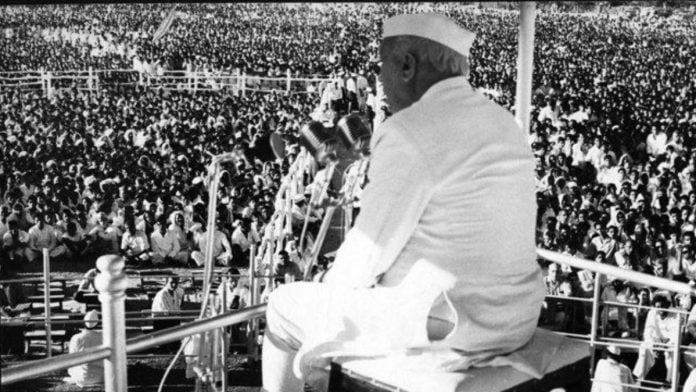
In a week when Sonia Gandhi’s memoir is the largest topic of discussion in India, it is perhaps not altogether incongruous to write about Jawaharlal Nehru. Of course, an even more fitting reason would be to invoke 14 November, Nehru’s birthday, as the reason for writing.
But I write today not to reminisce about 14 November. I write primarily as a democracy scholar. Using newer developments in democratic theory, I wish to analyse Nehru’s role in creating and stabilising India’s democracy.
A big divide in modern democratic theory is whether the causes of democratic longevity are socio-economic or whether, alternatively, we need to focus on politics per se, meaning political parties, ideologies and leaders. The former are the so-called structural factors, and the latter relate to human agency.
Also Read: Politicians may fade. We’ll always need engineers and scientists, said Nehru to students
Why didn’t poverty doom Indian democracy?
On the structural side, the biggest theory is income-based. Statistically, it has been shown that income could predict nearly three-fourths of all cases of democratic persistence and dictatorship after 1950. Democracy can be established at any level of income, but at low levels of income its mortality rate is very high. Democracies tend not to survive in poor societies.
According to the IMF-World Bank data, India became a lower-middle-income society only around 2006-07. Before that, India was a low-income country. That means for nearly sixty years after independence, minus the 21 months of the Emergency, India remained democratic in the most unpropitious economic circumstances.
This was radically different from Europe and the US, where universal franchise, a basic principle of modern democracy, was introduced only after the Industrial Revolution had taken place. Later in the 20th century, East Asia — Japan, South Korea and Taiwan — also followed the European pattern: high incomes first, universal franchise later.
If the income level can’t explain India’s democratic longevity, what does? Does it have something to do with Nehru and/or the Nehru years?
For agency-based theories, this is an obvious analytic pathway. They ask questions about parties, ideologies and leaders. Did the Nehru years — via the Congress party, an ideological commitment to democracy and leadership resolve — lay the foundations in such a way that democracy got institutionalised? The key term here is institutionalisation, which means that politicians and political parties could not easily think of coming to power or staying in power without elections. Non-electoral routes to power were basically unthinkable.
Weathering violence and disorder
Leaving income aside for a moment, let us consider some unique factors that made it even harder to establish democracy in the early years of Indian independence.
The first was Partition violence. While statistics about Partition deaths still remain surprisingly imprecise, scholars estimate that anywhere between 7,50,000 and a million deaths took place. Some 15-18 million people migrated across the two borders and had to be settled. Refugee camps dotted much of the landscape in the nation’s capital.
More than 600 princely states were also to be integrated. There were rebellions in Telangana and Jammu and Kashmir. The Telangana rebellion was Communist-led, generating widespread fear, as Nehru’s Fortnightly Letters to Chief Ministers make clear. Parts of the Northeast were restive. Communal animosities were extremely high.
As Samuel Huntington wrote long ago, under such conditions it is easier to suspend democracy, truncate institutional constraints on state authority, give the executive extraordinary powers, and choose order over democracy. Often, public order was imposed via military coups. In some countries, there were what came to be called “executive coups”, which meant excessive concentration of power in civilian authorities.
Something like this happened in Pakistan, India’s embittered cousin. Driven by interminable political dissensions, Pakistan could not get its first Constitution until 1956. Two years later, it was abrogated by President Iskander Mirza, who was ousted by Pakistan’s first military ruler Ayub Khan soon after. Pakistan could not even hold its first nationwide general election until 1970, by which time three national elections had already taken place under Nehru (and one under Indira Gandhi).
What happened in Pakistan was more common throughout Asia and Africa, even Latin America. But India’s military remained under civilian control.
Under Nehru, conflicts were managed with a combination of democratic inclusion and, where that did not work, force. Use of force to establish order was not the first instinct. Nehru did not suspend democracy or accumulate “unitary executive authority”, a term much in use today. The principle of executive power as institutionally constrained was accepted.
The so-called “state bosses” — Morarji Desai, Atulya Ghosh, Kamaraj, SK Patil, Govind Ballabh Pant, Nijalingappa — ran polities in their states. Nehru also accepted defeat in party forums. For example, his tentative plans to collectivise agriculture were defeated at the Congress party’s 1956 annual meeting, when Chaudhary Charan Singh’s argument — that peasant proprietorship was the bedrock of Indian agriculture — won the day.
Also Read: Crush the CJP, spare Rahul Gandhi? Modi govt’s two faces on protest
A commitment to electoral democracy
As early as 1942, Nehru had argued that universal franchise — making no distinctions of caste, class, race, ethnicity or gender — was based on the great twentieth-century premise, wrongly dismissed earlier, that “each person should be treated as having equal political and social value”.
Also, citizen freedoms were necessary. This was the reason why, despite admiring the Soviet Union for its massive economic achievements in the 1930s and 1940s, he would claim that “communism, for all its triumphs in many fields, crushes the free spirit of man”. He liked Soviet central planning, using it as a model for planning in India, but he wouldn’t abandon democracy.
Nehru’s commitment to electoral democracy had some truly remarkable behavioural implications. In the first national elections (1952), there were 173 million voters, of whom not more than 20 per cent were literate. Around 1,32,600 polling stations were set up. One million election officers were deployed. In the inaccessible parts of the country, ballots were sent by camel and boat. Unlike today’s Election Commission, Nehru’s Election Commission was given the mandate to cover the last mile, getting all adult citizens listed as voters and making it easy for them to vote. It took nearly six months to complete the election. But neither Nehru nor the Election Commission would give up.
A Nehruvian blemish
While the case of Nehru institutionalising elections is clear, there is one major democratic blemish in his record that needs to be noted.
Though famous for his liberal outlook, Nehru, with Ambedkar as Law Minister, personally led the fight for the First Constitutional Amendment, which put restrictions on freedom of expression. If public order was threatened, the freedom of citizens to speak and organise could be constitutionally constrained. The legacy of this amendment has been long and chequered. If the government of the day was liberal, the constraints were minimal. In the event of a more order-loving government, the restrictions could be draconian. He personally did not use them in a draconian manner. But his successors did, including Indira Gandhi and the current government.
In sum, Nehru’s role in institutionalising electoral democracy is undoubtedly salutary. India’s democracy was established against heavy odds, and it lasted. But the curbs on free speech are also an awkward Nehruvian legacy.
In liberal political circles, it is often asked: Nehru or no Nehru, would India’s governments have been repressive of dissent anyway? This is an unanswerable question.
Ashutosh Varshney is Sol Goldman Professor of International Studies and the Social Sciences and Professor of Political Science at Brown University. Views are personal.
(Edited by Asavari Singh)
To be generous to Prime Minister Jawaharlal Nehru, he had the democratic instincts not to misuse the First Amendment as a more headstrong government might. Starting with his own daughter.