



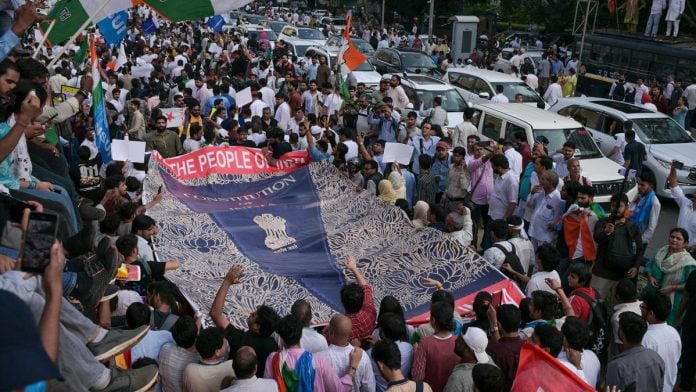
Events since October 10 have exhibited two faces of the Indian state. How the massive protests of the Cockroach Janata Party were crushed that day generated anxiety. A question arose: could a harsher crackdown be coming? However, two days later, the state allowed a massive march—led by Rahul Gandhi and supported by most opposition parties—to proceed toward the Supreme Court, a key constitutional site. State behaviour toward the two protests, both making the same demand, could not have been more different.
Why did October 10 induce anxiety?
Consider what all happened that day. The state reportedly deployed 40,000 police and paramilitary personnel to close off central Delhi; shut down multiple metro stations and trains coming to Delhi; blocked internet services for hours; failed to prevent vigilantes from Hindu right-wing groups from assaulting students; and detained or arrested approximately 7,000 people. Before the mass arrests, it also sent the police into airplanes and homes to arrest protest leaders. The Indian state acted like a police state.
Several China observers wondered what lay ahead. A distinguished China scholar asked me how far India was from the huge Tiananmen protests and their bloody ending.
Also Read: India’s Gen Z is fighting, not praying. Why its protests are bigger than politics
Tiananmen & the tale of recent Indian protests
Those old enough to remember the Tiananmen protests will recall that thousands of students challenged the rulers in April-May 1989. They occupied China’s Jantar Mantar, Tiananmen Square in Beijing. They wanted democracy in a country which has never practised it. There is a debate over whether they wanted elections to pick rulers or simply independent citizen assemblies to make decisions. But at the very least, they wanted the Communist Party and China’s one-party state to play a less dominant role in society and provide greater freedom for citizens.
The Chinese state finally called the military to crush the protest. Tanks were sent to the streets and squares of Beijing (and also to several other cities). Estimates suggest that several hundred students died and many more were injured and arrested; some soldiers were also killed. There have been no national-level student protests in China since then. Those that did erupt have remained locally confined.
I was a student in April-May 1989. Watching what happened in Beijing, my teacher, Myron Weiner (MIT), one of the greatest post-1945 American scholars of India, said that this could not take place in India. No government, however unpopular, would order tanks into Delhi. That turned out to be true on October 10. Because India is a democracy, the military option against the nation’s citizens is not available, except in cases of violent insurgency.
Moreover, China’s head of state is also generally the head of the military, de jure or de facto. Under Deng Xiaoping, China’s ruler during the Tiananmen protests, this was true de facto. Deng could order the military in a manner that would be most unlikely in India.
To put it in conceptual terms, India can temporarily become a police state, but it cannot be a military state, especially if the protests are peaceful. Only a wantonly Constitution-defying state can break this long-standing rule.
Then, on October 12, even the police state effectively disappeared.
The opposition parties, led by Rahul Gandhi, put together a massive turnout of protesters, who proceeded peacefully toward the Supreme Court. Section 163 (akin to the older Section 144), which prohibits assemblies of five or more people, was imposed in swathes of central Delhi. But watching the sentiment of the thousands who had gathered, the cops did not implement it with an iron hand. They let popular feelings be expressed so long as the protesters remained peaceful, which they did.
The police state returned yet again on October 16, when the CJP held a peaceful protest to lahrao tiranga (fly the tricolour, the national flag). But the police repression, though it did exist, did not acquire the dimensions of October 10.
Why the differential treatment?
How do we understand the two-faced behaviour of the central government, which controls Delhi Police?
The state appeared to follow what has become a popular scholarly distinction between civil society, led by NGOs and citizen organisations, and political society, led by political parties. The state gave the message that civil society would be crushed if the government deemed it necessary, but political society could be tolerated, at least for now.
It is noteworthy that the distinction between political society and civil society is not acceptable to all. The reason is simply that trade unions and student unions, normally placed in the conceptual box of civil society, cannot strictly be called non-political. That is why a group of scholars, which includes me, doesn’t equate civil society with being non-political. Even fan clubs of South Indian film stars have always been great participants in politics, as is also true of the RSS. We call civil society non-governmental, not non-political.
But governments often find the distinction very convenient. They can easily declare that civil society organisations should be non-political and that if they engage in protests or oppose the government, they should be suppressed.
Using such arguments, the Modi government has often attacked India’s civil society, including non-state academic and research institutions. Because protest is also a constitutionally guaranteed right in India, this argument has a fundamental problem. It runs afoul of a constitutional provision.
Also Read: Modi’s welfare strategy has reached a dead end. India’s youth want jobs, not food handouts
Limits of repression in India
Since it is the judiciary that has the final authority to determine whether the Constitution has been violated, the behaviour of courts in such situations becomes critical. As long as the executive can count on the judiciary being in all probability on its side, the government can continue to repress protests organised by civil society organisations.
The CJP is not a party; it is a civil society organisation. It needs judicial support when repressed. And if it can’t get that, it still has the option of forcing its way into the public sphere—via widespread popular approval. Even ruling parties worry about losing mass support. And available research suggests that sometimes if not always, the courts, too, brood over public image and credibility.
The quashing of two CJP-led protests, therefore, is not the end of the story. It is hard to believe that, given its popularity, the CJP will not find its way back. Meanwhile, political parties will also continue to press the government. The protests are likely to continue until at least some key demands are met.
China, effectively, does not permit civil society organisations, nor does it allow opposition parties. That is another reason the Tiananmen anxiety was unsound.
Ashutosh Varshney is Sol Goldman Professor of International Studies and the Social Sciences and Professor of Political Science at Brown University. Views are personal.
(Edited by Asavari Singh)