





Fashion retailers across markets and geographies are reassessing their store networks as changing consumer preferences and economic pressures reshape the industry. H&M has been closing stores, while Lululemon is slowing sales. Yet Zara continues to report revenue and profit growth.
If the same industry-wide pressures are affecting these brands, why are their fortunes diverging? Is the problem simply a slowdown in consumer spending, or are some brands doing a better job of responding to changing tastes, pricing expectations, and demand?
What do the balance sheets say?
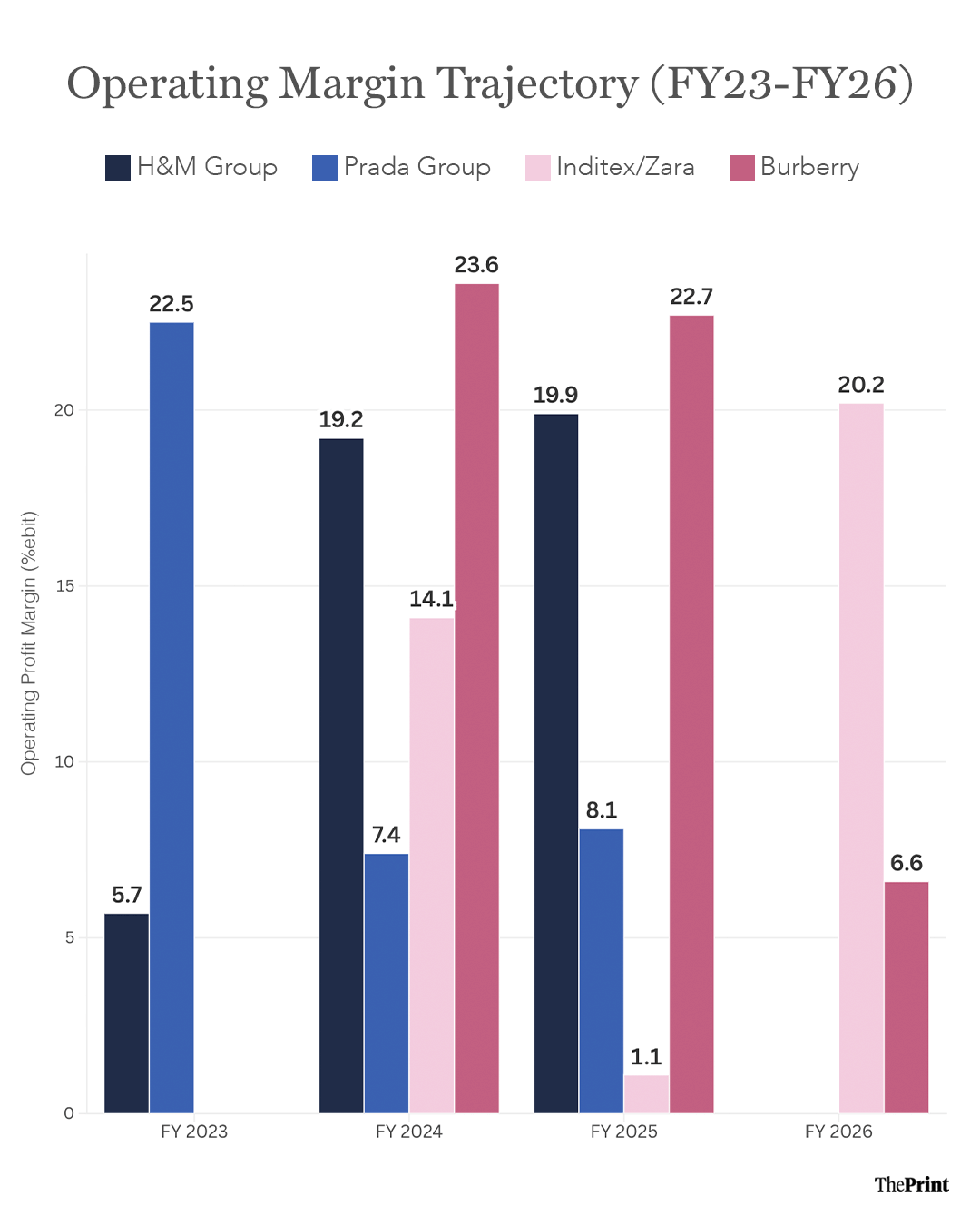
A look at the corporate balance sheets reveals the clear winners. We examine 4 brands across two distinct tiers: Zara and H&M in high-street retail and Prada Group (Miu Miu) and Burberry in the luxury sector.
In high-street retail, Zara continues to outperform its counterpart H&M by a large margin. With just around 22 stores compared with H&M’s 67 in India, Zara generates double the net sales.
While H&M has reported an increase in operating profits in FY25, a closer look at the brand’s net sales reveals a 3 per cent decline.
In plain language, this means that the brand is selling less merchandise. The increase in overall profit is largely attributed to sharp operational cost-cutting, including the closure of 128 stores over the year.
In the luxury sector, Prada’s subsidiary group Miu Miu had a 30 per cent rise in net sales, pushing the group’s overall sales up 3 per cent in FY26 (year ended March), compared with a 4 per cent decline the year before.
Meanwhile, although Burberry has reported a 2 per cent increase in store sales under Burberry Forward, its new “return to heritage” strategy, along with operational cost-cutting, its sales have been declining for years.
Why are some brands thriving and some not?
Over the past few years, neutral aesthetics was marketed as “quiet luxury”, but the trend is shifting again to maximalism, as per Vogue magazine’s Pinterest Predicts trends.
The overproduction and distribution of the neutral aesthetics trend, driven by fast-fashion suppliers (like Shein and Temu), created a sense of visual boredom. Brands such as H&M, which over-relied on safe neutrals, have seen sales decline.
Zara, on the other hand, has shown steady growth. With a team of 700 in-house designers, Zara maintained a distinct design language with visually appealing statement and neatly tailored pieces, directly addressing visual boredom.
This contrast is equally visible in the luxury sector as well. Burberry suffered years of decline in sales due to its overreliance on the brand name and indistinguishable marketing strategies. On the other hand, Prada’s Miu Miu demonstrated the power of a strong, distinct design language through its steady growth.
Following the same logic, with the launch of “Burberry Forward,” which returns the brand to iconic British heritage staples and artisanal cashmere, Burberry has seen a 2 per cent increase in store revenue after declining sales since 2023.
But design alone does not explain the shift. Shoppers themselves have changed.
As per The State of Fashion 2026 report by McKinsey & Company (an annual, comprehensive global industry forecast that analyses macroeconomic, supply-chain, and consumer sentiment shifts), tariffs imposed by the United States since 2024 have raised merchandise prices directly and added to uncertainty around consumer confidence and discretionary spending.
Gen Z and Millennial consumers are more aware of materials and supply chains and refuse to pay an aspirational tax under economic and environmental pressures.
According to the report, the new consumer is also seeking emotional connection, mental well-being, and alignment with like-minded communities. But they are highly discerning as well. Consumers can tell authentic purpose from superficial community-building.
An example can be seen in the case of athleisure pioneer Lululemon, which built its brand on the motto of “Be Human, Be Well, and Be Planet” in 2022. The brand integrated yoga studios, wellness events, and local ambassador networks directly into stores.
However, the physical experiential spaces couldn’t do enough to bridge the mismatch between the brand story and its products. The abundance of Lululemon dupes in the market and the sourcing of collections from the same Chinese supplier by athleisure brands such as Aastey (as claimed on Shark Tank India) have undermined Lululemon’s unique value proposition.
Coupled with that, Lululemon’s reliance on overproduced, petroleum-based synthetic fabrics could have deepened consumers’ emotional disconnect from the brand. The stark decline in Lululemon’s market capitalisation by over 50 per cent and falling revenues over the year is consistent with this.
Also Read: Fashion has gone from physical clothes to digital identity. It’s defined by code & pixels
Pricing and Inventory
Beyond brand positioning, profitability depends on getting two things right: pricing products at a level consumers consider worthwhile and managing inventory closely.
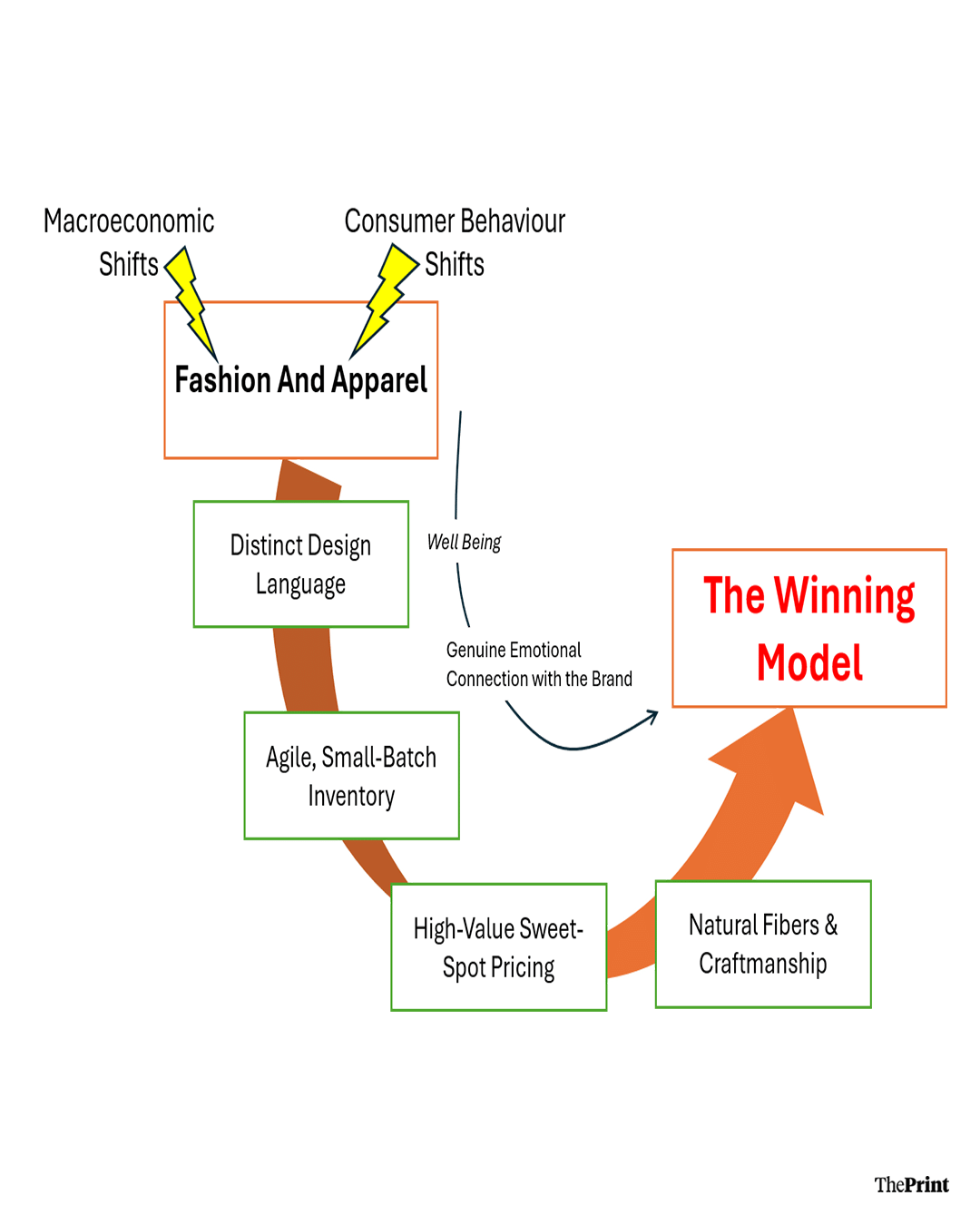
Along with a distinct design language, the winning brands have paired optimised premium pricing with intensive inventory management. The pressure to find a sweet spot price in a competitive market going through macroeconomic tightening is high.
The struggle (as discussed in a 2023 peer-reviewed paper on the effects of democratisation of luxury) is delivering a high-status design language at an accessible or acceptable value-for-money price.
Zara exemplifies this trade-off by charging small premiums over traditional fast-fashion brands and delivering products high on design language. Brands such as H&M, which are low on design differentiation and have comparatively cheaper-priced products, fall in direct competition with other mass-produced brands and face declining sales.
Similarly, inventory management is the differentiator between high-margin enterprises and struggling retailers. Zara uses its designers to adapt high-fashion runway trends into wearable fashion with a distinct design language in 15–20 days.
The company leverages smart data-backed operations and produces small batch quantities. By intentionally limiting production, it creates “artistic scarcity”. H&M, on the other hand, is heavily dependent on Asian manufacturing (China, Bangladesh, and India) and has a lead time as long as six months for basics, which requires long-range planning and risks a mismatch between volumes produced and changing consumer demand.
Decoding these performance gaps reveals a clear operational model for retail survival, one that mirrors the product and ecosystem strategy used by leading aspirational but democratised tech companies like Apple.
Apple avoids cheap price wars by focusing on distinctive product design, clear price tiers, and keeping inventory lean so supply never overwhelms demand and supports resale value. When applied to fashion and apparel, this playbook appears to work the same way.
Crafting distinct, recognisable garments that mass-market copiers cannot easily replicate, setting an “accessible-premium” price point that delivers high value to consumers, and keeping tight control on the inventory to avoid discounts and maintain resale value looks like the winning strategy.
Where India’s opportunity lies
This is where India’s opportunity lies, and where it can build a real differentiator. Human labour (of artisanal value) is being positioned as a marker of premium or luxury – a shift clearly shown by Chanel’s artisanal Métiers d’Art collections, Bottega Veneta’s hand-woven Intrecciato leatherwork, and trend forecasters: Mintel, in its 2026 beauty predictions, calls this the ‘Human Touch Revolution’.
The definition of exclusivity in apparel and fashion merchandise is clearly undergoing a shift towards visible human craftsmanship (which cannot be replicated by algorithms) and natural materials (that cannot be easily mass-produced).
Natural fibres that are 100 per cent spun and woven in India have zero tariffs under the India-EU Free Trade Agreement signed in January 2026.
The global linen fabric sector is projected to cross $18 billion, showing a shift towards natural and breathable fibres. Global markets are already saturated with high-volume and low-margin “cut-make-trim” or “fast fashion” merchandise from Chinese and Vietnamese suppliers.
So the question is: how can India go beyond cheap mass production alone and move towards a value-added apparel production value chain where it already has an inherent competitive advantage?
Value-added Apparel Production under the PM-MITRA Scheme
The Government of India’s flagship PM MITRA (PM Mega Integrated Textile and Apparel Park) Scheme aims to strengthen India’s textile and apparel manufacturing ecosystem through its 5F vision: Farm to Fibre to Factory to Fashion to Foreign.
Structured as a textile infrastructure initiative under the Ministry of Textiles, initiatives like PM MITRA are increasingly aligned with national policy priorities, including efforts to scale up man-made fibre (MMF) production and technical textiles.
However, expanding manufacturing capacity is only one part of the challenge. India must also build capabilities in design, product development and market responsiveness if it wants to move up the global apparel value chain.
The value chain for value-added apparel production is different from that of the “cut-make-trim” model, the lowest tier of apparel manufacturing, used by most fast-fashion factories. In such models, factories primarily cut fabric, stitch garments, and finish products according to specifications supplied by buyers.
Value-added apparel production would need a co-creative ODM (Original Design Manufacturing) model integrated with the premium and luxury markets. To do this within India’s PM MITRA hubs, a structured demand-led architecture must be implemented that will integrate artisan talent into the global value chain, instead of treating the craft as isolated cottage industries.
Firstly, collaboration among lead Indian designers and national institutes of apparel design (such as NIFT and IITs) must be facilitated with global luxury R&D laboratories such as that of the French luxury group Kering, through their flagship and curated programmes.
Secondly, apparel-specific processes such as sampling must be integrated with the value chain through technology (actual samples cannot be sent back and forth in a global value chain across countries). Digital prototyping using garment design software such as Adobe Substance 3D Sampler and CLO3D, for fast sampling of fabrics and fitting of the finished product, will be needed.
Finally, strategic nearshoring offices must be set up in leading fashion capitals such as Paris and Milan for actual sampling and facilitating corporate communications between the clients and the manufacturing centres in India.
However, it is important to maintain perspective on the timeline.
The PM MITRA scheme was launched in 2021, and five years later, most of the seven mega parks remain in their early developmental stage. Decisions made in the initial stages will decide India’s future in textile manufacturing for decades.
Artisanal heritage and integrated natural fibre manufacturing are India’s inherent strengths, which, if integrated well into the global value chain of premium fashion, can make India a design-led powerhouse globally.
(Edited by Maryam Hassan)