




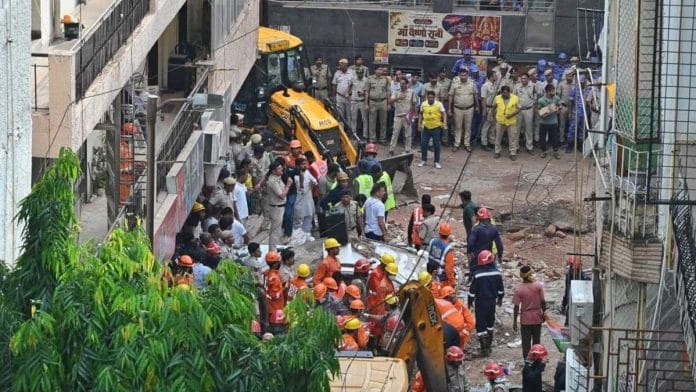

On 6 September, a five-storey building operating as a boys’ paying guest hostel in Delhi’s Satya Niketan collapsed, killing seven residents and injuring several more. Most residents were outstation students of Delhi University, which has a severe shortage of hostel capacity. Within days, the Delhi government announced that it would fast-track a long-overdue Paying Guest Accommodation Regulation and Safety Bill, promising licensing, safety audits and a public registry of accommodation providers.
But the discussion so far appears reactive, framed around one visible tragedy. That is precisely what is worrisome when the matter is one of rights rather than optics.
The judiciary has already recognised the stakes. Hearing a public interest litigation filed after the collapse, a Division Bench of the Delhi High Court in Aniket Kumar Gupta v. Government of National Capital Territory of Delhi & Ors observed that responsibility for such disasters cannot rest solely on the building owner. It extends to the Municipal Corporation of Delhi and to DU, whose failure to provide adequate hostel accommodation pushes thousands of outstation students into an unregulated private market. The court directed a citywide audit of PG hostels and sought answers on whether any regulatory framework governing such accommodation exists at all.
This sits within a longer constitutional law lineage, in which the Supreme Court has repeatedly read the right to shelter into Article 21’s guarantee of life. In Olga Tellis, the SC recognised that a livelihood-linked right to residence cannot be extinguished without due process. In Chameli Singh, it held that shelter is not a mere roof, but also includes the infrastructure necessary for a life of dignity.
A PG bill, if properly understood, should function as one such instrument for enforcing this necessary infrastructure.
Also Read: Delhi PGs didn’t become unsafe overnight. Students have been living with danger
Ingredients for a PG law with teeth
The first ingredient of an effective PG law must be a way out of the informality trap. Phased enforcement, promised in drafts, must come with a genuine incentive architecture for informal operators to register, along with sanctions for failure to comply. It cannot just be an extended deadline they can ignore as before.
Second, an inspecting authority independent of the municipal machinery—subject to judicial scrutiny— is essential. This should be accompanied by a separate grievance redressal forum that can act as an appellate authority over the proposed inspecting officer or body dealing with complaints filed through the online portal. This appellate authority should be established separately and specifically to address disputes relating to the bill that are not adequately adjudicated by the first authority, i.e. the officer or body dealing with anonymous online complaints. The time allotted to the first authority to deal with such grievances must also be limited. A prolonged adjudication process will be of little substantial benefit to either party.
Third, safety must be built into physical standards, not merely paperwork. The bill should classify paying guest accommodation by size, occupancy and other requisite factors, prescribing a minimum per-person floor area and a cap on beds per room. This would ensure that any structure, however hastily converted, cannot be let out without regard to capacity. A transparent, government-notified rate ceiling for student accommodation is equally necessary. If landlords are left to fix arbitrary rents according to their whims and fancies, they have every incentive to resist compliance costs by providing cheaper lodging options. This could further hollow out the system and create the conditions for incidents like Satya Niketan.
Fourth, compliance obligations must be matched by resident-facing entitlements, not merely regulator-facing duties. A resident whose premises fail a safety audit should have a statutory right to a refund of the deposit and advance rent, interim accommodation assistance, and compensation for loss flowing from a proven breach. These should be incorporated as implied, non-excludable terms in an agreement executed between the landlord/owner and the occupant, or in any other relevant form filled out by the occupant at the very outset. A savings clause should preserve recourse under ordinary civil court remedies. The government must also statutorily prescribe the mandatory clauses in any such document executed between landlords and occupants of PGs.
Fifth, this cannot be a one-time exercise. A standing consultative council of residents, operators, municipal and university representatives, along the lines of RWAs (Residents Welfare Associations), should continuously review the framework. Accountability for regulatory failure should be made explicit and enforcement costs transparently allocated so that there are incentives for compliance rather than concealment long after the cameras have moved on.
Also Read: MCD’s unsafe buildings list for Delhi. Declared dangerous, still in use
Safety is a duty of the state
It is worth remembering Cicero’s maxim: salus populi suprema lex esto — the safety of the people is the highest law. It is usually invoked to justify state power.
But the Supreme Court has time and again read the maxim together with the Directive Principles under Articles 38 and 39 (often called “The Socio-Economic Charter” of the Indian Constitution) to describe the affirmative duties of a welfare state, rather than as a separate licence for executive freedom.
The state must realise this too. The safety of people isn’t just a licence to regulate; it is an obligation to regulate adequately, in advance of harm, not merely in its aftermath.
A regulation drafted only after lives have been lost has already failed once. The task now is to ensure it does not fail a second time by being narrow, symbolic or unenforced.
Priyanshi Singh is an Assistant Professor of Law at Lloyd Law College and a former Academic Fellow at National Law University, Delhi. Arun Bhattacharya is an advocate at the Delhi High Court. Views are personal.
(Edited by Asavari Singh)