




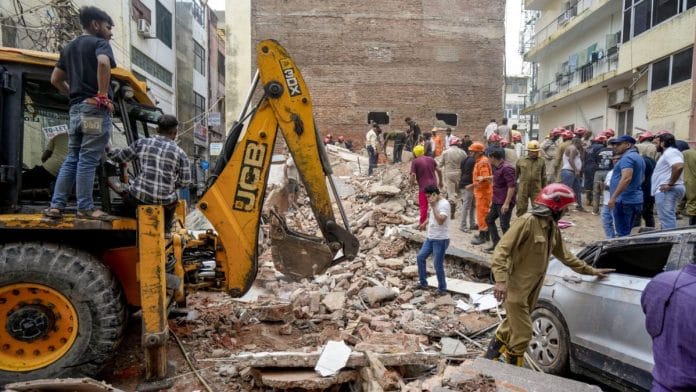

Did the recent Satya Niketan tragedy shock you? Well, it should have. But if you have spent enough time living as a paying guest in Delhi, you might also find yourself asking an uncomfortable question – how surprising is it, really, that a poorly maintained building eventually becomes a safety hazard?
I would be lying if I said most PGs come with well-maintained buildings and reliable facilities. Every owner, however, seems to have mastered the art of selling a dream. “24/7 water supply”, “fully furnished”, “safe and secure”, “all amenities available” — the list of promises goes on. The actual experience, unfortunately, can be quite the opposite.
For a student living miles away from home, one would assume that basic necessities are, well, basic. Water, for instance, should not qualify as a premium amenity. Yet almost every PG in Okhla Vihar faces water shortages, which are neither an annual event nor an occasional inconvenience.
Every month buckets become emergency storage tanks, bathrooms become strategic territories, and every evening comes with the same question: “Aaj paani aayega?”. Will there be water today? At this point, storing water feels less like a household chore and more like disaster preparedness.
And complaining to the owner? That is an entirely different exercise. You call, you message, you remind them, you complain again, only to receive the magical response: “Haan, dekhte hain.” Yes, we will see. What exactly they are looking for remains unclear. The water issue persists, the ceiling continues to crack, and the maintenance request quietly enters what appears to be an alternate dimension.
Also read: Expats in Gurugram expected a global city. They are battling waste and waterlogging woes
‘Home away from home’
I have been living in Delhi for over three years now. Finding and shifting between PGs has become a nightmare in itself. First, you search for a “livable” locality. Then comes the hunt for a decent PG. You inspect the room, negotiate the rent, ask about water, electricity, food, security and maintenance, and finally convince yourself that you have found a comfortable place.
You move in, unpack your belongings, and perhaps even convince yourself that you have finally found a “home away from home”. Then, within a month or two, the carefully curated promises begin to unravel.
The 24/7 water supply becomes 24/7 uncertainty. The “well-maintained building” develops cracks. The “quick maintenance service” becomes an elaborate waiting game. And the owner, who was remarkably enthusiastic while collecting the security deposit, suddenly becomes difficult to reach.
Once the rent has been paid, you hope they will respond, while they hope you will eventually stop asking.
Finding a decent PG in Jamia Nagar is no less exhausting. Living in an area where water shortages occur every other day adds another layer to the misery. Students repeatedly complain, but unless the problem directly threatens the monthly rent collection, it often seems to rank fairly low on the owner’s list of priorities.
This is where the Satya Niketan tragedy becomes more than just another disturbing headline. It forces us to reconsider the everyday hazards that students are expected to tolerate. A cracked ceiling, exposed wiring, faulty plumbing, overcrowding, poor ventilation or a neglected structural problem may initially appear to be minor inconveniences.
But negligence has a way of accumulating. What is ignored today can become dangerous tomorrow. And by the time something goes terribly wrong, everyone suddenly wants to know why nobody noticed the warning signs.
Had university hostels been more accessible to students, perhaps much of this ordeal could be avoided. Instead, students who move to Delhi for education are pushed into an unregulated housing market where affordability, availability and safety rarely coexist. The PG is marketed as a “home away from home,” but the phrase often comes with an unspoken disclaimer: terms and conditions apply.
The problem is not merely that something terrible happened. The problem is that so many smaller things happen every day, and we have become so accustomed to them that we no longer recognise them as warnings.
Maybe the real luxury in a Delhi PG isn’t an air conditioner, a washing machine or a balcony. Maybe it is simply knowing that the roof over your head will remain where it is supposed to be.
(Edited by Janaki Pande)