








On the evening when 20 rebel TMC Lok Sabha MPs announced their merger with the Nationalist Citizens Party of India, or NCPI, few in West Bengal or beyond had ever heard of the outfit. The NCPI was a registered but unrecognised party headquartered in Howrah, with negligible organisational presence and a history of contesting a handful of seats in Tripura, securing only a few hundred votes.
The MPs themselves acknowledged in private conversations that the choice was not driven by ideological affinity or any vision of building a new force. It was a calculated manoeuvre to claim that two-thirds of the TMC parliamentary contingent had merged with another party, thereby seeking to escape the disqualification provisions of the Tenth Schedule of the Constitution.
The entire exercise unfolded through sustained deliberations involving BJP leaders. Union minister Bhupender Yadav, West Bengal Chief Minister Suvendu Adhikari, and senior rebel figures, including Sudip Bandyopadhyay, held multiple discussions. Meetings with Union Home Minister Amit Shah formed part of the negotiation process. With the new parliamentary session underway, the Speaker—who allotted the rebels separate seating in the Lok Sabha—has yet to grant formal recognition to the new grouping as a separate party.
The NCPI members have since aligned themselves with the National Democratic Alliance (NDA) fold. Attending NDA meetings regularly, the grouping, on paper, has become the largest ally of the ruling coalition from West Bengal.
The deeper problem lies elsewhere.
The NCPI possesses no independent ground presence in West Bengal. Most of its new leaders lack independent organisational roots. Several entered politics as celebrities and rode to victory on the strength of TMC machinery and Mamata Banerjee’s personal appeal. That organisational scaffolding has vanished. The result is a party that exists largely as a parliamentary bloc, desperate for relevance and increasingly fractured by internal contradictions.
No solo future
West Bengal politics after the 2026 Assembly elections remains essentially bipolar. The BJP secured a decisive majority with more than 200 seats and a vote share approaching 46 per cent. The TMC, reduced to around 80 seats, nevertheless retained a resilient vote share of approximately 41 per cent—a loyal core that has not evaporated overnight. The Congress and the Left parties remain marginal, though they have shown signs of filling pockets of space created by the TMC turmoil.
Historical experience offers little encouragement for a third force. The Left Front sustained power for 34 years through a genuine multi-party alliance of the Communist Party of India (Marxist), the Communist Party of India, the Forward Bloc, the Revolutionary Socialist Party and smaller partners. When Banerjee briefly aligned with the NDA in the late 1990s and early 2000s, the BJP’s independent gains remained limited; its fortunes rose and fell with her organisational strength.
In the current landscape, no comparable vacuum exists for a new formation outside the BJP. If the NCPI contests independently, it will only use the BJP’s emerging base rather than attract opposition votes. Those votes will continue to consolidate either with the residual TMC or, in limited pockets, with the Congress and Left. Only a handful of leaders with residual personal appeal, such as a film personality of genuine mass following, might salvage a seat. For the rest, a solo journey leads nowhere.
Also read: Rahul Gandhi finally has an audience that isn’t laughing at him
Merge for survival
Absorption into the BJP is, therefore, the sole realistic path to residual political relevance. The NCPI leadership knows this. Several of its members have long records of grassroots work: Kakoli Ghosh Dastidar, Arup Chakraborty from Bankura, Jagadish Chandra Barma Basunia, a former Forward Bloc hand, Abu Taher Khan and Khalilur Rahaman from the Murshidabad region, and, to a lesser extent, Saayoni Ghosh.
These leaders once commanded local networks. The majority, however, are drawn from the worlds of cinema and sport—Shatabdi Roy, June Malia, Rachna Banerjee, Yusuf Pathan and Prasun Banerjee. Their electoral success rested almost entirely on the TMC organisation and the broader anti-Left or later anti-BJP wave.
That organisation no longer exists for them. Equally decisive is the BJP’s own performance in the assembly segments that fall under these Lok Sabha constituencies. In Kolkata North, Birbhum, Medinipur, Hooghly, Howrah, Cooch Behar, Bardhaman, Jhargram, Bankura and several other regions, the BJP recorded strong results.
In the next Lok Sabha elections, the party will not need external partners to contest these seats. Tickets will be scarce. Most NCPI leaders cannot reasonably expect nomination. Merger, however incomplete or delayed, at least offers the possibility of continued access to power and resources that solitary existence cannot provide.
Also read: Why one PM Modi-Nitin Nabin photo may worry BJP leaders and karyakartas
Muslim MPs resist
Three Muslim MPs, including Abu Taher Khan from Murshidabad, Khalilur Rahaman from Jangipur and Yusuf Pathan from Baharampur, have drawn a clear line. They have announced they will neither join the BJP nor extend formal support to the NDA. West Bengal’s Muslim population exceeds 27 per cent and has long formed a core component of the TMC vote.
In the 2026 Assembly election, a substantial share of the party’s retained 41 per cent came from Muslim-dominated pockets. The three constituencies represented by these MPs are among the most densely populated by Muslims in the state. Murshidabad, Jangipur and Baharampur each have Muslim majorities approaching or exceeding 60 per cent. These leaders understand the arithmetic of political survival.
Association with the BJP, whether through formal merger or sustained NDA membership, would extinguish their prospects in these seats. The NDA currently has no Muslim MPs from other parties. Their entry would make them the first, and the backlash in their home constituencies would be immediate and severe. They have, therefore, chosen to keep their distance, attending only developmental meetings with the state government while publicly rejecting any deeper alignment.
Also read: Why Prashant Kishor’s Bankipur victory in Bihar should ring alarm bells for Modi-Shah’s BJP
BJP’s internal backlash
The BJP’s own ranks in West Bengal are far from enthusiastic. The induction of former TMC leaders has already triggered visible discontent. When three former TMC Rajya Sabha members were absorbed and given immediate prominence, sections of the state unit protested that the party was abandoning its long-standing opposition to turncoats.
Senior figures have publicly and privately expressed unease at welcoming leaders long associated with the very culture of governance the BJP had campaigned against—allegations of corruption, muscle power and administrative high-handedness at the local level.
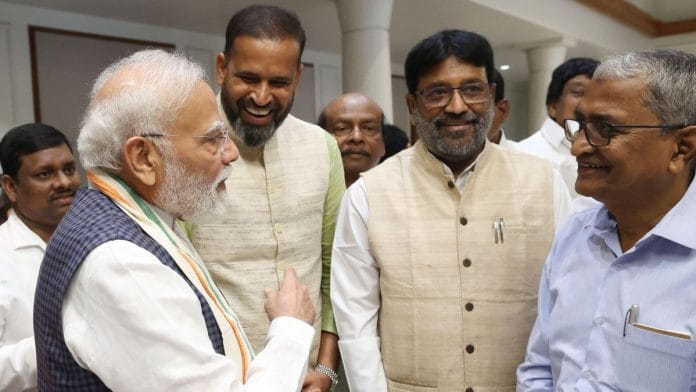
Many of the current NCPI leaders carry similar baggage in the public mind. The BJP’s 2026 victory rested not only on anti-incumbency against the TMC but on a specific rejection of that style of politics. Absorbing the same faces risks diluting the moral and political capital the party has accumulated among its cadres and a section of the electorate. The NCPI leadership has met the Prime Minister, fuelling speculation of an eventual full merger.
Chief Minister Suvendu Adhikari has invested considerable energy in shaping the present arrangement. Yet the internal resistance remains strong. For the moment, the BJP needs the parliamentary numbers—20 MPs—particularly for legislative business. Once that utility diminishes, the willingness to accommodate large numbers of them, especially with tickets, will shrink further.
The NCPI, thus, finds itself on a lonely road. It has no independent organisational soil in which to grow, no natural constituency beyond the transient parliamentary arithmetic, and no political space in West Bengal outside the shadow of the BJP.
Survival depends on absorption. Independence is an illusion. The cracks already visible among its Muslim members and the quiet resentment within the BJP ranks only underline the precariousness of its position. In the harsh arithmetic of Bengal politics, there is simply no room for a third force that exists primarily as a vehicle for political survival.
Sayantan Ghosh is the author of two books, ‘Battleground Bengal’ and ‘The Aam Aadmi Party’. Views are personal.
(Edited by Saptak Datta)