






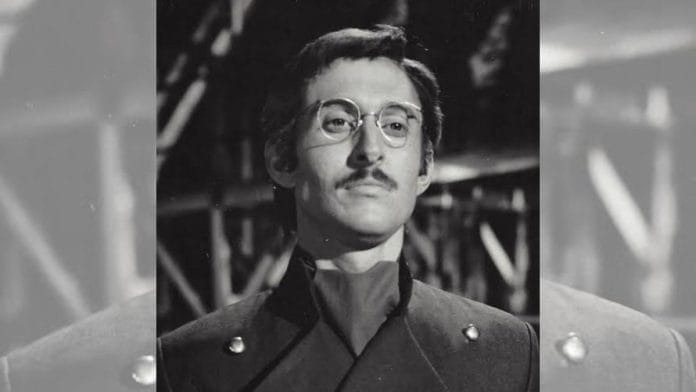

Tom Alter was a gem of an actor. He was a titan whose command over Hindi and Urdu, theatrical poise and screen presence set him apart from many Indian actors. This combination made his persona unique on the silver screen. It was hard to believe that a white man could say “khwaab” with nukta, something Indian audiences did not expect.
And that is precisely why Dial 1975 (2026) is not the farewell he deserved. To label the film, which released on 21 August, as his final curtain call isn’t just unfortunate — it feels like an insult to an artist of his calibre.
The film is set against Emergency, where there is a scramble to secure a German wireless phone prototype which would allow rebels to bypass government surveillance. To uncover their strategy, jailor Irish, played by Alter, has to retrieve the leaked recording linked to the phone within 24 hours. Irish recruits a convicted criminal, Prakash, played by Uday Thapar, for the task, but standing in front of him is K.K. Menon’s Govind, a court-martialled army man.
While Alter’s character plays an important role in the film, he appears only for a few minutes across its two-hour runtime. He mostly turns up between scenes, speaking to fellow officers and spelling out the developments of the plot. It feels as if the character exists only to explain to the audience what is happening. There is little for Alter to actually perform: no memorable dialogue, no linguistic flourish, no layers to the character. The role feels less like a character and more like a plot device.
For most of his career, Bollywood made Tom Alter the “white British officer”. In his early days, he played the chief customs officer in Charas (1976), a CID officer alongside Dharmendra in Des Pardes (1978), a police commissioner in Hum Tere Aashiq Hain (1979), and police officers in films like Kaanshwara Rama (1977) and list is never ending.
But even when the industry reduced him to these token roles, Alter brought something the stereotype could never contain: linguistic precision. He slowly shattered the foreign caricature that Hindi cinema had often created around white characters. The moment he spoke, you knew this was not just another foreigner inserted into an Indian film.
And then came Satyajit Ray’s Shatranj Ke Khilari (1977), where Alter played Captain Weston. It remains one of those roles that showed just how naturally he belonged to the Indian cinematic and cultural landscape. He was perhaps the most lovable and astonishing white man Indian cinema had seen.
Also read: Tom Alter’s last film Dial 1975 releasing 9 yrs after his death. It’s set in the Emergency
An unprecedented farewell
Dial 1975 gives Alter the same kind of role he had played for much of his career, a police officer. But this time, it feels less like a character and more like an attempt to cash in on his legacy. His presence is disjointed, almost forcefully inserted into the narrative.
What is most frustrating is that the film never allows Alter to do what he did best. There is no room for the quiet authority he brought to a scene — qualities we have seen across films, television and theatre.
Alter did not choose Dial 1975 as his farewell. He did not announce his retirement, nor did he know that this would become his final film. He died in 2017, while Dial 1975, originally slated for release years earlier, remained unreleased for almost a decade.
That makes the disappointment somewhat different. This is not about blaming Alter for the choice of his final role. He never chose this as his final statement as an actor. It is about what we, as audiences, are left with. A film that happened to become his last release has now acquired the weight of a farewell that Alter himself never intended.
A final performance does not have to be a great film, but it should at least remind us why the actor mattered. It should leave behind a glimpse of the qualities that made audiences remember him.
An actor who spent nearly four decades mastering language and performance is reduced to explaining the plot. And the irony is hard to miss in Dial 1975, the story is literally narrated through a telephone.
The telephone is trying to hold the broken pieces of the plot together. Unfortunately, so is Alter’s character.
(Edited by Janaki Pande)