






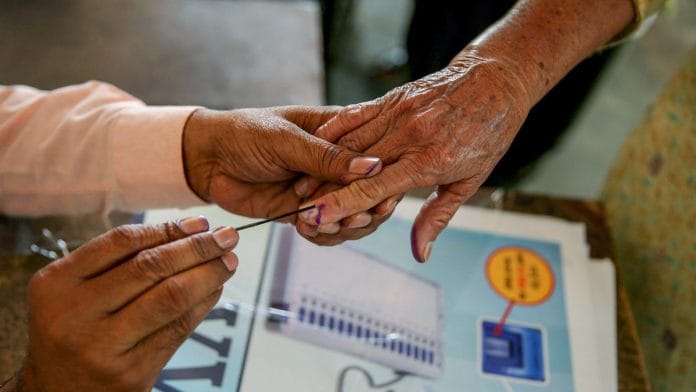


Jairam Ramesh’s pitch for making the right to vote a fundamental right deserves a serious answer rather than reflexive dismissal. He is the General Secretary in-charge Communications of the Indian National Congress and among the more constitutionally literate politicians in contemporary India. But the answer is not the one he is looking for.
The argument has historical roots. When the Constituent Assembly’s Advisory Committee on Fundamental Rights met in April 1947, the debate on whether to enumerate the franchise as a fundamental right was animated. BR Ambedkar and Jagjivan Ram argued for it. Sardar Patel, C Rajagopalachari, and others opposed explicit enumeration—partly for the practical reason that the princely states, not yet fully integrated, might baulk at accepting universal adult franchise as a constitutional imperative. But Patel acknowledged that universal adult franchise was, in itself, an implicit fundamental right. That position found expression in Article 326, which enshrines elections based on universal adult suffrage. The framers did not reject the idea; they embedded it differently.
The question, then, is whether, after seven decades, we should make that implicit status explicit. The answer requires us to distinguish between three different things that are being conflated in the current debate: The right to vote as a statutory right, as a fundamental right, and as a basic structure element of the Constitution.
The basic structure argument
The most powerful constitutional protection available to universal adult franchise is not Part III of the Constitution, which houses fundamental rights, but the basic structure doctrine. The Supreme Court in Indira Gandhi v. Raj Narain (1975) established that free and fair elections are part of the basic structure, which no Parliament can abrogate even through a constitutional amendment. Universal adult franchise under Article 326, inseparable from that principle, already enjoys a level of protection that no ordinary fundamental right possesses. Fundamental rights can be reasonably restricted under Article 19(2), can be suspended during a national emergency, and can be regulated by Parliament within the contours the Court prescribes. The basic structure cannot be touched at all.
Ramesh’s formulation, ironically, would place the franchise on a lower pedestal than where Sardar Patel’s implicit understanding already situated it. The constitutional battle worth fighting is to have the Supreme Court conclusively affirm that systematic dilution of universal adult franchise—through administrative processes, discriminatory deletions, or regulatory capture of the electoral machinery—violates the basic structure. That is a stronger shield than Part III.
Also read: The math behind India’s elections—Why proximity matters
On the SIR question
The Special Intensive Revision process has a prescribed procedure and an appellate mechanism. The grievances that have emerged—particularly in West Bengal—are about the appellate remedy not being operationalised in time, not about the process being constitutionally impermissible in design. That is a procedural failure, challengeable under Article 226 before the high courts, and on Article 14 grounds if the deletions show discriminatory targeting by geography, religion, or community. A fundamental right to vote would add little to this existing toolkit. The remedies are already there.
What is absent is not the constitutional category but the enforcement architecture: Mandatory pre-deletion notice with a fixed response window, a standing judicial officer to hear appeals in real time, and automatic stay of deletion pending final decision. These are statutory reforms within the Representation of People Act 1951. They require political will, not constitutional amendment.
Also read: India can’t constantly be in campaign mode—simultaneous elections are good for voters & parties
The unenforced fundamental rights problem
Here one must be brutally candid. India’s record of enforcing fundamental rights that have been solemnly declared is, to put it charitably, uneven.
First, the right to free and compulsory education has been a fundamental right since 2009. Seventeen years later, the 25 per cent reservation mandate in private schools remains a contested battlefield of non-compliance, litigation over fee reimbursement, and State-level evasion. Free and compulsory education is neither reliably free nor genuinely compulsory across large parts of the country.
Second, the right to privacy, declared fundamental by a nine-judge bench in Puttaswamy (2017), has coexisted with an expanding surveillance infrastructure, a data protection regime that arrived years late and in diluted form, and a chilling effect on communication that would have alarmed the very bench that delivered the judgment.
Third, freedom of thought, expression, belief, faith, and worship stands guaranteed in Articles 19 and 25. Yet anti-conversion legislation, in multiple states, penalises the act of religious persuasion between consenting adults. These laws survive not because the courts have approved them on merits but because enforcement of the fundamental right against them is slow, expensive, and uncertain.
The pattern is consistent and dispiriting: Constitutional declaration precedes enforcement capacity by decades, if the enforcement arrives at all. Adding the right to vote to Part III without simultaneously building the enforcement infrastructure would be another entry in a long ledger of aspirational rights that citizens carry in their pockets but cannot easily cash.
Also read: Yesterday’s militants in Punjab are martyrs for today. BJP’s hope in a non-Hindu majority state
What should actually be demanded
Three things would achieve more than a constitutional amendment:
First, litigate and settle judicially that systematic dilution of the franchise—whether through roll manipulation, arbitrary deletions, or institutional capture of the Election Commission—constitutes a violation of the basic structure, directly challengeable before the Supreme Court under Article 32 without the mediation of ordinary statutory remedies.
Second, amend the Representation of People Act to create a time-bound, judicially supervised appellate mechanism for electoral roll deletions, with automatic stay as the default, not the exception.
Third—and this is the companion reform without which the rest is incomplete—implement the Supreme Court’s direction in Anoop Baranwal v. Union of India (2023) on an independent appointment process for Election Commissioners. A constitutional right to vote enforced by a constitutionally compromised Election Commission is an armoured castle with a broken gate.
Ramesh’s instinct is right: The franchise needs stronger protection than it currently enjoys. His diagnosis of institutional deterioration in the Election Commission is widely shared across the constitutional spectrum, well beyond his own party. But the prescription of elevation to fundamental right status, while symbolically powerful, mistakes category for capacity. India does not need more rights on paper. It needs the rights it already has enforced.
The right to vote is already, in Sardar Patel’s own understanding, an implicit fundamental right and, in the basic structure doctrine, an unamendable constitutional commitment. The work is not to declare it anew but to make it real.
The author is a retired IAS officer of the Punjab cadre (1984 batch) who superannuated as Special Chief Secretary, Government of Punjab. Views are personal.
(Edited by Theres Sudeep)