









It is widely believed that voters are more likely to support candidates who come from their local area. Drawing on fine-grained data from India’s 2014 general election, this article suggests that local candidates win not simply because voters want them, but because they can mobilise people who would otherwise remain untouched by the broader party machinery.
It is one of the most consistent findings in electoral politics: voters are more likely to support candidates who come from their local area (Gorecki et al. 2022). Politicians therefore often go to great lengths to present themselves as local. For example, the Shiv Sena candidate for Borivali constituency in Mumbai for the 2024 general elections described himself as a ‘bhoomi putra´ and stressed that he would continue to live among voters and remain accessible to them. Similarly, the BJP’s (Bharatiya Janata Party) Lok Sabha candidate for the Amritsar constituency for the 2024 general elections, Taranjit Singh Sandhu, was actively trying to project himself as the ‘son of the soil’ to counter the perception that he was an outsider, shaped in part by his long foreign service career. Clearly, being seen as local is viewed as an electoral advantage or at the very least used to avoid the disadvantage of being perceived as an outsider.
However, what it means to be local can take different forms. Indian parliamentary constituencies are geographically large and socially diverse, often encompassing several towns, villages, and neighbourhoods. They are also constructed by grouping together multiple assembly segments, and they can cut across administrative and social boundaries that people might otherwise use to define their sense of locality. For example, sharing the same zila may generate a sense of shared identity, even when the district is divided across multiple constituencies. A candidate may be perceived as local simply because they are recognised as a Mumbaikar, even if they do not come from the specific neighbourhoods that fall within the constituency. Similarly, in Gujarat, a candidate from Rajkot might be viewed as local not only in a narrow constituency sense but also through a broader Saurashtra regional identity that continues to structure political discourse in the state. Voters may therefore feel a sense of shared identity with candidates from their region or locality, or believe local candidates are more likely to represent their interests once elected, directing government spending and attention towards their community.
In a new study, we argue this picture is incomplete. Drawing on exceptionally fine-grained data from India’s 2014 general election, we propose a different explanation – one that focuses not on what voters want, but on what local candidates can do. Specifically, we argue that local candidates are embedded in social networks in their communities, and that these networks serve as a powerful resource for mobilising voters (Shrimankar and Heath 2026).
The study and data
India is an ideal setting for testing this argument. Elections are fought primarily through intensive, face-to-face campaigning. Candidates rely on brokers, party workers, local activists, and community leaders to contact voters and get them to the polls. In this environment, a candidate’s existing social connections, rooted in family ties, kinship networks, caste associations, and local influence, represent a significant campaign resource. Those who are deeply embedded in local networks can mobilise more people, reach more households, and extend the reach of their campaign beyond what party machinery alone could achieve.
More practically, India offers a perfect setting for testing our alternative explanation because of the rich publicly available data. All candidates contesting elections in India are legally required to submit sworn affidavits that disclose information about their place of residence, financial assets, education, and criminal cases. At the same time, the Election Commission of India publishes highly disaggregated election results at the individual polling station level. Taken together, these sources make it possible to link candidates to thousands of polling booths within each constituency and examine how electoral outcomes vary across space.
For our research, we use polling booth data from 80 parliamentary constituencies in Uttar Pradesh (UP) and 26 parliamentary constituencies in Gujarat from the 2014 Lok Sabha elections. To measure candidate localness, we geocode the location of each candidate’s home address from the affidavit return. We collect the address data for all the candidates of the BJP and Congress Party in Gujarat and BJP, Congress Party, Samajwadi Party (SP) and the Bahujan Samaj Party (BSP) in UP. For each candidate we google map their address to extract the longitude and latitude. We then calculate the euclidean distance (in kilometres) between the candidate’s geo-located current address and each polling booth in the district. The total number of polling stations in the two states is 180,234, giving us 534,552 candidate-booth level observations.
Crucially, this dataset allows us to examine how a candidate’s vote share changes as we move further from their home address, holding all else constant. We complement this aggregate analysis with individual-level survey data from the 2014 National Election Study, which covers 3,311 respondents across 221 polling booths in Gujarat and UP, and includes questions about campaign contact and political participation.
Also Read: Listen to Rahul Gandhi. Fake voters should appall you, whichever party you support
Key findings
The local advantage is real and significant
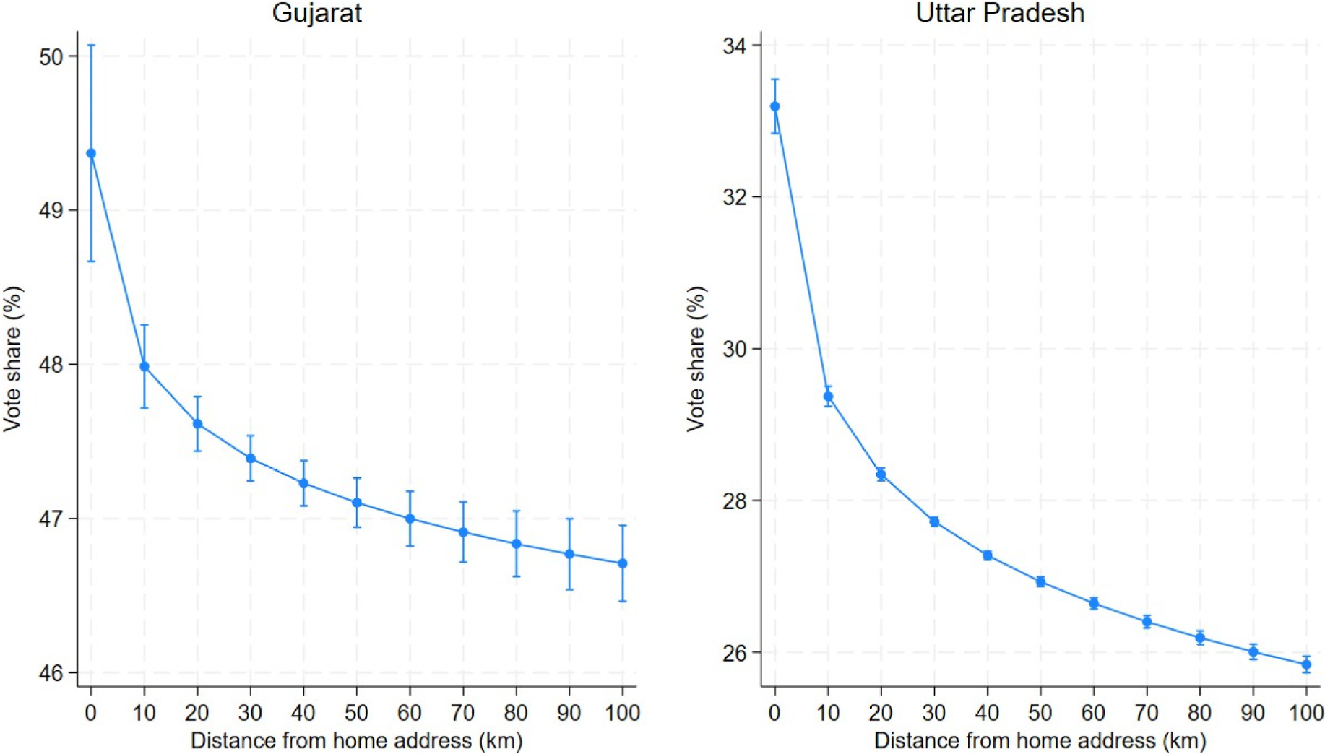
Candidates perform substantially better in polling booths close to their home address than in booths further away (See Figure 1). Electoral support falls by around 4 percentage points (p.p.) over the first 10 kilometres, with most of the decline concentrated in the first 5 to 10 kilometres. The effect then levels off. For comparison, research from the United States finds a decay of less than 2 p.p. over roughly 160 kilometres (Gimpel et al. 2008). The Indian case, in other words, shows a considerably stronger local effect. One possible explanation is that election campaigns in India rely much more heavily on face-to-face mobilisation in comparison to other western established democracies and may therefore be at an even greater advantage because of their personal networks in their local area.
Figure 1. Candidate distance and polling station vote share in Gujarat and Uttar Pradesh
Geography is relational
The pattern holds across both states and all major parties – BJP, Congress, BSP, and SP – though there is some variation in its magnitude.
Importantly, candidates do not just benefit from being close to voters – they also benefit from being far away from their rivals. When a candidate’s home base is close to a polling booth while their opponent’s is distant, the local mobilisation advantage is amplified. When two candidates live near the same area, their networks cancel each other out and neither gains a significant edge.
The advantage varies by candidate characteristics
If the local effect were simply about voters preferring ‘someone from around here’, we would expect it to be roughly uniform across candidates. Instead, we find that it is considerably stronger for candidates with characteristics associated with dense local networks. Dynastic politicians, those with family members who have previously held elected office, show a much stronger local advantage than non-dynastic candidates. Candidates facing multiple criminal charges also show a larger local effect. This latter finding is initially puzzling, since survey experiments consistently show that Indian voters express a preference against candidates with criminal records (Banerjee et al. 2014, Chauchard, Kasjna and Harish 2019). The most plausible interpretation is that these candidates command extensive local power bases – networks of businesses, neighbourhoods, and community organisations – that translate into mobilisation capacity regardless of the stated preferences of voters. We find no significant variation by candidate wealth or gender.
Local candidates increase turnout
Beyond vote share, we find that turnout is around 2 p.p. higher in polling booths located close to a candidate’s home than in booths further away. This is consistent with the idea that candidate networks bring additional voters to the polls who might not otherwise have participated.
Survey evidence supports the mobilisation mechanism directly
Using the individual-level survey data, we find that voters who live closer to a candidate’s home address are significantly more likely to have been contacted by a political party during the campaign – whether through door-to-door canvassing, phone calls, or other means. They are also more likely to have campaigned on behalf of a party themselves, by distributing leaflets, canvassing neighbours, or attending events. Both findings point in the same direction: candidate proximity increases the intensity of campaign activity, which in turn boosts both turnout and vote share.
Conclusion
Taken together, these findings suggest that local candidates win not simply because voters want them, but because they can mobilise people who would otherwise remain untouched by the broader party machinery.
In comparative terms, the effect of localism on electoral performance is particularly strong. The findings highlight the continuing importance of ground-level face-to-face campaigning, where locally embedded mobilisation networks remain a valuable political resource. The findings also raise questions about candidate selection: parties that choose candidates with strong local network ties – even if those candidates carry reputational costs – may be making rational strategic calculations about their ability to mobilise votes. The finding that dynastic and criminally charged candidates show the strongest local effects suggests that the Indian electoral system continues to reward certain forms of local power and connectivity.
However, as digital technology expands in India and WhatsApp becomes an increasingly important campaign tool, it remains unclear how long these local effects will endure. Nevertheless, despite the growth in technologies associated with travel and telecommunication, we do not believe the local mobilisation advantage will simply disappear. The social infrastructure that underpins local mobilisation – kinship networks, caste associations, neighbourhood loyalties – is likely to remain geographically anchored even as the communication tools used to activate it evolve.
This article first published by Ideas for India (I4I).