




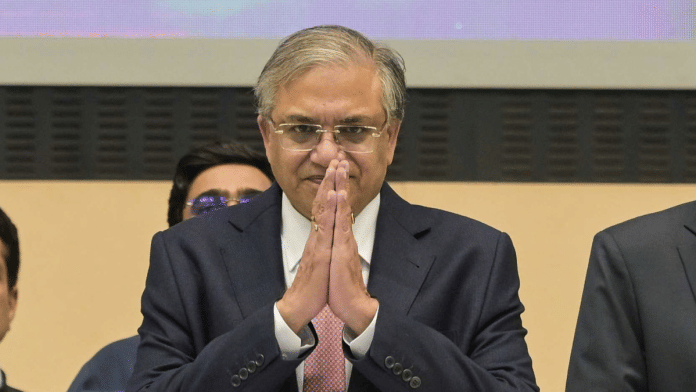

I don’t want to bore you by repeating the innumerable allegations against Chief Election Commissioner Gyanesh Kumar. Even before The Indian Express published Ritika Chopra’s expose on disagreements within the Election Commission, most of us had wondered how deep the rot within the constitutional body had reached.
In August 2025, over a year ago, I wrote here: “I know fewer and fewer people who admire our present election commissioners. Chief Election Commissioner Gyanesh Kumar, in particular, has lost the respect of much of the nation.”
This February, I wrote about Gyanesh Kumar in ThePrint: “that never before in the history of modern India have we had a man who is less respected handling one of the most important jobs in our democracy.”
The following month, I wrote that if Gyanesh really cared about the sanctity of the electoral process, he would have resigned in the face of mounting criticism that he was partisan and biased.
So I am not going to sound like a stuck record and repeat what a disgrace this man’s continuance in office is to Indian democracy. Because I think most people already know that. Even his defiant shamelessness no longer comes as a shock. We expect nothing better from him.
Only one question remains: what happens next?
What happens if Gyanesh stays?
One answer is obvious. Don’t expect Kumar to do the honourable thing and resign. An honourable man would say: “I have no wish to prolong this controversy and damage Indian democracy, so I will step down.”
He could even add: “Though I have done nothing wrong, I believe my continuance in office will affect people’s faith in the electoral system.”
The government would accept his resignation and, in recognition of his services as a stooge of long standing, having been involved in the government’s work on Article 370 and the Ram Janmabhoomi trust, could make him an ambassador after a decent interval. Or even a governor, a post for which standards are now abysmally low. Meanwhile, another stooge would be hired to replace Gyanesh.
But it doesn’t look like Gyanesh will go willingly. And I don’t think the government is ready as yet to drag him out of his office, kicking and screaming. For this solution to work, he will have to be pushed because he won’t jump.
The government will be reluctant to push, not because it loves Gyanesh or is lacking in ruthlessness, but because of what his exit will do to the Prime Minister’s image.
Also Read: People in power no longer care to be seen as neutral. CEC Gyanesh Kumar isn’t the only one
Modi and the lessons of the UPA
Nobody in the BJP has forgotten the lessons it learned from the UPA’s last days. The BJP remembers that, as the controversies mounted, the UPA decided to sack anyone the press targeted. In the process, Manmohan Singh came across as a weak leader who gave in to pressure, and each ministerial sacking only fed the press and the Opposition’s appetite for more scalps.
Narendra Modi does not want that to happen to his government. From the time he took office, he has treated the press with dismissive contempt and been unwilling to give in to pressure.
That’s why it took him so long to sack Dharmendra Pradhan. Pradhan resigned as Education Minister in July 2026 after weeks of youth-led protests at Jantar Mantar and elsewhere.
Narendra Modi acted only after the Jantar Mantar protests threatened to spread across the nation, and he feared losing the support of young people. (But he needn’t worry about that now. Reports suggest that Gyanesh has been busy disenfranchising young voters)
So, if this government finally sacks Gyanesh, it will only be because Modi has run out of options.
The government’s calculation
So what happens if Gyanesh stays?
The issue of his abuse of the electoral system may not go away. While the press can be tamed, social media is beyond anyone’s control. And the government is learning that the sheep-like support of the news channels and the planted stories attributed to “sources” make less and less difference to public opinion.
It did not help during the Jantar Mantar protests and has not helped quell the rising wave of public anger over the revelations about the Election Commission.
The government hopes to tire out the people calling for Gyanesh’s ouster. It reckons that within a week the media will run out of fresh revelations. By then, the government could manage the other Election Commissioners and stop them from saying anything negative.
It hopes that fatigue will set in and that the criticisms of Gyanesh will seem boring and repetitive. The public will lose interest, and the government will obligingly offer a few distractions.
Even if the Opposition does bring another impeachment motion against Gyanesh, it can count on the presiding officers of both Houses of Parliament to bury it as they did with the last one.
And so far, at least, the Supreme Court has not intervened in several Election Commission-related matters. So the government may be able to depend on the Court’s indifference.
It could work, as this kind of strategy has certainly worked before.
Delhi’s SIR could change the calculation
In the end, however, it depends on public opinion. One reason why the controversy has taken off is because of the anger over the SIR process in Delhi.
Of the roughly 1.45 crore voters in Delhi, as many as 47 lakh were struck off during the SIR enumeration phase. Of the roughly 97 lakh voters who remained on the draft list, about 33 lakh were issued notices over discrepancies in their details.
People who have voted for years are now being told to prove that they have a right to vote.
Only a crook or a fool or Gyanesh Kumar could believe that such large-scale deletions would not provoke a public outcry.
I imagine that someone in the government will tell Gyanesh to sort this mess out quickly. Once that happens, the government will hope that public anger with the CEC will die down and protests will seem less important.
Can the controversy be contained?
Is this a realistic assessment?
Part of the problem is Gyanesh himself. He may well be a lovely person in private, but in public he comes off as arrogant, insensitive and deeply unlikable. Such is his public persona that when you hear that he has been interfering with the electoral process, nobody has any difficulty in believing it.
Also, the unspoken agenda behind the protests and the government’s support for Gyanesh is the forthcoming Uttar Pradesh Assembly election. The election is due in February-March 2027, and Gyanesh has said it will be held on schedule.
The government believes that if it wins UP by a large margin, it can end the perception that its popularity is fading. Gyanesh could well be a key figure in that strategy.
But now, with so much doubt cast on the Election Commission’s motives, even if the BJP does win UP, that victory may seem less legitimate.
I don’t think the government has decided what to do. It will probably wait to see if public anger persists. If the anti-Gyanesh perception grows, then it may be forced to remove him.
But even if it rides out this uproar, it’s hard to dispel the feeling that the good times are over for this government. When things go wrong, the crises keep coming.
Vir Sanghvi is a print and television journalist and talk show host. He tweets @virsanghvi. Views are personal.
Edited by Maryam Hassan
What, exactly, is the charge against Mr Gyanesh Kumar that is supported by non-zero evidence? That there are differences of opinion within the commission? That SIR has been unduly harsh this time? That too many people are being excluded – is it indeed that many more than natural deaths and migration? And where exactly is the evidence that he is targeting a certain profile of voters? The entire hullabaloo seems an effort by the opposition to lower people’s faith in the democratic process, since they don’t seem to be winning enough
The whole govt machinery has gone to the dogs. The Opposition, supreme court, media, and civil society have failed in ensuring an error-free SIR.
Retaining him would be a – grave – error of judgment.
Vir Sanghvi Saheb itna achha likhte hain, comment post karne ki gunjayish hi nahin chhodte …
Why do a few media personnel like Vir Saghvi make a small issue a big one? There were some objections raised by ECs, but in which office do the employees not have an argument? If a person is really affected by SIR, he or she an file an objection or a case. How many citizens have filed such objections? Why cannot media spend some resources and and publish such data?