






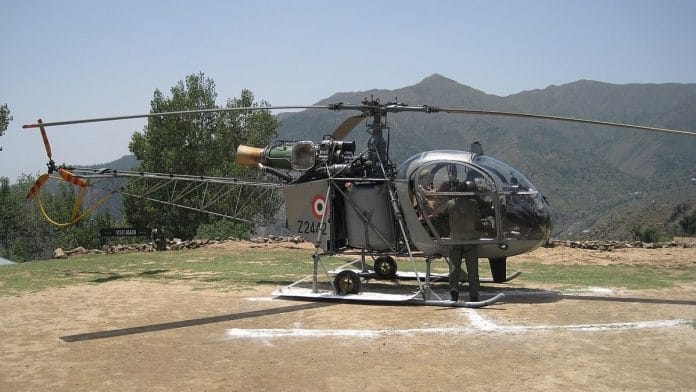


The 20 May accident involving a Chital, a re-engined Cheetah helicopter, in Ladakh has once again brought to the forefront the long-standing issue of procuring a replacement for the ageing Chetak/Cheetah fleet. The Indian Armed Forces face a critical operational challenge in replacing their ageing fleet of these Light Helicopters.
For six decades, the vintage Aérospatiale Allouette-III and Lama, christened as Chetak and Cheetah helicopters, and licensed and manufactured by Hindustan Aeronautics Limited (HAL) since the 1960s and 1970s, have been logistical lifelines for troops deployed in remote forward areas, including the Siachen Glacier.
The Chetak/Cheetah fleet has served the Armed Forces well for more than six decades. However, these airframes have long outlived their operational lifespans—suffering from high accident rates and maintenance fatigue. They were phased out in other Air Forces a long time ago.
The quest to modernise this fleet underscores a complex narrative of procurement delays, strategic policy shifts, and the evolving imperatives of indigenous defence manufacturing.
The procurement track record for India’s next-generation Light Helicopter has been characterised by repeated cancellations and procedural bottlenecks during the last three decades. It’s not that the Armed Forces did not foresee the requirement for a light helicopter once the Chetak/Cheetah fleet neared the end of their technical life.
Also read: Ode to a powerful beast – What flying the Chetak is like at the daunting heights of Himalayas
Endless delays
ALH (Advanced Light Helicopter) was conceived in 1979 to replace the Chetak/Cheetah fleet. The 2,500 kg single-engine helicopter was to be designed and manufactured by HAL. However, as the project progressed, it transformed into a 5,500 kg twin-engine machine due to revised requirements of the users. Its size, weight and performance made it an impossible alternative to the Chetak/Cheetah in high altitudes, especially the Siachen sector. Considering the operational necessity, Light Helicopters were to be procured through a global tender to replace over 400 Chetak and Cheetah helicopters. However, the multi-billion-dollar acquisition programmes were repeatedly derailed by technical, bureaucratic, and integrity issues.
The initial Reconnaissance and Surveillance Helicopter (RSH) tender for 197 helicopters was cancelled in 2007 at the final stage due to allegations of procedural deviations and a single-vendor situation. A replacement tender floated in 2008 advanced through rigorous field evaluation trials, pitting Eurocopter (now Airbus) against Russia’s Kamov. Yet, after years of deliberation, this process was also scrapped in 2014 amid allegations of corruption, and a strategic pivot by the incoming NDA government toward domestic manufacturing under the ‘Make in India’ initiative.
Following these cancellations, India pursued a Government-to-Government (G2G) agreement with Russia in 2015 to manufacture 200 Kamov Ka-226T helicopters. The balance requirement was to be met by the Light Utility Helicopter (LUH), which was under development and testing by HAL. This deal also languished for nearly a decade and was ultimately put on hold due to disagreements over the degree of technology transfer and indigenous content localisation.
HAL, meanwhile, continued work on the LUH project, which is a 3-ton class, single-engine helicopter, tailored specifically for high-altitude operations. The project has progressed reasonably well by HAL standards. However, this programme has been affected by technical glitches that are yet to be resolved.
The Indian Army and the Indian Air Force have pursued the joint procurement of 12 helicopters. They are still at the Contract Negotiation Committee stage, awaiting approval as PJSQRs. It is unlikely in the present state that the LUH from HAL would be able to replace the Chetak/Cheetah fleet to the satisfaction of the users unless major corrective actions are taken.
Also read: Replacing ageing Cheetah/Chetak choppers to take at least 10 yrs, hopes pinned on LUH & leasing
A way ahead
These cumulative failures have left a massive capability gap, forcing the military to continue operating sub-optimal, high-risk assets in the world’s most hostile flying terrains. The Indian Army has also resorted to hiring civil helicopters to augment its air maintenance effort. Unfortunately, the same cannot be done for the operational tasks. There is an urgent need to fast-track the procurement of Light Helicopters. This critical operational shortfall has adversely affected the capability of the Indian Army and the Indian Air Force in high-altitude forward areas, both in the northern and eastern sectors.
There are locations in the high altitude where no other helicopter in our inventory can operate, leaving the Armed Forces no choice but to continue using these machines. These must be immediately replaced with modern Light Helicopters to bridge the existing operational and technological gap. This could be done in two stages.
As the LUH being manufactured by HAL is likely to take time to mature and operationalise, it would be important to identify the number of Light Helicopters (mainly Cheetah) required for deployment at high altitudes. These could be procured urgently on a fast track. The remaining Chetak/Cheetah deployed in the lower altitudes could be later replaced by the indigenous LUH. The choices available in the market are plenty, both in single and twin-engine configurations.
Air Marshal AS Butola is former Air Officer Commanding-in-Chief of IAF Training Command and a test pilot. Views are personal.
(Edited by Theres Sudeep)