



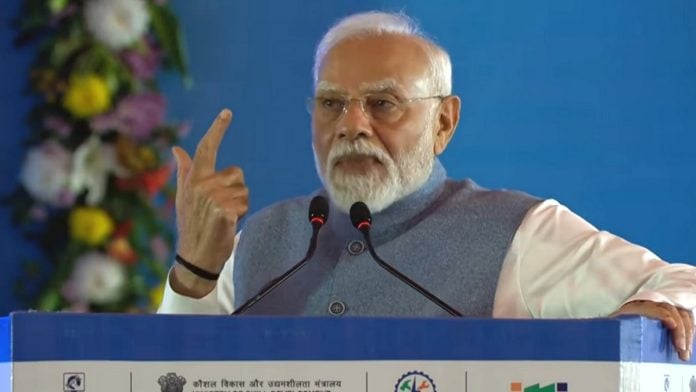
At the 5th Kaushal Deekshant Samaroh in Lucknow on 21 November, Prime Minister Narendra Modi told ITI students that they deserved as much samman, or respect, as IIT graduates, and asked them to stop valuing higher education degrees that only produce clerks at the cost of skills. He made an important point about overcoming the stigma attached to skill-based manual work. The precursor to this was a speech delivered by RSS chief Mohan Bhagwat in Mumbai in February 2023. He said a lack of dignity of labour was one of the main reasons for unemployment in India and that no work should be considered of lesser value. He claimed no society could generate jobs for more than “30 per cent” of its people, implying the rest need to be self-employed.
In effect, Modi and Bhagwat are arguing that unemployment in India is less of an economic problem and more of a cultural issue. Since our culture does not respect manual labour, most seek higher education, which gives you degrees without jobs.
What Modi said is not new. The vision inherent in his ITI talk has already been implemented in various ways. It is clearly visible in PM Vishwakarma, a central government initiative that provides funding and loans to people in various caste-based occupations, including carpenters (Suthur), blacksmiths (Lohar) and potters (Kumhar).
This imagination is not limited to Modi and the RSS. The Telangana government under KCR too introduced funding to modernise hereditary, caste-based occupations. For instance, KCR argued that Telangana has a large Golla (sheep-rearing) community but still imports sheep from other states. He said his aim is to fund the community so that its members could begin to export sheep to other states and even other countries and build better lives. KCR too did not hesitate to state that nowhere in the world is it possible to offer government jobs to everyone. It is instead prudent to enhance skills for better livelihood opportunities. The current government in Telangana too is encouraging skill-based education through its recent initiatives.
How should one make sense of such initiatives? Are they not a practical solution to a structural problem India has been facing for many decades now? With graduates making up about 67 per cent of India’s unemployed youth, a diminished manufacturing sector, shrinking government jobs and limited hiring in the service sector (including IT), is this not a long-term solution to the problem of unemployment and underemployment in India?
But there’s also a major downside to this approach.
Also Read: Forget Akbar and Aurangzeb. Muslim politics must start with the Varanasi weaver
The falling graph of higher education
Under PM Modi’s leadership and the social vision offered by the RSS, this alternative is already being executed through the New Education Policy (NEP). Under it, vocational training has been made mandatory in school education. Again, the justification has been to teach students the dignity of labour. As an extension of this vision, the NEP offers students ‘opportunities’ to take up vocational training after Class 10 rather than higher education.
This again makes ostensible sense when you look at the stark reality of the employment situation in India. To give just one instance of how deep the crisis is, in 2015 more than 22 lakh people, including 255 PhD holders and lakhs of postgraduates, applied for 368 government peon posts in Uttar Pradesh. Similarly, in 2025, nearly 25 lakh people applied for 53,749 peon posts in Rajasthan, including law graduates and PhDs.
The conclusion drawn is that higher education in India is futile. This is clearly visible in the way, under the current government, centres of higher learning and universities have been systematically undermined through a fund crunch, poor recruitment and changes in the syllabus.
It is also visible in the falling graph of budgetary allocation for education. The Ministry of Education’s share fell from 4.6 per cent in 2013-14 to roughly 2.5-2.6 per cent in 2025-26. According to NITI Aayog, over 94,000 government schools closed down over the last decade. This, however, was done on the basis of the logic of rationalisation and optimisation of resources by merging schools with low enrollment.
Also Read: NITI Aayog wants India to reimagine skilling, pitches ‘skills not degree’, training from Class 6
A return to varnashrama dharma?
One of the long-term outcomes of this policy direction would be a return to caste occupations.
Students belonging to specific castes, mostly Dalits and the more disadvantaged OBCs, will get locked into their hereditary caste occupations, while, by default, the option of higher education will be left to the privileged higher castes or to those economically well-off sections of Dalits and OBCs who have moved up the economic ladder by availing themselves of the benefits of reservations. Should this not be interpreted as a return to the age-old varnashrama dharma, where birth determines opportunity and occupation?
There is a more intricate problem of the culture of dignity of labour. How should we value manual and skill-based work in India? There is a point in saying carpentry should be respected as a skill. But once you do that, the argument follows that those castes should continue to pursue these occupations because they inherit the skills and can further enhance them through state funding and greater marketisation of the goods.
The moot question is how does one balance the dignity of labour with social and economic mobility? Should there not be enough incentives for children of these communities to aspire to higher education and move out of their caste-based occupations?
In India, as BR Ambedkar reminded us, what we have is not a division of labour but a division of labourers. If caste-based stigma and segregation accompany the occupation, then education is also a source of social mobility that opens up employment opportunities and the chance to move to urban and metropolitan centres. We know, however, that urban areas and cities are bursting at the seams and cannot endlessly accommodate migration from villages and mofussil areas.
The problem is convoluted and has the potential to create a civic crisis. Democracy has created greater aspirations without commensurate economic opportunities. The Gandhian way of dignifying and spiritualising manual labour has come to be seen as a reimposition of the varna system. How then do we value manual and skill-based jobs without locking specific and targeted castes into their hereditary professions? This remains, perhaps, the most significant question of our times.
Ajay Gudavarthy is an Associate Professor of Political Science at the Centre for Political Studies, Jawaharlal Nehru University (JNU). Views are personal.
(Edited by Asavari Singh)