



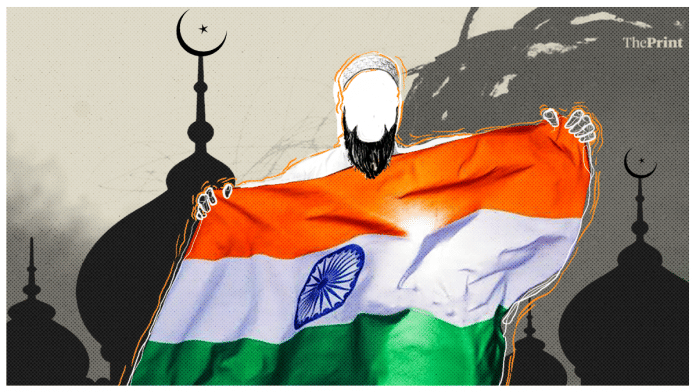
The general argument has been that if one is targeted for being a Muslim, one should resist by claiming a singular and exclusive Muslim identity. The response to communalism that is attempting to erase Muslim presence is by offering a consolidated Muslim political mobilisation. But this understanding neither seems to work as a political strategy nor does it reflect the sociological reality of Muslims in India. How then should Muslims reimagine a radically different minority politics?
Secularism and the Muslim question were perhaps the most discussed issues in the Constituent Assembly and the Constitution-making process. In light of Partition, Muslim identity and politics were imagined as necessarily homogeneous. At the time of independence, the idea that treating Muslims as a single bloc would restore confidence and a sense of security was shared by Muslim elites and the secular imagination. Muslims as a religious minority were considered as seeking common assurances for their religious and cultural practices. This was reflected in the granting of Muslim personal laws. A fallout of this was the infamous Shah Bano controversy, in which the government response was seen as protecting the religious autonomy of Muslims.
More recently, growing majoritarianism under the Modi government has been met with a counter-discourse of Islamophobia, which yet again foregrounded a common identity and treated Muslims as a homogeneous bloc. It is strongly felt that the only way to push back against majoritarian consolidation is through claims for a singular and exclusive Muslim politics.
Except, this hasn’t helped. Instead, Muslim politics in India needs to be reimagined around heterogeneous identities constituted by caste, class and cultural differences.
Also Read: Muslim dissenters need cover in India. The Republic cannot blame only the Qaum
Why communalism is also about class
The consolidation of majoritarian politics in India is neither caste-blind nor class-blind.
To begin with, those targeted in either routine violence or organised riots are overwhelmingly poor Muslims. It is the poor shawl sellers from Kashmir who are the target of routinised hatred. Here, contempt for the poor gets translated into communal hatred against poor Muslims.
The bulk of secular discourse in India, however, does not seem to address this underlying sociological reality. It instead frames the question of secularism around restoring the secular image of the Mughal rulers. The public discourse is mostly about framing Akbar as a secular ruler or Aurangzeb as a modern or even visionary emperor. This discourse is in no way connected with today’s Muslim living on the margins of the economy and society. It instead eclipses the fact that Muslims are becoming increasingly vulnerable owing to their poverty and low scores on the Human Development Index.
Communal polarisation in India does not prohibit Prime Minister Modi from hugging sheikhs in the Middle East or from identifying the Muslim in India by his clothes and as a puncture wala.
We need to relocate the question of class in communalism. We need to imagine a new Muslim public that is centred on the popular symbolism of the Muslim artisan in Varanasi who makes those beautiful silk saris. It is the aesthetics of the artisanal work that needs to quintessentially define the Muslim public. It is not the Taj Mahal that matters here but the question the Telugu poet Sri Sri once asked: ‘Taj Mahal Kattadaniki ralethina coolie levaru?’ (Who were the coolies that laboured to build the Taj Mahal?)
Anthropologist Jan Breman traces growing communalism in Gujarat directly to the decline and closure of the textile mills in Ahmedabad. The trade union movement provided Muslims with a source of larger solidarities. It was Muslims as a working class who provided the basis for secular politics, not the exclusive representational politics of Muslim elites. The character of such Muslim leadership is clearly visible in the nature of Asaduddin Owaisi’s political mobilisation. The history of this kind of politics in the AIMIM could, in fact, be traced back to the Razakars—the militia that terrorised poor peasants in the Nizam’s Hyderabad.
Also Read: The Opposition’s ‘vote chori’ campaign has a language problem
Muslim politics must reckon with caste
Alongside class, the intricate connections with caste need to be considered in reimagining Muslim politics. There cannot be a Muslim politics that is disconnected from the changing caste dynamics within Hindu society.
Historian Dilip Menon argues that communal violence in India has always followed a pattern in which growing subaltern caste mobilisation by Dalits and OBCs found an outlet in communal violence. Implosion within the Hindus gets expressed as explosion against Muslims.
One could further build on this argument to say that there is a deep historical connection here because most of those who converted to Islam came from castes once considered ‘untouchable’. It was mostly Dalits who converted to Islam and Christianity. It is this underlying and undying caste hatred that gets remobilised as communal violence and majoritarian anxiety.
A 2024 report by the All India Pasmanda Muslim Mahaz said that most victims of mob lynching were Pasmanda Muslims. It is more than an irony that the BJP is the only political party attempting to mobilise Pasmandas as an independent social constituency. This aligns with its strategy of mobilising the more marginalised sub-castes among Dalits and OBCs. Neither Muslim politics nor the secular parties are willing to articulate such demands.
These underlying social factors cannot be mobilised through a secular politics framed around the symbols of caste and class elites among Muslims. A homogeneous and exclusive Muslim identity is essentially an elite imagination within religious minorities. Muslim politics in the present context needs to be imagined through cross-cutting solidarities around caste and class.
In my own writings, I have argued that Muslim politics needs to move beyond what I call secular sectarianism. It is not by making exclusive/sectarian demands concerning Muslims alone but by joining forces with other subaltern castes that Muslim politics will become secular.
Minority social organisations in India will also have to be part of broader struggles against neoliberalism and the privatisation of public goods such as health and education. Internal transformation around questions of caste and class inequality has to be the new basis for resistance against majoritarianism and communalism and for a new secular ethos.
Ajay Gudavarthy is an Associate Professor of Political Science at the Centre for Political Studies, Jawaharlal Nehru University (JNU). Views are personal.
(Edited by Asavari Singh)