




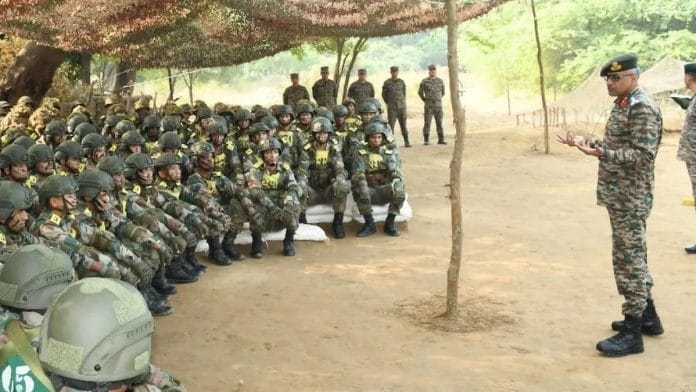

The first batch of Agniveers is about to complete four years of service. The Indian Navy’s inaugural batch will be the first to cross the finish line later this year, with the Army and Indian Air Force following on their respective timelines early next year. For the government and the armed forces, this is the first real test of one of India’s most consequential military manpower reforms since Independence.
The government must not succumb to the political temptation of defending Agnipath 1.0 as sacrosanct or scrapping it as a populist electoral measure. In my view, it must strive for a comprehensively reformed Agnipath 2.0 that retains its fiscal logic while putting military effectiveness and fairness first.
The reform was necessary
The fundamental logic behind Agnipath remains sound. India cannot indefinitely maintain a manpower-heavy military in which a growing proportion of the defence budget is consumed by salaries and pensions, leaving less for modernisation.
The armed forces need to become younger, leaner and technologically more capable. The pension bill cannot be reduced merely by tinkering with pension rules. The more durable solution is to change the manpower architecture itself. That was the rationale behind my support, although with reservations, for a short-service engagement even before Agnipath was announced.
However, a sound strategic objective does not automatically produce a sound scheme.
Agnipath was introduced in 2022 with a four-year engagement and fixed pay of Rs 30,000–40,000, after which up to 25 per cent of each batch could be selected for permanent service. The remaining 75 per cent would leave without a pension but with a Seva Nidhi package and other transition benefits. The controversy that followed was predictable, and not merely political. It raised legitimate questions about training, military effectiveness, morale, retention, compensation and the employability of those leaving after four years.
Four years later, we can move beyond the policy and examine the evidence.
Four years may be too short
A soldier is not simply trained once and then ready for a lifetime of employment. Military competence is accumulated through training, field experience, exercises, unit employment and exposure to increasingly sophisticated equipment. This is particularly true for technical personnel.
The armed forces are inducting increasingly complex sensors, communication systems, air-defence systems, unmanned platforms and precision weapons. Training a sailor, airman or soldier to operate them is only the beginning. Experience in maintaining and employing these systems is equally important. The experience of Operation Sindoor has reinforced this lesson. Reports indicate that the Services found operational experience valuable and are seeking greater retention partly because modern platforms require longer training and greater familiarity.
The irony is obvious. Agnipath releases many soldiers just when they are becoming genuinely useful. This is not an argument for restoring the old system, but for designing retention around military requirements. In addition, the tenure could be increased to five years.
The Services are reportedly seeking a higher retention rate. The Army and Air Force have been reported to be considering around 50 per cent, while the Navy has reportedly sought an even higher proportion because of the technical nature of naval employment. No such increase has yet been approved.
Increasing retention to 50 per cent would certainly address part of the problem. But simply replacing 25 with 50 in the rule book would be another half-measure. Why should an infantry rifleman, a tank crewman, a missile technician, a radar operator, an aeronautical technician and a naval engineer necessarily have the same retention requirement? They do not.
Agnipath 2.0 should have a five-year tenure and differentiated retention. The Services should identify manpower categories where four to five years is sufficient and those where the training investment and operational experience justify longer retention. Technical and specialist trades should have substantially higher retention than general duty manpower categories. The objective should be to retain the skills the military needs, not merely a fixed percentage of heads. This would preserve the youthful profile while preventing the wasteful loss of trained manpower.
The biggest flaw — ‘unequal soldiers’
An Agniveer and a regular soldier can serve in the same section, occupy the same trench, man the same weapon and face the same bullet. Yet their pay during service and their death and disability compensation are substantially different. This is difficult to defend militarily, morally or institutionally.
Differences in the terms and conditions of service between short-service and permanent personnel are legitimate. The distinction between the value placed on their lives while serving is not.
Agnipath 2.0 must therefore establish complete parity during the period of active service in pay and applicable allowances; operational benefits; insurance; death and disability compensation; medical care; family welfare and other service-related benefits. The distinction should primarily be in tenure, pension and post-service benefits. But a young man cannot be told, while in service, that his life is valued less because he has signed a four-year contract.
Manpower arithmetic needs correction
The original intake was about 46,000 Agniveers annually beginning in 2022-23, which has increased to 70,000 in 2026. Approximately 2.08 lakh Agniveers would be in service at the end of the year. The government has denied disclosure of manpower shortages in the armed forces, citing national security. Per information in the public domain, approximately 60,000 regular personnel of the Armed Forces retire every year.
At a 25 per cent retention rate, replacing 60,000 annual retirements through retained Agniveers alone would require an annual intake of about 2.4 lakh. Even at 50 per cent retention, it would require about 1.2 lakh. The numbers demonstrate why Agnipath cannot be examined in isolation from the overall manpower restructuring of the Armed Forces.
However, this must not become an excuse for recreating the old manpower-heavy structure. Also, reforms for optimisation, reduction, reorganisation and restructuring of the manpower-intensive armed forces, which were created to fight full-scale conventional wars of the last century, must be pursued relentlessly.
The solution should be a smaller permanent cadre and a larger short-service cadre, rather than simply returning to mass permanent recruitment. That is where Agnipath 2.0 could become a genuinely transformative reform.
Also Read: Future of India’s IBGs rests on rollout speed, tech. History rarely rewards armies that wait
Assured transition pathways
The original weakness of Agnipath was the assumption that a young man leaving the military after four years would simply find his way into civilian employment. That was never good enough.
The government has done well to subsequently strengthen the exit architecture considerably. In July 2026, the Home Ministry announced 50 per cent reservation for Ex-Agniveers in Constable/GD vacancies in CAPFs and Rifleman vacancies in Assam Rifles, along with age relaxation and exemption from the physical and written examinations. A dedicated Ex-Agniveer wing has also been created in the MHA. The Railways has separately earmarked 10 per cent reservation in Level-1 posts and 5 per cent in Level-2 and above posts for Ex-Agniveers. Various state governments have also earmarked varying numbers of vacancies in police and other departments. The central government needs to coordinate these measures to bring about uniformity in state-level reservations.
The government has also begun formal recognition of military skills for civilian employment and has created educational pathways to convert military training into recognised qualifications.
These are welcome developments. The next step should be to create a National Agniveer Transition Authority under an appropriate ministry.
It should provide a single-window transition system covering CAPFs, state police, Railways, defence PSUs, government employment, private industry, skill certification, higher education and entrepreneurship. An Agniveer should know, before he joins, what his career options will be after four years. The government should also consider a law for affirmative action by the private sector.
Agnipath 2.0
Agnipath was introduced in a hurry and without the benefit of a pilot project. That was its original weakness.
But four years of implementation now provide practical experience. The Armed Forces and the MoD must undertake a formal, transparent review before the first large-scale release of Agniveers.
Agnipath 2.0 should have six essentials.
First, it must not be a standalone reform but an intrinsic part of the transformation of the Armed Forces related to manpower optimisation, reduction, reorganisation, restructuring and balancing intake with release/retirements.
Second, a five-year initial engagement, rather than four. Third, differentiated retention with protection of seniority, rising substantially for technical and specialist manpower and determined by military requirements rather than an arbitrary universal percentage. Fourth, parity of pay, allowances and death/disability benefits between Agniveers and regular personnel while serving. Fifth, a National Agniveer Transition Authority to coordinate employment, education, skill certification and entrepreneurship. Sixth, assured employment pathways, with the existing 50 per cent CAPF reservation and other central and state government opportunities implemented through time-bound recruitment rather than merely announced quotas.
Agnipath should not be judged as a recruitment scheme, but as one component of comprehensive restructuring of India’s manpower-heavy military.
The test of the Modi government is not whether it admits that the original scheme had flaws. The test is whether it has the political courage to correct them without surrendering the larger objective.
India needs a younger Army, but not a less experienced one; a cheaper military, but not a cheaper soldier; and a smaller pension bill, but not at the cost of combat effectiveness. The answer is not to retreat from Agnipath. It is to make Agnipath worthy of the Indian soldier.
Lt Gen H S Panag PVSM, AVSM (R) served in the Indian Army for 40 years. He was GOC in C Northern Command and Central Command. Post retirement, he was Member of Armed Forces Tribunal. Views are personal.
(Edited by Asavari Singh)
With zero understanding of military matters, have had utmost concern over the Agnipath scheme. How does it gel with the technology dense wars of the future. 2. One reform lies within the government’s power. After increasing the percentage of retention, every single Agniveer should be absorbed into the central armed police forces, state police forces. Young, tough, trained. Of course, they will need a sensitisation programme since they will now be dealing with fellow citizens, not enemy soldiers.